
Industries
Why hospitality employees leave and how to understand why
Hotel, restaurant and banquet staff leave for reasons that vary by department and season. How to ask what sits behind the first answer and act on it.
8 min readRead articleA sports event organiser builds tournaments, runs and leagues with a small core team and a large temporary crew. This page looks at crews, volunteers, timelines and match day control.
Not sure what you need? Tell us about your business in six short steps and we will come to the first meeting prepared.
Share your requirementsA sports event organiser plans and runs marathons, cricket and football tournaments, school meets, corporate leagues and fan events. A small core team handles sponsors, permissions, registrations, logistics and communication. For a few days, the event grows to many times that size: ground crew, scorers, ticket and entry staff, medical support, hospitality and volunteers. Timelines are fixed by the date of the event and cannot slip. Months of work compress into early starts and long days, then the team disperses until the next event. Venue owners, federations, sponsors and teams each give instructions, and the organiser's people must handle them calmly. Related reading: hospitality HR. The business lives on repeat bookings, which depend on the same dependable people coming back, so how crews are briefed, treated and thanked matters a great deal.
These are the places the people side of this kind of business tends to give way. The rest of this page works through them.
HR here has to work for each of these groups, not only the office. The set-up below is written with all of them in mind.
GullyHR runs talent acquisition for permanent roles in sports event organisers. For each role we agree the job description with you, find and screen candidates against it, and support the offer through to joining. Tell us the role and the number of people, and we start there.
We recruit permanent employees. We do not supply contract or temporary staff.
Every business interviews, but few have a written process that works the same way for every role and every interviewer. GullyHR designs yours, from the role brief to the offer, trains your managers to run it, and can run it for you on the roles you hand us.
We agree what the role must deliver, the must-have and nice-to-have skills, and how each will be scored.
Screening call, assessment, interview rounds and decision points, sized to the role and the number of people you hire.
Structured questions for each role family and a rating guide, so two interviewers judge the same answer the same way.
A short briefing for your managers on what to ask, what to avoid and how to give a clear yes or no.
Who approves, how the offer is made, and how candidates are kept informed from first call to joining.
Every event means finding, briefing and equipping people who may not have worked together before.
Unclear roles, no food or rest and no thanks mean volunteers do not return, and the organiser starts again.
Weeks of preparation end in sixteen-hour match days, and the same few absorb the stress at every event.
Day rate, travel, food and overtime are agreed by phone, and complaints arrive after the event.
A crew member learns the layout and escalation path an hour before gates open and makes avoidable errors.
Sponsors, officials and venue staff each give orders, and crew do not know whose word holds.
Who holds the first aid kit, who clears a crowd and whom to call are known only to a few.
The best scorer or ground lead is paid late once and takes a competing organiser's date next time.
Start with the topics that matter most here: Recruitment and Talent Acquisition; HR Operations and Governance; Employee Engagement and Experience. Then work through the rest. Each topic is written for hospitality, not in general.
Requisition to joining, the same way every time.
An HR function that runs the same way every month.
Communication, recognition and the conditions people actually work in.
How many people, in which roles, by when — and what they will cost.
Structure, reporting lines and who is allowed to decide what.
A first day that is the same for the fifth joiner as the first.
Records, attendance, leave and the day-to-day HR that must simply work.
Salary structure, payroll inputs and a month that closes on time.
Goals, reviews and ratings that hold up in a conversation.
Training planned from need rather than from the calendar.
Named backups for the roles that cannot be vacant.
Two routes — one for complaints, one for conduct — kept separate.
Policies a manager can apply, and obligations with owners and dates.
Induction, records, incident reporting and follow-through.
Who leaves, when, why — and which of them mattered.
Resignation to relieving letter, in a defined order.
Records that survive people, and approvals that do not queue.
A short monthly pack management actually reads.
The pieces a sports event organisers business puts in place, in an order that makes each easier. Open any card for the detail.
A list of trained crew and volunteers by role, with notes on reliability and pay agreed.
A list of trained crew and volunteers by role, with notes on reliability and pay agreed. Use the recruitment process to widen it.
Day rate, hours, travel, food, conduct and payment date given in writing before the day.
Day rate, hours, travel, food, conduct and payment date given in writing before the day. File them in the HR documentation.
A calendar of events with preparation, event and recovery weeks, and leave arranged around it.
A calendar of events with preparation, event and recovery weeks, and leave arranged around it. See the shift and leave rules.
A one-page role sheet, a map, a contact tree and the chain of command for match day.
A one-page role sheet, a map, a contact tree and the chain of command for match day.
Crowd, medical and fire contacts for each venue, with equipment checked before gates open.
Crowd, medical and fire contacts for each venue, with equipment checked before gates open. Link it to workplace safety.
A short debrief on what slowed them down and who did well, kept for the next planning round.
A short debrief on what slowed them down and who did well, kept for the next planning round.
Before changing anything, find out what is true today. These checks take an afternoon and tell you which of the topics above to start with.
Share your requirementsConfirm with a qualified professional. What applies to you depends on your business, your state and your arrangements, and it changes. This page describes practice. It does not state a legal position.
The services below fit this kind of business best. Each starts by recording where you stand, and every later report compares against that. We do not promise outcomes.
A bench of crew and volunteers built before the next event.
Event-wise crew terms, role sheets and briefing packs.
Crowd, medical and fire roles planned for every venue.
Preparation, event and recovery weeks planned for the core team.
Start with a free conversation, or see the paid HR Diagnostic.
Understand the business, its workforce, current processes and HR challenges.
Find the missing, weak, inconsistent or person-dependent processes.
Create the structure, processes, policies, SOPs, dashboards and systems needed.
Help HR and department managers actually adopt the new system.
Digitise repetitive and approval-based workflows where it is worth doing.
Track hiring, attendance, employee cost, performance, training and attrition.
Strengthen the people-management system continuously, not once.
From the GullyHR blog: one on HR in hospitality, and one on each of the topics this page points to.
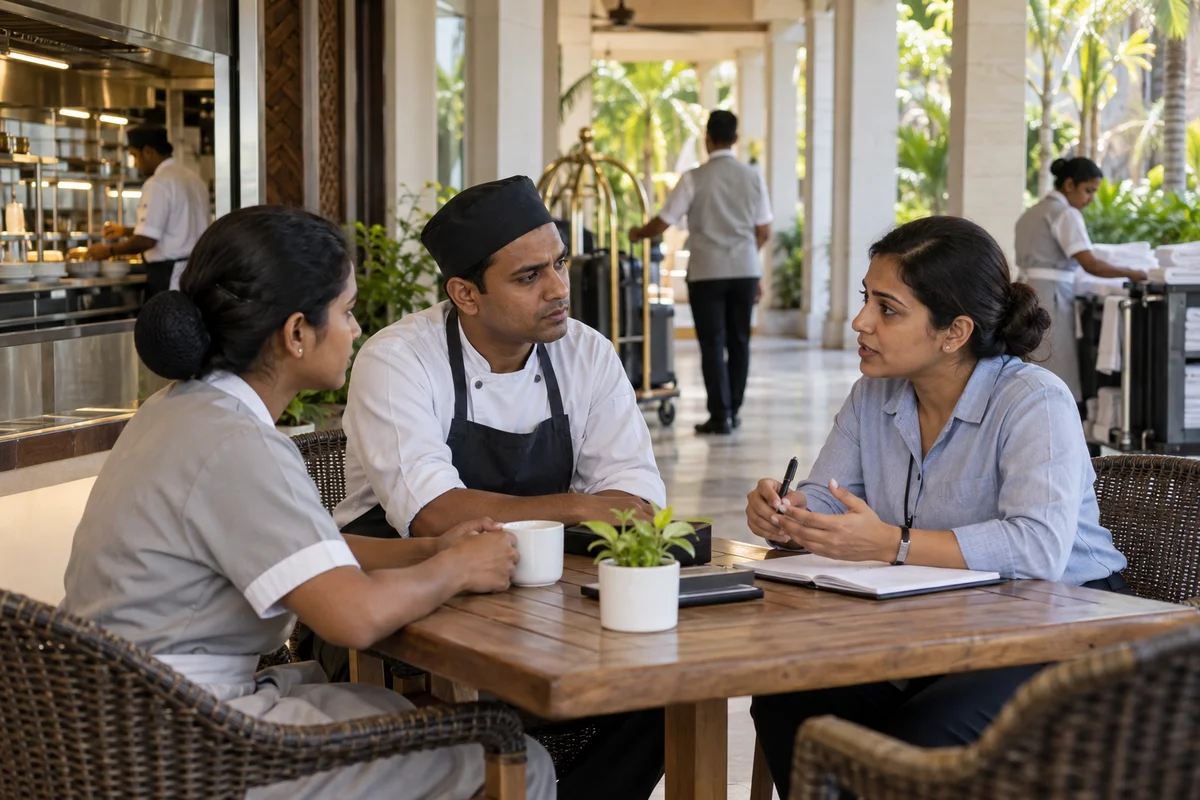
Hotel, restaurant and banquet staff leave for reasons that vary by department and season. How to ask what sits behind the first answer and act on it.
8 min readRead article
How a D2C founder can test a performance marketing hire on real work, ignore weak signals such as dashboard screenshots, and run a fair process.
7 min readRead article
Every growing company reaches a point where the founder approving everything stops being speed and starts being the bottleneck. Twelve signs it has happened, and what to fix first.
9 min readRead article
Eighty per cent responded, the report was thorough, and six months later trust was lower than before. What went wrong between the survey and the silence.
8 min readRead articleMore on the GullyHR blog.
Pay on the promised date, brief them properly and feed and rest them on the day. Keep a list with notes and offer repeat dates to those who delivered.
They need clear roles, safe conditions, food, rest and recognition. Whether any arrangement creates obligations is a matter to confirm with a qualified professional.
Role, dates and hours, rate and payment date, travel and food, conduct and who they report to. Have the standard form checked by a qualified professional.
Plan recovery weeks after big events, share the match day duties and build deputies so the same people are not always on the front line.
Name one event lead and a small chain below them, tell sponsors and venue staff, and brief crew that instructions come through the chain.
Name leads for crowd, medical and fire, check equipment and routes before gates open and brief the crew. Confirm legal requirements with a qualified professional.
All 143 business types in hospitality · Find another business type
Tell us what is slowing your team down. We’ll help you find a practical way forward, starting with a conversation.