


















Industries
Why hospitality employees leave and how to understand why
Hotel, restaurant and banquet staff leave for reasons that vary by department and season. How to ask what sits behind the first answer and act on it.
8 min readRead articleA hotel or guest house runs every hour of the day and moves with occupancy. Here is how to organise departments, shifts and staff housing so guests meet a settled, trained team.
Not sure what you need? Tell us about your business in six short steps and we will come to the first meeting prepared.
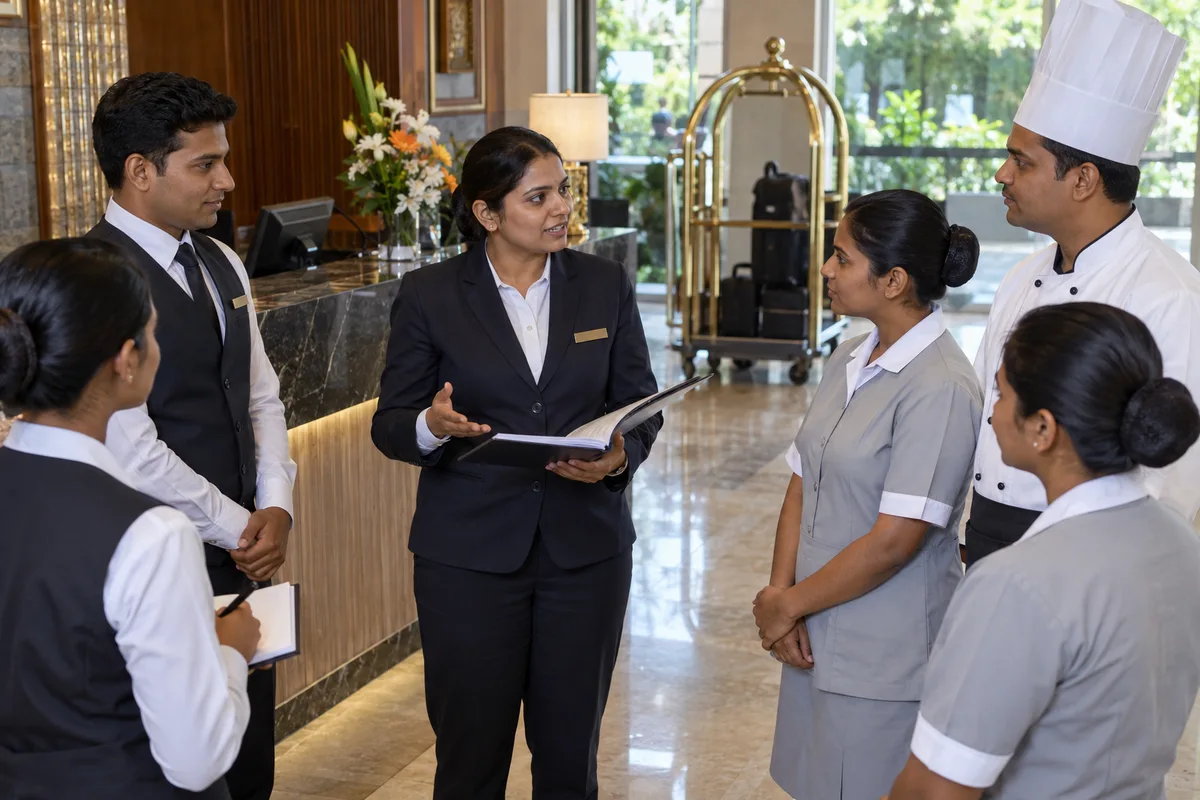
Share your requirementsA hotel or guest house sells rooms, food and service around the clock. The front office checks guests in and out, takes bookings and answers questions, housekeeping prepares rooms and public areas, the kitchen and restaurant serve meals, and maintenance, security and a night team keep the building running. Smaller guest houses combine several of these jobs in a handful of people, while larger hotels have departments with heads, supervisors and trainees. Guests judge the stay by the people they meet, and a missed turnover or an unanswered call shows at once. Occupancy swings with holidays, weddings, conferences and the tourist season, so the number of people needed can double and then fall. Many staff come from other towns and live on the premises or in nearby rented rooms. See also HR for hospitality. What makes HR different here is that the team lives with the business. Rotas cover nights, split shifts and weekly rest days, a housing arrangement is part of the job, and a visible path from trainee to supervisor often decides whether good people stay or move to the hotel down the road.
These are the places the people side of this kind of business tends to give way. The rest of this page works through them.
HR here has to work for each of these groups, not only the office. The set-up below is written with all of them in mind.
Festival weeks and wedding dates fill every room while off-season weeks leave the team idle, and neither is planned.
Night duty, split shifts and weekly rest days fall unevenly on the willing, and fatigue shows in service.
Room turnover is physical and timed, and attendants who finish early are given more rather than thanked.
Who gets a bed, what is charged, what rules apply and what happens on leaving are settled by custom, and disputes grow.
Front office, kitchen and housekeeping each manage their own people with different standards and no shared policy.
Interns and new joiners are put on shift quickly, and the standard depends on the supervisor on duty.
Neighbouring properties compete for the same cooks, receptionists and supervisors, and the loss is felt in the next busy week.
A complaint is fixed at the desk, but no one sees the pattern that points to a training gap.
Start with the topics that matter most here: HR Strategy and Workforce Planning; Learning and Development; Employee Engagement and Experience. Then work through the rest. Each topic is written for hospitality, not in general.
How many people, in which roles, by when — and what they will cost.
Training planned from need rather than from the calendar.
Communication, recognition and the conditions people actually work in.
Structure, reporting lines and who is allowed to decide what.
Requisition to joining, the same way every time.
A first day that is the same for the fifth joiner as the first.
Records, attendance, leave and the day-to-day HR that must simply work.
Salary structure, payroll inputs and a month that closes on time.
Goals, reviews and ratings that hold up in a conversation.
Named backups for the roles that cannot be vacant.
Two routes — one for complaints, one for conduct — kept separate.
Policies a manager can apply, and obligations with owners and dates.
Induction, records, incident reporting and follow-through.
Who leaves, when, why — and which of them mattered.
Resignation to relieving letter, in a defined order.
Records that survive people, and approvals that do not queue.
A short monthly pack management actually reads.
An HR function that runs the same way every month.
The pieces a hotels and guest houses business puts in place, in an order that makes each easier. Open any card for the detail.
A core team for the low season, a list of trained extra hands for peaks and a way to link bookings to rotas.
What this coversHideA core team for the low season, a list of trained extra hands for peaks and a way to link bookings to rotas. The workforce plan holds it.
Night duty, split shifts and rest days spread evenly, with swaps agreed through the supervisor.
What this coversHideNight duty, split shifts and rest days spread evenly, with swaps agreed through the supervisor. The attendance and shift process holds the rules.
Who is eligible, any charge, house rules, visitors, safety and what happens when someone leaves.
What this coversHideWho is eligible, any charge, house rules, visitors, safety and what happens when someone leaves. The HR policies and governance work holds them.
Checklists for check-in, room standards and table service, with a sign-off before a trainee works alone.
What this coversHideChecklists for check-in, room standards and table service, with a sign-off before a trainee works alone. The learning and development process holds the plan.
Named steps with the skills for each, so a room attendant or commis can see how to become a supervisor.
What this coversHideNamed steps with the skills for each, so a room attendant or commis can see how to become a supervisor.
A simple monthly look at complaints and praise by department, used to decide what to teach next.
What this coversHideA simple monthly look at complaints and praise by department, used to decide what to teach next.
Before changing anything, find out what is true today. These checks take an afternoon and tell you which of the topics above to start with.
Share your requirementsConfirm with a qualified professional. What applies to you depends on your business, your state and your arrangements, and it changes. This page describes practice. It does not state a legal position.
The services below fit this kind of business best. Each starts by recording where you stand, and every later report compares against that. We do not promise outcomes.
A staffing plan linked to occupancy, with a core team and extra hands for peaks.
Fair rotas for nights, split shifts and rest days across departments.
Department standards, sign-offs and a ladder from trainee to supervisor.
Written terms for staff accommodation, conduct and day-to-day rules.
Start with a free conversation, or see the paid HR Diagnostic.
Understand the business, its workforce, current processes and HR challenges.
Find the missing, weak, inconsistent or person-dependent processes.
Create the structure, processes, policies, SOPs, dashboards and systems needed.
Help HR and department managers actually adopt the new system.
Digitise repetitive and approval-based workflows where it is worth doing.
Track hiring, attendance, employee cost, performance, training and attrition.
Strengthen the people-management system continuously, not once.
From the GullyHR blog: one on HR in hospitality, and one on each of the topics this page points to.

Hotel, restaurant and banquet staff leave for reasons that vary by department and season. How to ask what sits behind the first answer and act on it.
8 min readRead article
Hiring decisions made one request at a time, in the month the pain is worst. What a workforce plan contains and why a twelve-month view changes what you hire.
7 min readRead article
A calendar of courses, a budget spent by March and no record of what any of it changed. What a learning and development process contains when it starts from need rather than from the catalogue.
7 min readRead article
Eighty per cent responded, the report was thorough, and six months later trust was lower than before. What went wrong between the survey and the silence.
8 min readRead articleMore on the GullyHR blog.
Link past occupancy by week to the people you had, set a core team that covers the quiet weeks, and keep a list of trained extra hands for peaks. Confirm the arrangements for temporary staff with a qualified professional.
By a written rota that rotates the heavier duties, with rest after a night and clear rules for swaps. Unwritten sharing falls on the same few people.
Who may stay, any charge or deduction, the house rules, safety arrangements and what happens when someone leaves or changes department. Confirm the terms and their consequences with a qualified professional.
With a room standard checklist, a supervised first few days and a sign-off before a new attendant works alone. Spot checks by the supervisor keep the standard.
By writing the basics once: terms of work, rota, house rules, a short induction and a record for each person. A simple routine does most of the work of a department.
Pay fairly, give a visible next step and a say in the rota, and ask them what would make them stay before a neighbour does. Review who left and why each quarter.
Give them a plan of what they will learn, a named supervisor and a review at the end. Treating them only as extra hands wastes the chance to find future staff.
We would look at how your headcount follows occupancy, how night duty and rest days were shared last month, and what is written about staff accommodation. A sensible first piece of work is usually a staffing plan against occupancy with fair department rotas, or a short accommodation terms document. Scope, timing and fee are agreed in writing afterwards, so you decide what goes ahead.
All 14 business types in hospitality · Find another business type
Identify payroll leaks, record gaps and hiring bottlenecks in a free first conversation, and leave knowing what to fix first.
Know what you need? Share your requirements in four short steps.
Want the full picture? See the paid HR Diagnostic.
Prefer a quick message? Chat on WhatsApp