


















Industries
Why hospitality employees leave and how to understand why
Hotel, restaurant and banquet staff leave for reasons that vary by department and season. How to ask what sits behind the first answer and act on it.
8 min readRead articleEvent businesses win or lose on the day, with a crew that is assembled for a few hours and a client who sees everything. Here is how to organise crews, vendors and peak weekends.
Not sure what you need? Tell us about your business in six short steps and we will come to the first meeting prepared.
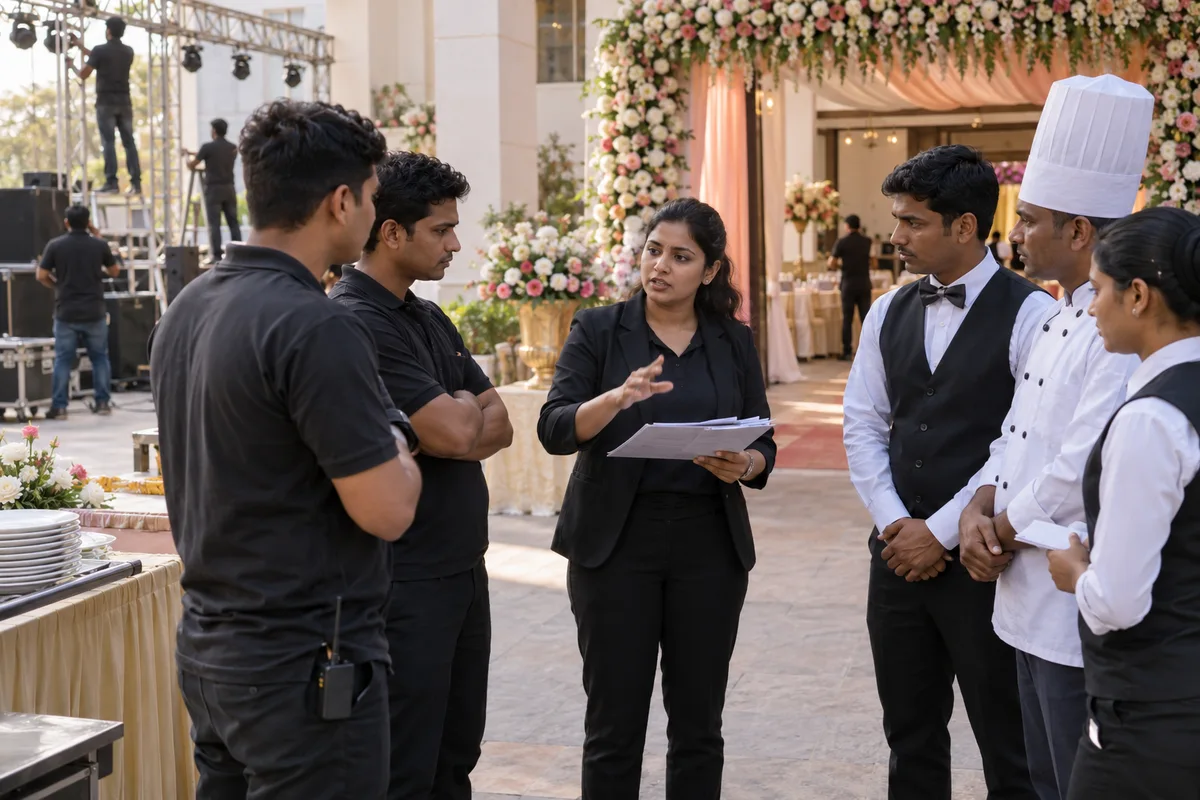
Share your requirementsAn event planner designs and runs weddings, receptions, conferences, launches and private celebrations, and a banquet hall provides the venue, rooms, setup and often the service. Both sell a single occasion, with no chance to repeat it. A small permanent team of planners, coordinators and venue managers works with a large set of outside people: decorators, caterers, sound and light operators, photographers, florists and extra service staff who are engaged for the event. A planner often works across several events at once, and a banquet hall may run a morning function and an evening one in the same hall. The calendar is driven by auspicious dates, festivals and the wedding season, so some weeks are crowded and others are almost empty. See also HR for hospitality. What makes HR different here is that most of the people on site on the day are not on the payroll, so clarity on who does what, who leads each part and how everyone is briefed and paid must be built into the way the event is planned, not discovered at the venue.
These are the places the people side of this kind of business tends to give way. The rest of this page works through them.
HR here has to work for each of these groups, not only the office. The set-up below is written with all of them in mind.
Several events land on the same dates, and coordinators and supervisors are stretched thin across them.
Setup and service staff arrive from different sources and meet for the first time at the venue.
A late decorator or a sound failure becomes your failure, yet roles and escalation are unclear.
The run sheet sits with the planner, and floor staff learn the plan from one another.
Long days, late nights and constant client contact build up, and good planners leave after a hard season.
Rates, transport and food are agreed informally, and late settlements spoil the goodwill needed next time.
A promise made at the sales stage is unknown to the people serving on the day.
Without events, work dries up, and the skilled people who were stretched in the season look elsewhere.
Start with the topics that matter most here: Recruitment and Talent Acquisition; Compensation, Payroll and Benefits; Employee Administration. Then work through the rest. Each topic is written for hospitality, not in general.
Requisition to joining, the same way every time.
Salary structure, payroll inputs and a month that closes on time.
Records, attendance, leave and the day-to-day HR that must simply work.
How many people, in which roles, by when — and what they will cost.
Structure, reporting lines and who is allowed to decide what.
A first day that is the same for the fifth joiner as the first.
Goals, reviews and ratings that hold up in a conversation.
Training planned from need rather than from the calendar.
Named backups for the roles that cannot be vacant.
Communication, recognition and the conditions people actually work in.
Two routes — one for complaints, one for conduct — kept separate.
Policies a manager can apply, and obligations with owners and dates.
Induction, records, incident reporting and follow-through.
Who leaves, when, why — and which of them mattered.
Resignation to relieving letter, in a defined order.
Records that survive people, and approvals that do not queue.
A short monthly pack management actually reads.
An HR function that runs the same way every month.
The pieces a event planners and banquet halls business puts in place, in an order that makes each easier. Open any card for the detail.
Timings, roles, who leads each part, vendor contacts and escalation, shared before the day.
What this coversHideTimings, roles, who leads each part, vendor contacts and escalation, shared before the day. The workforce plan shows how to match crews to the calendar.
Names, skills, contacts, past events and feedback, so reliable people are called back first.
What this coversHideNames, skills, contacts, past events and feedback, so reliable people are called back first. The employee information management holds the records.
A short standard briefing covering the client's promises, service flow, safety and who to call, with a lead for each area.
What this coversHideA short standard briefing covering the client's promises, service flow, safety and who to call, with a lead for each area.
Day rates, meals, transport, late-night allowance and the date of payment, told before the event.
What this coversHideDay rates, meals, transport, late-night allowance and the date of payment, told before the event. The compensation strategy sets the principles.
Rotate lead roles across events, plan rest days around peak weekends and agree recovery time afterwards.
What this coversHideRotate lead roles across events, plan rest days around peak weekends and agree recovery time afterwards. The attendance and shift process holds the rules.
Use the off-season for training, vendor reviews, venue upkeep and development of coordinators, and say what the arrangement is for the team.
What this coversHideUse the off-season for training, vendor reviews, venue upkeep and development of coordinators, and say what the arrangement is for the team.
Before changing anything, find out what is true today. These checks take an afternoon and tell you which of the topics above to start with.
Share your requirementsConfirm with a qualified professional. What applies to you depends on your business, your state and your arrangements, and it changes. This page describes practice. It does not state a legal position.
The services below fit this kind of business best. Each starts by recording where you stand, and every later report compares against that. We do not promise outcomes.
A calendar-based plan for core staff and temporary crews across peak weekends and quiet months.
A repeatable way to find, check and bring back event crews and coordinators.
A look at what keeps good coordinators through the season and into the next.
Training for floor staff and coordinators who handle clients and guests under pressure.
Start with a free conversation, or see the paid HR Diagnostic.
Understand the business, its workforce, current processes and HR challenges.
Find the missing, weak, inconsistent or person-dependent processes.
Create the structure, processes, policies, SOPs, dashboards and systems needed.
Help HR and department managers actually adopt the new system.
Digitise repetitive and approval-based workflows where it is worth doing.
Track hiring, attendance, employee cost, performance, training and attrition.
Strengthen the people-management system continuously, not once.
From the GullyHR blog: one on HR in hospitality, and one on each of the topics this page points to.

Hotel, restaurant and banquet staff leave for reasons that vary by department and season. How to ask what sits behind the first answer and act on it.
8 min readRead article
Candidates who accept and never arrive are usually lost in the silence between offer and joining. What actually causes it, and a contact plan that closes the gap.
8 min readRead article
Most salary structures grew one negotiation at a time. How to build grades and bands from what you already pay, without repricing everybody at once.
8 min readRead article
Payroll says one joining date, the personal file says another and the manager remembers a third. How to establish a single trustworthy employee record and keep it that way.
7 min readRead articleMore on the GullyHR blog.
Plan the calendar early, name a lead for each event with a backup, and use a register of trusted crews and vendors. Leads and backups matter more than extra headcount.
Timings, roles, the lead for each area, vendor contacts, the client's special requests and who to call if something fails. Share it with everyone before the day, not at the venue.
Agree scope, timing, contacts and escalation in writing, brief them with the run sheet and review each event afterwards. Confirm the contract terms with a qualified professional.
With rates, meals, transport and any late-night allowance agreed in advance and settled on the date you promised. Confirm the rules that apply to your arrangements with a qualified professional.
Rotate lead roles, plan rest after peak weekends, spread client calls and use the quiet months to recover and train. Ask them what would help before they leave.
Through a handover note from sales to the planner and a short briefing to the crew before the event. If the floor does not know, the client's request is missed.
Use the time for training, vendor reviews, venue upkeep and planning next season, and be clear with the team about what to expect. Idle months without a plan lose good people.
Begin by telling us about your next few peak weekends. We would look at who leads each event, whether a written run sheet exists, and how temporary crews and vendors are recorded and paid. A good first piece of work is often a run sheet format plus a crew and vendor register, so coordinators are not rebuilding the plan each time. We agree the scope in writing before anything starts.
All 14 business types in hospitality · Find another business type
Identify payroll leaks, record gaps and hiring bottlenecks in a free first conversation, and leave knowing what to fix first.
Know what you need? Share your requirements in four short steps.
Want the full picture? See the paid HR Diagnostic.
Prefer a quick message? Chat on WhatsApp