
















Industries
Why retail employees leave and how to understand why
Why store staff and managers leave retail jobs, and how to ask about rosters, weekends, targets and incentives in an exit conversation that leads to action.
7 min readRead articleA home decor business sells showpieces, wall art, lamps, cushions, mirrors and festive decor to families and designers. Staff must style and advise, handle fragile stock with care, and cope with sharp peaks around Diwali, weddings and new home moves.

Not sure what you need? Tell us about your business in six short steps and we will come to the first meeting prepared.
Share your requirementsA home decor business is often a single showroom or a small chain, with arranged room sets, shelves of showpieces, lamps and mirrors, wall frames and fabric items. Customers browse for ideas and often come with a space in mind. Sales associates must suggest combinations, sense taste and budget and keep the room sets looking fresh. Stock is fragile, odd-shaped and easily scratched, so handling in the store room, packing and delivery decide how many pieces arrive whole. Demand peaks around Diwali, house warming season and weddings, and drops sharply afterwards. Many shops also sell through social media and marketplaces, which need photographers, packers and couriers. Small teams have to do all of this. For the wider sector picture, read HR for retail.
These are the places the people side of this kind of business tends to give way. The rest of this page works through them.
HR here has to work for each of these groups, not only the office. The set-up below is written with all of them in mind.
GullyHR runs talent acquisition for permanent roles in home decor business. For each role we agree the job description with you, find and screen candidates against it, and support the offer through to joining. Tell us the role and the number of people, and we start there.
We recruit permanent employees. We do not supply contract or temporary staff.
Every business interviews, but few have a written process that works the same way for every role and every interviewer. GullyHR designs yours, from the role brief to the offer, trains your managers to run it, and can run it for you on the roles you hand us.
We agree what the role must deliver, the must-have and nice-to-have skills, and how each will be scored.
Screening call, assessment, interview rounds and decision points, sized to the role and the number of people you hire.
Structured questions for each role family and a rating guide, so two interviewers judge the same answer the same way.
A short briefing for your managers on what to ask, what to avoid and how to give a clear yes or no.
Who approves, how the offer is made, and how candidates are kept informed from first call to joining.
The associate with the eye for colour and placement sells the most. When she leaves or is on leave, advice turns flat and sales dip.
Display needs regular change to look alive, but nobody is told how often or who decides. Customers see the same tired set for months.
Glass, ceramic and resin pieces break in the store room and in transit. Without a damage log, the shop cannot tell whether it is a handling, packing or supplier problem.
Diwali and wedding season bring crowds and many gift orders. Casual hands arrive with no briefing and the regular team is stretched.
An item is shown on the page and sold at the counter. Staff oversell or hold back without a stock rule.
Hanging a mirror or a large frame at a customer's home is done by whoever is free. Damage to walls and pieces becomes a dispute.
Returns of lamps, wall hangings and cushions are argued at the counter. Staff improvise the answer.
A year-old associate knows the stock and the regular buyers, then leaves for a bigger showroom or an interior firm.
Start with the topics that matter most here: Learning and Development; HR Strategy and Workforce Planning; HR Operations and Governance. Then work through the rest. Each topic is written for retail, not in general.
Training planned from need rather than from the calendar.
How many people, in which roles, by when — and what they will cost.
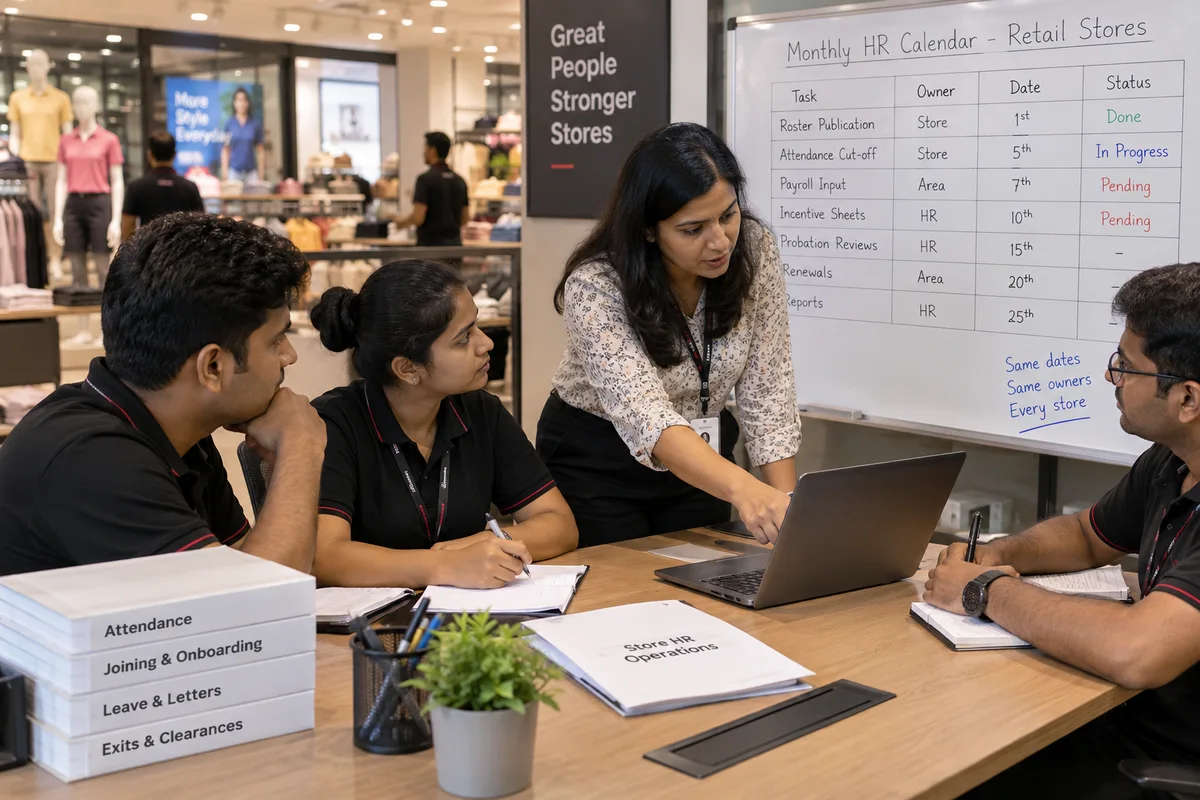
An HR function that runs the same way every month.
Structure, reporting lines and who is allowed to decide what.
Requisition to joining, the same way every time.
A first day that is the same for the fifth joiner as the first.
Records, attendance, leave and the day-to-day HR that must simply work.
Salary structure, payroll inputs and a month that closes on time.
Goals, reviews and ratings that hold up in a conversation.
Named backups for the roles that cannot be vacant.
Communication, recognition and the conditions people actually work in.
Two routes — one for complaints, one for conduct — kept separate.
Policies a manager can apply, and obligations with owners and dates.
Induction, records, incident reporting and follow-through.
Who leaves, when, why — and which of them mattered.
Resignation to relieving letter, in a defined order.
Records that survive people, and approvals that do not queue.
A short monthly pack management actually reads.
The pieces a home decor business business puts in place, in an order that makes each easier. Open any card for the detail.
Photos of room sets, colour pairings and answers to common questions, so advice does not depend on one eye.
Photos of room sets, colour pairings and answers to common questions, so advice does not depend on one eye. See learning and development.
A named person, a monthly or festive reset date and a short check by the manager.
A named person, a monthly or festive reset date and a short check by the manager.
A simple record of breakage at receipt, storage, packing and delivery, with the cause, reviewed monthly.
A simple record of breakage at receipt, storage, packing and delivery, with the cause, reviewed monthly. The HR documentation process can carry it.
Decide how many temporary hands are needed, when they start, who briefs them and how extra hours are treated.
Decide how many temporary hands are needed, when they start, who briefs them and how extra hours are treated. The attendance, shift and leave process gives a base.
A small trained group for heavy or wall-mounted pieces, with a checklist for protecting homes and a way to report damage.
A small trained group for heavy or wall-mounted pieces, with a checklist for protecting homes and a way to report damage.
What is accepted, what needs the manager and how to explain, shared with every associate and used the same way.
What is accepted, what needs the manager and how to explain, shared with every associate and used the same way.
Before changing anything, find out what is true today. These checks take an afternoon and tell you which of the topics above to start with.
Share your requirementsConfirm with a qualified professional. What applies to you depends on your business, your state and your arrangements, and it changes. This page describes practice. It does not state a legal position.
The services below fit this kind of business best. Each starts by recording where you stand, and every later report compares against that. We do not promise outcomes.
Styling and product knowledge captured so advice stays with the shop.
Festive rosters and temporary hands arranged without wearing the core team.
Damage logs, display calendars and staff files in one tidy system.
A short briefing for seasonal and new staff on stock handling and customer manners.
Start with a free conversation, or see the paid HR Diagnostic.
Understand the business, its workforce, current processes and HR challenges.
Find the missing, weak, inconsistent or person-dependent processes.
Create the structure, processes, policies, SOPs, dashboards and systems needed.
Help HR and department managers actually adopt the new system.
Digitise repetitive and approval-based workflows where it is worth doing.
Track hiring, attendance, employee cost, performance, training and attrition.
Strengthen the people-management system continuously, not once.
From the GullyHR blog: one on HR in retail, and one on each of the topics this page points to.

Why store staff and managers leave retail jobs, and how to ask about rosters, weekends, targets and incentives in an exit conversation that leads to action.
7 min readRead article
A founder's guide to hiring freshers and running a first-year programme: campus or open drives, a screening round, a training plan by quarter, mentors and checkpoints.
6 min readRead article
How a D2C founder can decide which digital marketing work to hire for, which to buy from an agency, and which to split, with a worksheet and a five step plan.
6 min readRead article
Every growing company reaches a point where the founder approving everything stops being speed and starts being the bottleneck. Twelve signs it has happened, and what to fix first.
9 min readRead articleMore on the GullyHR blog.
Write down her colour and placement rules, photograph strong room sets and let a second associate shadow her. Advice then belongs to the shop.
Look at last year's footfall and order peaks, and add hands for packing and billing first. Brief each person on day one and give a named senior.
Log where it happens. Often a few steps cause most damage, such as stacking in the store room or poor packing. Fix those with simple training and better materials.
That is for you and your professional adviser to decide. A small trained group with a written arrangement is safer for fragile pieces than casual hands each time.
The main product groups, how to read a customer's space and budget, return rules and how stock is shared with the online page.
We would look at your festive staffing plan, damage record and display duties. A simple damage log and a festive briefing sheet are sensible first jobs. Wider work is scoped after we have spoken and written down before it starts.
All 128 business types in retail · Find another business type
See all HR topics for retail, or another industry.
Tell us what is slowing your team down. We’ll help you find a practical way forward, starting with a conversation.