












Industries
Why retail employees leave and how to understand why
Why store staff and managers leave retail jobs, and how to ask about rosters, weekends, targets and incentives in an exit conversation that leads to action.
7 min readRead articleA fabric shop sells dress material, suiting, shirting, silks and furnishing cloth by the metre. Counter staff cut, measure and advise; stock handlers manage heavy rolls; and regular tailor and boutique customers expect fair rates and accurate lengths.

Not sure what you need? Tell us about your business in six short steps and we will come to the first meeting prepared.
Share your requirementsA fabric shop is built around rolls and the person who cuts them. Customers include individuals buying for a stitched outfit, tailors who buy often and boutiques that want a particular quality. Counter staff pull a roll, measure by the metre, cut and fold, and advise on drape, wash care and quantity needed. Behind them are stock handlers who move heavy bolts, a billing clerk, and a godown or upstairs store. Many shops also sell on credit to tailors and maintain relationships over years. Business peaks around festivals and wedding seasons, school uniform buying and cooler months for suiting. Accuracy in measuring matters, and short measure or poor cutting harms the shop's name quickly. For the wider sector picture, read HR for retail.
These are the places the people side of this kind of business tends to give way. The rest of this page works through them.
HR here has to work for each of these groups, not only the office. The set-up below is written with all of them in mind.
GullyHR runs talent acquisition for permanent roles in fabric shops. For each role we agree the job description with you, find and screen candidates against it, and support the offer through to joining. Tell us the role and the number of people, and we start there.
We recruit permanent employees. We do not supply contract or temporary staff.
Every business interviews, but few have a written process that works the same way for every role and every interviewer. GullyHR designs yours, from the role brief to the offer, trains your managers to run it, and can run it for you on the roles you hand us.
We agree what the role must deliver, the must-have and nice-to-have skills, and how each will be scored.
Screening call, assessment, interview rounds and decision points, sized to the role and the number of people you hire.
Structured questions for each role family and a rating guide, so two interviewers judge the same answer the same way.
A short briefing for your managers on what to ask, what to avoid and how to give a clear yes or no.
Who approves, how the offer is made, and how candidates are kept informed from first call to joining.
A fraction short on each cut adds up, and customers notice. A fraction long eats margin. Staff are on edge either way.
Which silk crushes, which cotton shrinks and how much to advise for a gown sits with the old hands. New staff guess.
Pulling and lifting bolts, climbing ladders to reach top racks, and dust in the air cause strains and falls, yet nothing is written.
Tailors buy on account from a favourite seller. When he leaves, the account follows or turns into a dispute over dues.
End pieces and returned lengths pile up, and stock counts do not match. Nobody knows where the fault arose.
Queues build, staff rush and errors mount. After the peak, hours fall and the best staff look around.
New designs come in, shelved by memory. A customer asks for a pattern and the shop says it has none while it sits in the godown.
Online browsing brings customers who know trends and ask for photos or fabric details, and the traditional counter team feels out of its depth.
Start with the topics that matter most here: Learning and Development; Retention and Attrition Management; Health, Safety and Wellbeing. Then work through the rest. Each topic is written for retail, not in general.
Training planned from need rather than from the calendar.
Who leaves, when, why — and which of them mattered.
Induction, records, incident reporting and follow-through.
How many people, in which roles, by when — and what they will cost.
Structure, reporting lines and who is allowed to decide what.
Requisition to joining, the same way every time.
A first day that is the same for the fifth joiner as the first.
Records, attendance, leave and the day-to-day HR that must simply work.
Salary structure, payroll inputs and a month that closes on time.
Goals, reviews and ratings that hold up in a conversation.
Named backups for the roles that cannot be vacant.
Communication, recognition and the conditions people actually work in.
Two routes — one for complaints, one for conduct — kept separate.
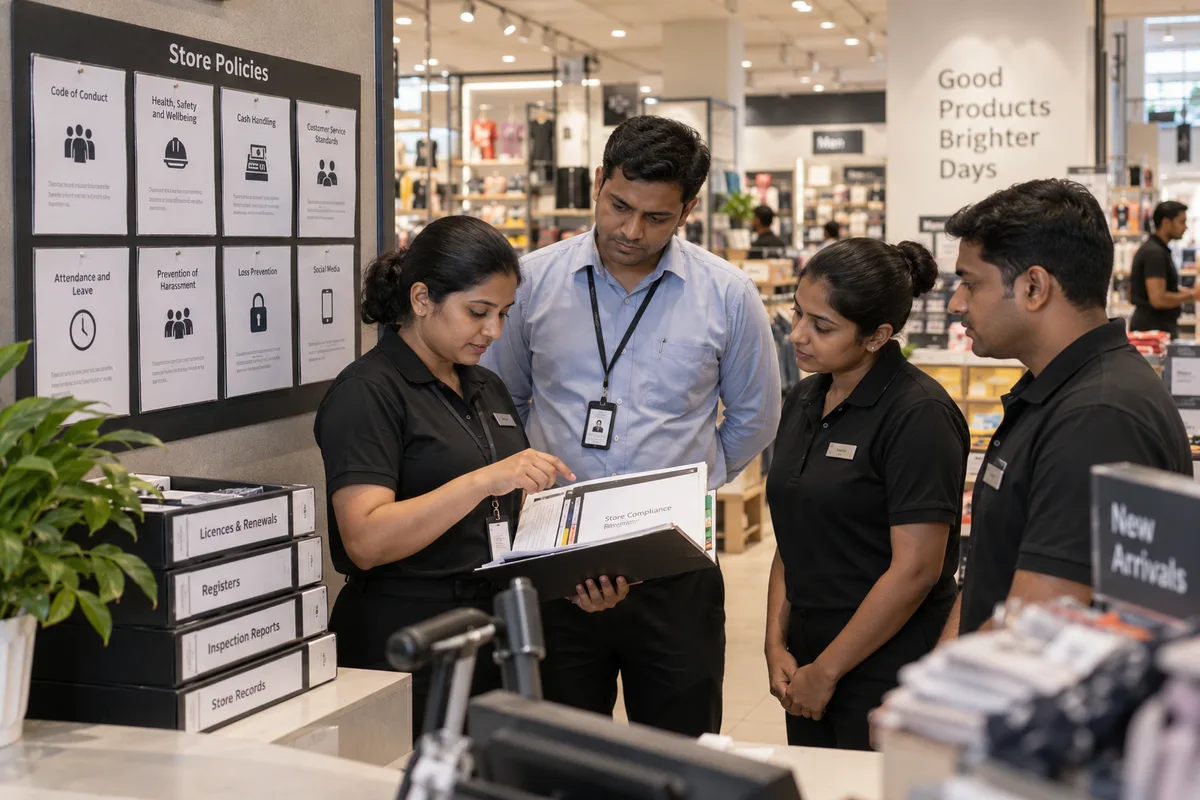
Policies a manager can apply, and obligations with owners and dates.
Resignation to relieving letter, in a defined order.
Records that survive people, and approvals that do not queue.
A short monthly pack management actually reads.
An HR function that runs the same way every month.
The pieces a fabric shops business puts in place, in an order that makes each easier. Open any card for the detail.
A standard measuring tool, a periodic check and a rule that large cuts are measured twice.
A standard measuring tool, a periodic check and a rule that large cuts are measured twice. See the hr documentation process.
A simple guide on fibres, wash care, shrinkage and quantity for common outfits.
A simple guide on fibres, wash care, shrinkage and quantity for common outfits. The learning and development process shows how to set it up.
Lift with two, use proper ladders and store heavy rolls low.
Lift with two, use proper ladders and store heavy rolls low. The workplace health and safety work covers this.
A ledger with a limit per tailor, held by the shop, and a second staff member who knows each account.
A ledger with a limit per tailor, held by the shop, and a second staff member who knows each account.
A bin and a simple log for end pieces, so counts reconcile.
A bin and a simple log for end pieces, so counts reconcile.
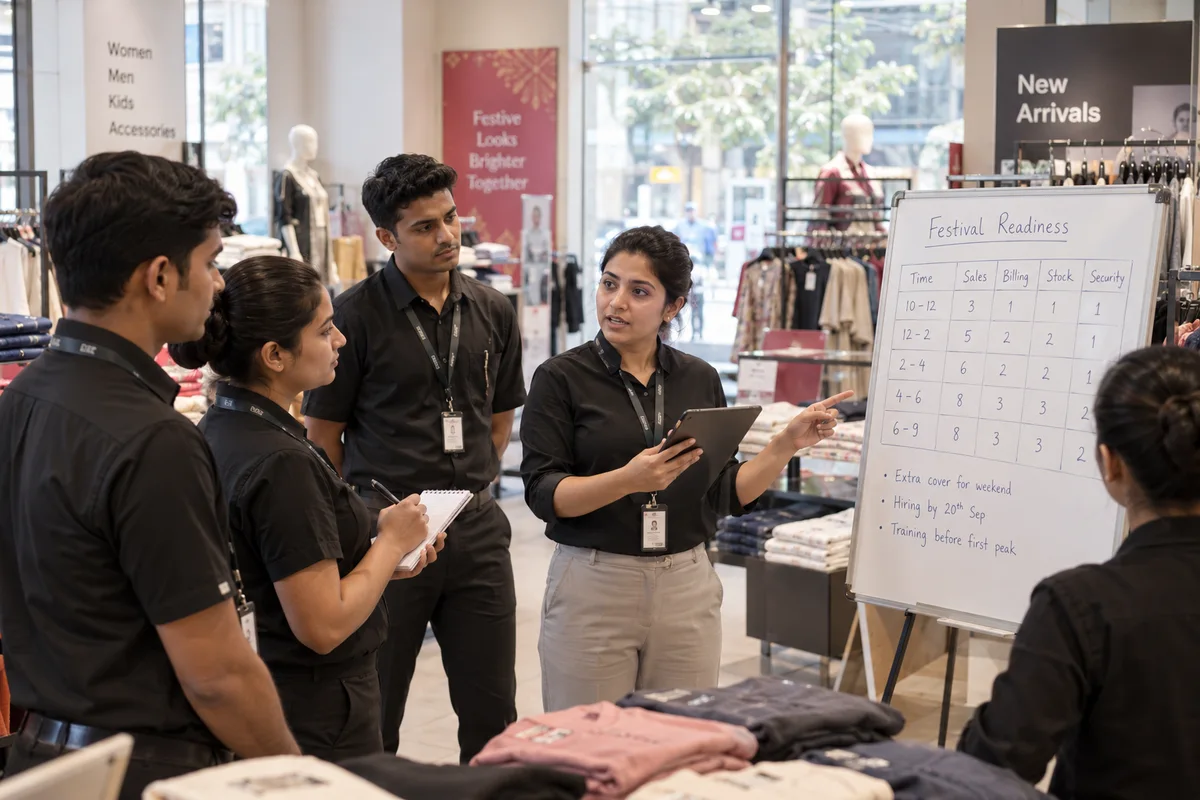
Rosters, extra hands and break times for festival and wedding weeks.
Rosters, extra hands and break times for festival and wedding weeks. See the attendance, shift and leave process.
Before changing anything, find out what is true today. These checks take an afternoon and tell you which of the topics above to start with.
Share your requirementsConfirm with a qualified professional. What applies to you depends on your business, your state and your arrangements, and it changes. This page describes practice. It does not state a legal position.
The services below fit this kind of business best. Each starts by recording where you stand, and every later report compares against that. We do not promise outcomes.
Measure checks and tailor ledgers that keep accuracy and accounts with the shop.
A fabric guide that moves senior knowledge to newer staff.
Safe lifting and ladder routine for roll handling.
Rosters and breaks for festive and wedding rush weeks.
Start with a free conversation, or see the paid HR Diagnostic.
Understand the business, its workforce, current processes and HR challenges.
Find the missing, weak, inconsistent or person-dependent processes.
Create the structure, processes, policies, SOPs, dashboards and systems needed.
Help HR and department managers actually adopt the new system.
Digitise repetitive and approval-based workflows where it is worth doing.
Track hiring, attendance, employee cost, performance, training and attrition.
Strengthen the people-management system continuously, not once.
From the GullyHR blog: one on HR in retail, and one on each of the topics this page points to.

Why store staff and managers leave retail jobs, and how to ask about rosters, weekends, targets and incentives in an exit conversation that leads to action.
7 min readRead article
A founder's guide to hiring freshers and running a first-year programme: campus or open drives, a screening round, a training plan by quarter, mentors and checkpoints.
6 min readRead article
What really keeps mobile app and web developers in a small firm: stay conversations, growth paths, fair release rules and a risk sheet an owner can use this month.
6 min readRead article
A shift, weekly and monthly safety routine for rubber plants that names who checks platen guards, mill trip bars, autoclave doors, burst-test cages and slings, and who acts on near misses.
7 min readRead articleMore on the GullyHR blog.
Use a verified tool, measure big cuts twice, check periodically and treat errors as process issues first. A calm routine helps more than suspicion.
Keep the ledger and the usual orders in the shop's records, let a second person meet the account and let the owner be known to them.
Write short notes on the main fibres and common advice, have seniors teach in short sessions and let juniors try with a senior listening.
Teach lifting with two, store heavy rolls low, provide a sturdy ladder and encourage reporting of strains.
Pair them with a younger colleague for trend queries and give them time to learn. Respect their strength in fabric and fit.
We would look at who holds tailor accounts, how measuring is checked and how knowledge is shared. A good first job is a tailor ledger rule and a fabric guide. Wider work is scoped with you and put in writing before it starts.
All 128 business types in retail · Find another business type
See all HR topics for retail, or another industry.
Tell us what is slowing your team down. We’ll help you find a practical way forward, starting with a conversation.