



















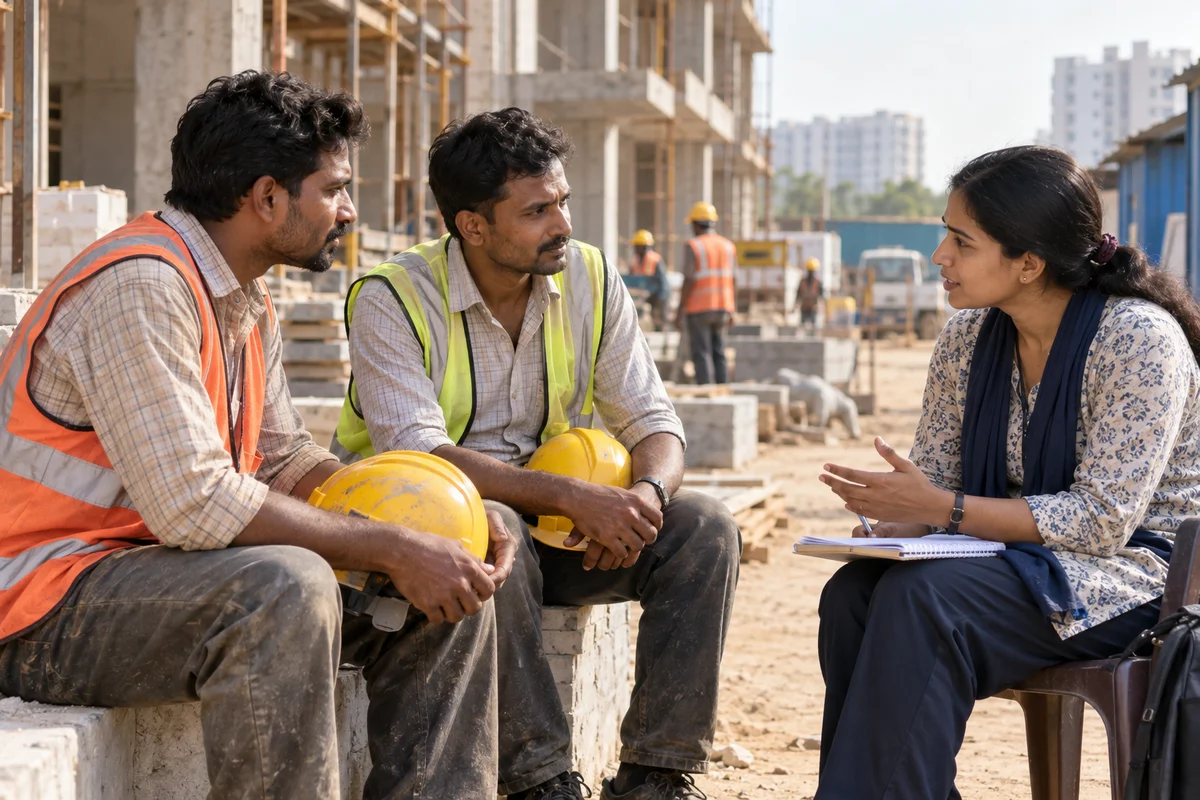
Why construction and real estate employees leave and how to understand why
Site engineers, supervisors, crews and sales teams leave for different reasons. How to ask what shaped their decision and act on it between projects.
8 min readRead articleAn electrical infrastructure firm lays cable, raises towers and builds substations for utilities and industrial clients. Work is spread over many sites, crews move often, and a person without the right certificate cannot go up the pole.

Not sure what you need? Tell us about your business in six short steps and we will come to the first meeting prepared.
Share your requirementsAn electrical infrastructure firm takes orders to lay underground cable, string overhead lines, erect towers or fit out substations. Each order becomes a project with its own site, a crew from the home office and a larger group of local workers. Teams are small, move from one stretch of line to the next, and are often put up in a camp near the work. Supervisors and linemen hold the real know-how, and the paperwork follows them slowly. Safety certificates decide who may work on which task. The construction and real estate hub covers what the wider sector shares, and the infrastructure contractors hub covers the neighbouring trades.
These are the places the people side of this kind of business tends to give way. The rest of this page works through them.
HR here has to work for each of these groups, not only the office. The set-up below is written with all of them in mind.
Presence on a remote stretch of line is noted on paper and reaches the office days later, so costing and pay are always catching up.
Climbing, live-line and high-voltage tasks need valid proof for each person, and a lapse is found when a client inspector asks.
Each stretch needs extra hands who stay a few weeks, and their names, skills and site rules are rarely written down.
Beds, food, water, distance from home and weekends away decide whether linemen return for the next project.
The same lineman works on three projects in a month, and the books want hours split between them.
Crews are moved by road overnight and expected to start the next morning, which raises tiredness on risky tasks.
Strong linemen are promoted to lead a crew with no help in handling people, records or client reviews.
Start with the topics that matter most here: Health, Safety and Wellbeing; HR Operations and Governance; Learning and Development. Then work through the rest. Each topic is written for construction and real estate, not in general.
Induction, records, incident reporting and follow-through.
An HR function that runs the same way every month.
Training planned from need rather than from the calendar.
How many people, in which roles, by when — and what they will cost.
Structure, reporting lines and who is allowed to decide what.
Requisition to joining, the same way every time.
A first day that is the same for the fifth joiner as the first.
Records, attendance, leave and the day-to-day HR that must simply work.
Salary structure, payroll inputs and a month that closes on time.
Goals, reviews and ratings that hold up in a conversation.
Named backups for the roles that cannot be vacant.
Communication, recognition and the conditions people actually work in.
Two routes — one for complaints, one for conduct — kept separate.
Policies a manager can apply, and obligations with owners and dates.
Who leaves, when, why — and which of them mattered.
Resignation to relieving letter, in a defined order.
Records that survive people, and approvals that do not queue.
A short monthly pack management actually reads.
The pieces a electrical infrastructure firms business puts in place, in an order that makes each easier. Open any card for the detail.
One line per person with tasks cleared, certificate dates and the next renewal, reviewed monthly by the safety officer.
What this coversHideOne line per person with tasks cleared, certificate dates and the next renewal, reviewed monthly by the safety officer. The health and safety work sets the routine.
A daily crew list sent by phone from the site by the foreman, matched against the muster at camp.
What this coversHideA daily crew list sent by phone from the site by the foreman, matched against the muster at camp. The attendance process defines who sends what and when.
A list of people who worked well before, with their skills and contacts, so a new stretch is staffed from known names.
What this coversHideA list of people who worked well before, with their skills and contacts, so a new stretch is staffed from known names. The recruitment process keeps it fresh.
Minimum conditions for beds, food, water and rest days, and rules for overnight moves, agreed once with project heads.
What this coversHideMinimum conditions for beds, food, water and rest days, and rules for overnight moves, agreed once with project heads.
A simple daily note from the foreman showing who worked where, so project costing and pay allowances use one source.
What this coversHideA simple daily note from the foreman showing who worked where, so project costing and pay allowances use one source.
A short course on instructing a team, writing the day report and handling a client visit.
What this coversHideA short course on instructing a team, writing the day report and handling a client visit. The manager development programme can carry it.
Before changing anything, find out what is true today. These checks take an afternoon and tell you which of the topics above to start with.
Share your requirementsConfirm with a qualified professional. What applies to you depends on your business, your state and your arrangements, and it changes. This page describes practice. It does not state a legal position.
The services below fit this kind of business best. Each starts by recording where you stand, and every later report compares against that. We do not promise outcomes.
Certificate tracking, toolbox talks and rest rules for crews working at height and near live lines.
A daily field record that reaches the office the same day and supports costing by project.
A path from helper to jointer to lineman to foreman, with tasks signed off on site.
Field allowances and grades set against what nearby line contractors pay linemen and supervisors.
Start with a free conversation, or see the paid HR Diagnostic.
Understand the business, its workforce, current processes and HR challenges.
Find the missing, weak, inconsistent or person-dependent processes.
Create the structure, processes, policies, SOPs, dashboards and systems needed.
Help HR and department managers actually adopt the new system.
Digitise repetitive and approval-based workflows where it is worth doing.
Track hiring, attendance, employee cost, performance, training and attrition.
Strengthen the people-management system continuously, not once.
From the GullyHR blog: one on HR in construction and real estate, and one on each of the topics this page points to.

Site engineers, supervisors, crews and sales teams leave for different reasons. How to ask what shaped their decision and act on it between projects.
8 min readRead article

A shift, weekly and monthly safety routine for rubber plants that names who checks platen guards, mill trip bars, autoclave doors, burst-test cages and slings, and who acts on near misses.
7 min readRead article
Every growing company reaches a point where the founder approving everything stops being speed and starts being the bottleneck. Twelve signs it has happened, and what to fix first.
9 min readRead article
Plastics training dies when it waits for a free Saturday. Tie it to mould changes, purges and cold starts, use one-point lessons and a visible skill ladder, and protect it in peak months.
7 min readRead articleMore on the GullyHR blog.
Plan the next project before this one ends, keep camp conditions decent and give grades that reward skill. Linemen move for steady work, fair allowances and a supervisor they respect.
Because it ties a person to the tasks they may do. When HR holds the dates, the safety officer and project head see lapses early, and rosters are built only with people who are cleared.
Keep a list of people who worked well, give each a short site briefing before day one and note their skills and attendance. Repeat names are your most reliable crew for the next stretch.
Ask the foreman for a one line daily note naming each person and project. It is light work in the field, and costing and allowances can then use the same record instead of guesses.
Pair him with a good foreman, give him small supervisory tasks, teach day reports and client handling, and review progress after a few months. Pay and title should change when he is ready.
First we would ask for your certificate list, one crew's site record set beside the camp muster, and the last two projects' crew changes. A grade scale for field staff with a certificate tracker is a natural opening job, and scope is written for your sign-off.
All 6 business types in infrastructure & engineering contractors · Find another business type
See all HR topics for construction and real estate, or another industry.
Tell us what is slowing your team down. We’ll help you find a practical way forward, starting with a conversation.
