





Why facility management staff leave and how to understand why
Housekeeping, technician and security staff at client sites leave for reasons head office rarely hears. How to ask, what to look for and how to act on it.
7 min readRead articleA tap that drips, a ceiling fan that hums and will not turn, a door that jams: the repair is easy, but sending a stranger into someone's flat is not. Skill checks and conduct decide the reputation.

Not sure what you need? Tell us about your business in six short steps and we will come to the first meeting prepared.
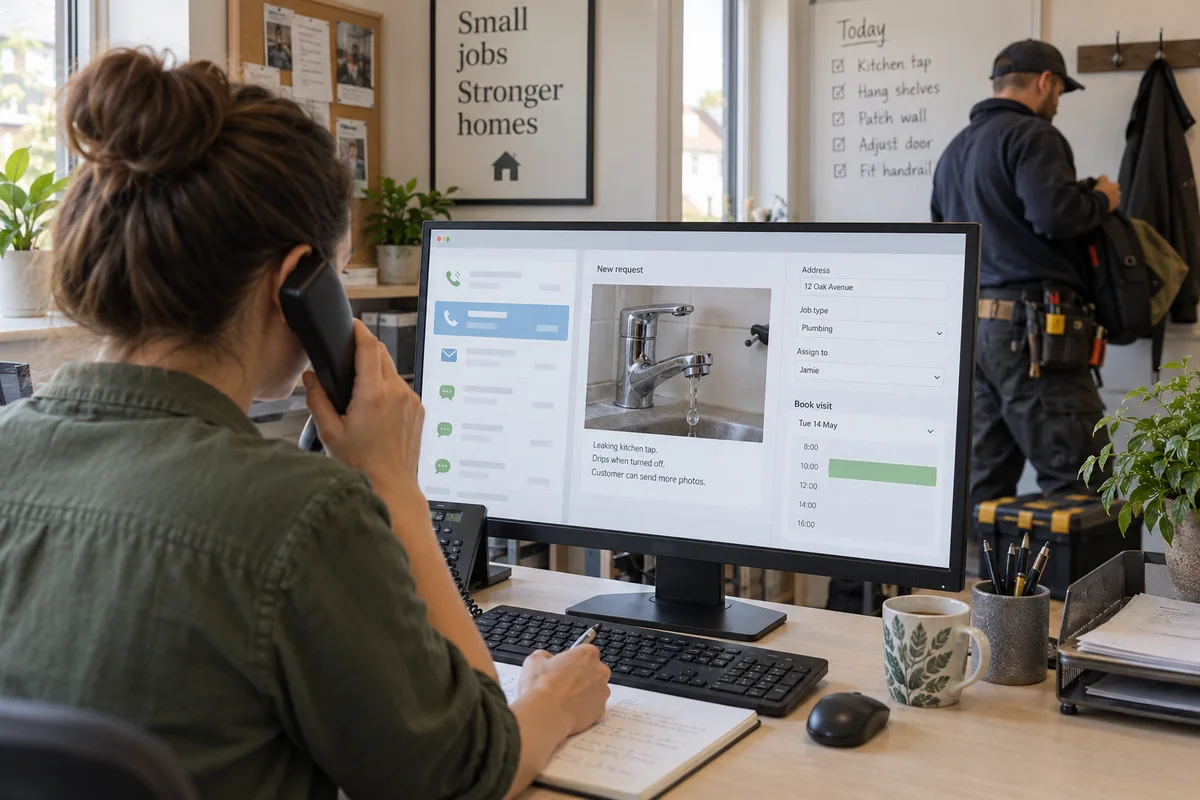
Share your requirementsA handyman and home repair service takes small jobs from households and small offices: a leaking washer, a tripping MCB, a cracked floor tile, a sagging cupboard hinge, a patch of damp on a wall. Requests come by phone, app or a neighbour's word, and visits are booked in time slots across the city. Technicians are electricians, plumbers, carpenters, painters and general helpers, most of whom learned the trade on sites and not in a classroom. They work alone or in pairs inside the customer's home, with their own toolbox. The owner sells trust and speed, and both depend on who knocks on the door. See also HR for facility management.
These are the places the people side of this kind of business tends to give way. The rest of this page works through them.
HR here has to work for each of these groups, not only the office. The set-up below is written with all of them in mind.
GullyHR runs talent acquisition for permanent roles in handyman and home repair services. For each role we agree the job description with you, find and screen candidates against it, and support the offer through to joining. Tell us the role and the number of people, and we start there.
We recruit permanent employees. We do not supply contract or temporary staff.
Every business interviews, but few have a written process that works the same way for every role and every interviewer. GullyHR designs yours, from the role brief to the offer, trains your managers to run it, and can run it for you on the roles you hand us.
We agree what the role must deliver, the must-have and nice-to-have skills, and how each will be scored.
Screening call, assessment, interview rounds and decision points, sized to the role and the number of people you hire.
Structured questions for each role family and a rating guide, so two interviewers judge the same answer the same way.
A short briefing for your managers on what to ask, what to avoid and how to give a clear yes or no.
Who approves, how the offer is made, and how candidates are kept informed from first call to joining.
A man claims to be an electrician and is sent to a flat. The first sign of a gap is a burnt switchboard or an unhappy customer.
One tricky leak pushes every later booking back. The evening ends with angry calls and a technician who has not eaten.
A direct meeting invites a cheaper private visit next time, and the business never learns of it.
Who owns the tool, who pays for a cracked meter and who buys the spares is never settled, so disputes simmer.
Work at height, live circuits and gas connections happen daily. Safe-practice teaching is informal and unrecorded.
Customers, in some homes a woman alone by day, judge the firm on how a technician speaks and behaves. One complaint undoes months of goodwill.
Some are on the rolls, some paid per visit, some work for two firms. Attendance, rates and duties differ for each.
Few finished jobs are inspected. Poor workmanship is found by the household, not by the supervisor.
Start with the topics that matter most here: Health, Safety and Wellbeing; Organisation Design; Employee Relations. Then work through the rest. Each topic is written for facility management, not in general.
Induction, records, incident reporting and follow-through.
Structure, reporting lines and who is allowed to decide what.
Two routes, one for complaints, one for conduct, kept separate.
How many people, in which roles, by when, and what they will cost.
Requisition to joining, the same way every time.
A first day that is the same for the fifth joiner as the first.
Records, attendance, leave and the day-to-day HR that must simply work.
Salary structure, payroll inputs and a month that closes on time.
Goals, reviews and ratings that hold up in a conversation.
Training planned from need rather than from the calendar.
Named backups for the roles that cannot be vacant.
Communication, recognition and the conditions people actually work in.
Policies a manager can apply, and obligations with owners and dates.
Who leaves, when, why, and which of them mattered.
Resignation to relieving letter, in a defined order.
Records that survive people, and approvals that do not queue.
A short monthly pack management actually reads.
An HR function that runs the same way every month.
The pieces a handyman and home repair services business puts in place, in an order that makes each easier. Open any card for the detail.
A short practical test by a senior tradesman for each skill claimed, with a grade that decides which jobs the person is sent to.
A short practical test by a senior tradesman for each skill claimed, with a grade that decides which jobs the person is sent to. The role design work turns it into clear job levels.
Dress, greeting, shoe covers, manner with women and children, what never to ask for and how to leave a flat, taught at joining and repeated.
Dress, greeting, shoe covers, manner with women and children, what never to ask for and how to leave a flat, taught at joining and repeated. The policies and governance work gives it weight.
A written list of what the firm supplies, what the technician owns, who bears a loss and how spares are billed, so nothing is argued later.
Time allowances per job type taken from your own history, and a rule that the dispatcher re-books early instead of letting the day slide.
Time allowances per job type taken from your own history, and a rule that the dispatcher re-books early instead of letting the day slide. The attendance and shift process holds the schedule.
A supervisor visit or a customer call-back on a share of jobs each week, with findings passed back to the technician.
A clear rule on side visits to the firm's customers, plus reasons to stay: steady jobs, fair rates and recognition.
Before changing anything, find out what is true today. Work through the checks using a recent operating period. The time needed depends on the records you hold; note missing evidence and use the findings to choose a priority.
Share your requirementsConfirm with a qualified professional. What applies to you depends on your business, your state and your arrangements, and it changes. This page describes practice. It does not state a legal position.
The services below fit this kind of business best. Each starts by recording where you stand, and every later report compares against that. We do not promise outcomes.
Clear trade levels and a grade for each technician, so each job goes to the right person.
A practical routine for ladder and live-wiring jobs, with training recorded per person.
A fair way to handle a customer complaint about conduct, from first report to outcome.
Slots, job times and leave seen together so the day does not slip.
Start with a free conversation, or see the paid HR Diagnostic.
Understand the business, its workforce, current processes and HR challenges.
Find the missing, weak, inconsistent or person-dependent processes.
Create the structure, processes, policies, SOPs, dashboards and systems needed.
Help HR and department managers actually adopt the new system.
Digitise repetitive and approval-based workflows where it is worth doing.
Track hiring, attendance, employee cost, performance, training and attrition.
Strengthen the people-management system continuously, not once.
From the GullyHR blog: one on HR in facility management, and one on each of the topics this page points to.

Housekeeping, technician and security staff at client sites leave for reasons head office rarely hears. How to ask, what to look for and how to act on it.
7 min readRead article

A shift, weekly and monthly safety routine for rubber plants that names who checks platen guards, mill trip bars, autoclave doors, burst-test cages and slings, and who acts on near misses.
7 min readRead article
A founder's guide to building job grades, titles and billing levels for a growing IT services firm, with a step-by-step method and a grade description outline.
6 min readRead article
An employee brings you a complaint about their supervisor. What happens next should not depend on who is in the room. A grievance procedure a small company can actually run.
8 min readRead articleMore on the GullyHR blog.
Give a short practical test with a senior tradesman for each trade claimed. Start new people on simple jobs with a supervisor's call-back, and record the grade so dispatch follows it.
Either can work, but the mix should be chosen on purpose. Write down rates, attendance and duties, and confirm the right treatment with a qualified professional.
Take it seriously, hear the customer, hear the technician and decide through a written process. Keep a record even when the outcome is only a warning.
Make staying worthwhile with steady work, fair rates and recognition, and set a clear rule on private work. Threats rarely hold anyone.
Safe practice for the riskiest tasks, the home conduct standard and basic skills for the trade. Keep it short, hands-on and recorded.
We would ask who has tested each technician's claimed trade, how booked times compare with actual times, and who owns tools and pays for breakage. A reasonable opening job is a grading test per trade with a written home conduct standard. After that call, the scope is put in writing before any work begins.
All 56 business types in facility management · Find another business type
See all HR topics for facility management, or another industry.
Tell us your industry, team size and the issue you want to address. Bring one example of where work gets delayed or ownership is unclear, and the deadline or decision you are working towards.