HR for Landscape and Garden Maintenance Companies: Crews, Seasons and Equipment
Landscape upkeep runs on crews, seasons and weather. This is how to plan, pay and keep the gardeners and machine hands who keep client sites looking right.
Make this work for your business. Share your team size, priorities and what you need help with. We’ll use your brief to prepare for the first conversation.
A landscape maintenance company looks after lawns, hedges, trees and grounds for apartment complexes, offices, campuses and homes, under recurring contracts, with design and installation jobs on the side. Work follows the season: planting, pruning and monsoon clean-ups bring peaks and quieter months follow. Crews of gardeners and helpers go to sites under a supervisor, carrying brush cutters, lawn mowers, sprayers and sometimes a tractor. Part of the crew is casual or migrant, and wages are paid weekly. The owner balances recurring site contracts against project crews, and machine safety against output. For the wider sector, read the facility management overview. The HR work here is mostly about planning round the season, keeping casual hands on a list and keeping people safe around cutting machines.
Plan→
Hire→
Onboard→
Manage→
Develop→
Perform→
Engage→
Retain→
Exit→
Improve
When HR is weak in landscape maintenance companies, you may see
Demand follows the season
Casual hands leave no trace
Cutting machines injure people
Rain breaks the plan
Supervisors are good gardeners, not yet managers
Pay comes in different forms
Travel to site is left to chance
Each client wants something different
These are the places the people side of this kind of business tends to give way. The rest of this page works through them.
Why GullyHR for landscape maintenance companies
Crews planned round the season, casuals on a list, cutters used safely.
For landscape and garden maintenance firms with recurring site contracts, project crews and a casual workforce. Crews are planned from the contract calendar, casual hands are recorded and machine safety becomes a routine.
01
Crews planned from the contract calendar
We lay planting, pruning and clean-up peaks over your recurring contracts, so you know weeks ahead when project crews are needed and when the quiet months leave people idle.
02
A register for every casual hand
Each casual and seasonal worker goes on a simple list with contact, skills, wage terms and last site, so the people you used in spring can be found again.
03
Brush-cutter safety taught before use
We write a short routine for cutters, mowers, sprayers and the tractor: what is taught, what protective gear is issued, and who signs off before anyone works alone.
04
A written rule for rain days
One page says what happens to pay, travel and rescheduling when weather stops work, so the crew hears the same answer from every supervisor.
Our services for landscape maintenance companies
Start with any one of these. Scope and fee are agreed in writing after a free first conversation.
HR audit
We begin with last year's calendar of contracts and project jobs and set it beside the crews you actually fielded each month. Then we read the casual worker records, if any, and the way weekly wages were agreed and paid. On a site visit we watch how brush cutters, mowers and sprayers are used, what protective gear is worn and how the supervisor briefs the crew. We ask gardeners what they were taught and who taught them. The report lists gaps in order of risk.
What you receive
A season-by-season crew plan comparison against your contract calendar
A casual workforce review showing who is recorded and who is not
A machine and protective gear observation sheet from a site visit
An example, not a client storyPicture an owner who believes the casual hands are all trained because the best gardener showed them the brush cutter. The audit asks three of them what they were told and gets three different answers, and that gap becomes the first item in the safety plan, written up before the next season starts.
The first process is the seasonal plan, built from the contract calendar so peaks in planting, pruning and monsoon clean-up are seen before they arrive. Second is casual registration, a few lines per worker, done on the first day. Third is machine safety, covering the check before starting, the gear worn and the sign-off. Fourth is the rain rule, with pay, travel and rescheduling spelled out. Finally comes a site sheet for each contract, listing gates, water points, client contacts, special requests and the person who answers the phone.
What you receive
A seasonal crew planning sheet linked to the contract calendar
A one-page site sheet for each recurring contract
A rain-day rule covering pay, travel and rescheduling in plain words
An example, not a client storySay heavy rain stops work at four sites on a Tuesday and each supervisor tells the crew something different about pay. A written rain rule, explained once at the start of the season, would have given every crew the same answer and spared the owner a week of complaints from crews comparing notes at the depot.
Through the peak weeks we keep the casual register current as people arrive and drift away, and we flag which crews are short for next week. We check that machine sign-offs are done before a new hand works alone and that protective gear has actually been issued. We hold regular conversations with supervisors who are good gardeners and are still learning to manage people. We also keep track of travel arrangements, wage terms by crew and any injury or near miss, so the owner sees patterns early.
What you receive
A weekly crew and site status note for the owner
A running casual register with last site and skills
A near-miss and injury log reviewed with supervisors
An example, not a client storySuppose two crews are short in the same week because three casual hands went home for a festival and nobody noticed. With the register kept current and a weekly look ahead, the shortfall is seen early and a recall list is used before a client complains. The owner also learns to ask crews about festival leave in advance.
The roles that hold a landscape firm together are the supervisor who can run a crew and speak to a client, the operator who handles cutting machines safely, and the planting lead who knows the work. We write what each role does across the seasons, including the quiet months. Then we source, screen and test: a practical exercise on a live bed or lawn for operators, a briefing exercise for supervisors, and a conversation with each candidate about working outdoors in the hottest and wettest weeks. Finalists are scored on the same sheet, with notes you can read.
What you receive
A role card for site supervisor and installation lead across all seasons
A practical task and scoring sheet for machine operators
A shortlist report with scores and reasons for each finalist
An example, not a client storyTake a firm that promotes its best pruner to supervisor and then watches him struggle to brief a crew or speak to a resident. A role card and a briefing exercise, run before the promotion, would have shown what support he needed or whether another person suited the post better, without losing a good pruner in the process.
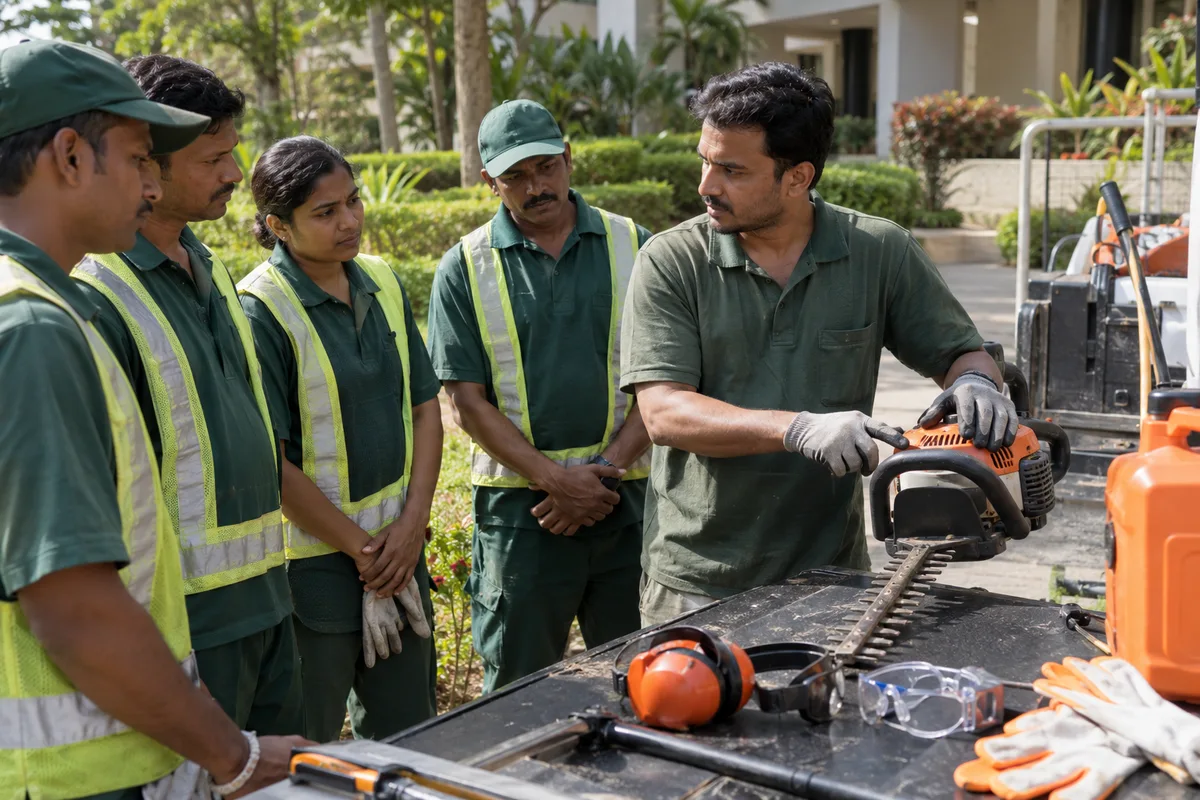
For crews we run depot sessions on starting, using and shutting down each machine, how to carry and store fuel, what gear to wear and what to do after an injury. Sprayer handling gets its own session, covering mixing, storage and re-entry rules your adviser confirms. For supervisors we teach how to brief a crew, read the site sheet, handle a client request and speak to a worker who is slow. Every session ends with a sign-off recorded against the person and a date for the next refresher on the same machine.
What you receive
A machine safety session for cutters, mowers and sprayers with sign-off
A supervisor workshop on briefing a crew and handling client requests
A training record per worker showing what was taught and when
An example, not a client storyPicture a helper handed a brush cutter on his second day with only a shout of instructions from a busy supervisor. A depot session before first use, with a signed record, is what the training service sets up, so the first time he starts the machine is not the first time he hears the rules.
A landscape company pays in different forms, with some crews on monthly pay, some weekly and some by job, and nobody should have to guess which applies. We write the pay and attendance rules for each group, the rain rule, the travel rule, the gear and machine rules, and a short conduct page for client premises. In the HR system we hold each person's group, site history, machine sign-offs and gear issued. Your own adviser confirms the machinery, casual-labour and employment duties that apply to you.
What you receive
A short handbook for permanent crews and casual hands
A pay-group and attendance rule sheet explained in plain words
A gear and machine issue record kept in your HR system
An example, not a client storySay a casual gardener leaves in the middle of a week and claims a travel allowance that was never written down. A policy sheet that states how transport is arranged and paid, signed by each worker at joining, settles the claim without any argument over memory, and the same sheet answers the next worker who asks.
Questions owners of landscape maintenance companies ask us
We lay your contract calendar over last year's crew sizes, find the weeks where you were short or idle, and draw a plan for the next season. That includes a recall list of casual hands and a clear point at which you decide to hire permanent staff. Your adviser confirms what applies to seasonal and casual terms.
We would start a simple register: name, contact, skills, last site, wage terms and any machine training. It is filled on the first day and checked by the supervisor. That gives you a recall list for next season, a base for fair treatment and a way to see who returns each year. Your own adviser confirms which records you must keep.
We design and run the depot session and the sign-off, covering starting, use, fuel, protective gear and what to do after an injury. We cannot replace a certified machinery trainer where one is required, and your adviser confirms that. We make sure no one works alone with a cutter before their name is on the record.
In a case like this the skills can be taught, so we would first talk to him about what he wants. Then we would give him a short supervisor course on briefing, site sheets and client requests, with a mentor for the first months. If the role does not fit, we would help you agree another route without losing his craft.
Who does the work in landscape maintenance companies
Roles we help you hire in landscape maintenance companies
GullyHR runs talent acquisition for permanent roles in landscape maintenance companies. For each role we agree the job description with you, find and screen candidates against it, and support the offer through to joining. Tell us the role and the number of people, and we start there.
We recruit permanent employees. We do not supply contract or temporary staff.
Where HR strains in landscape maintenance companies
Demand follows the season
Peaks and troughs leave a fixed team too big in some months and too small in others.
Casual hands leave no trace
People engaged for a day or a project are paid in cash and appear on no list, so good ones cannot be called back.
Cutting machines injure people
Brush cutters, mowers, sprayers and pruning at height carry real risk, and protective gear gets left in the van.
Rain breaks the plan
A washed-out day disrupts attendance and pay, and arguments follow about who bears the lost day.
Supervisors are good gardeners, not yet managers
The best person on the crew is promoted and left to learn how to run a team alone.
Pay comes in different forms
Weekly, daily and per-job payment sit side by side, and disputes follow.
Travel to site is left to chance
Crews reach sites by whatever is going, which affects punctuality, safety and who pays for the ride.
Each client wants something different
One site wants hand edging and another wants speed, and crews learn which only when corrected.
HR topics for landscape maintenance companies
Start with the topics that matter most here: HR Strategy and Workforce Planning; Health, Safety and Wellbeing; Compensation, Payroll and Benefits. Then work through the rest. Each topic is written for facility management, not in general.
The pieces a landscape maintenance companies business puts in place, in an order that makes each easier. Open any card for the detail.
Plan crews from the contract calendar
For each contract and season, the people needed by week, with a core team and a pool of casuals you can call.
What this coversHide
For each contract and season, the people needed by week, with a core team and a pool of casuals you can call. Write it into a seasonal crew plan.
Register every casual
Name, identity, contact, dates and pay, even for a single day, so good people can be called back next season.
What this coversHide
Name, identity, contact, dates and pay, even for a single day, so good people can be called back next season.
Make machine safety a routine
Instruction before first use on a cutter or sprayer, protective gear issued and recorded, and a daily check by the supervisor.
What this coversHide
Instruction before first use on a cutter or sprayer, protective gear issued and recorded, and a daily check by the supervisor. Build it with safety routines for outdoor crews.
Write the rain rule
What happens to pay and attendance on a washed-out day, agreed before the monsoon and explained to every crew.
What this coversHide
What happens to pay and attendance on a washed-out day, agreed before the monsoon and explained to every crew.
Prepare supervisors
A short programme on briefing a crew at the van, settling disputes and recording the day.
List the casual workers you used last month and check how many are on any record.
Ask a crew member what they were taught before first using the brush cutter.
Visit a site and check whether protective gear is issued and worn.
Write down what happens to pay on a rain day and ask the crew if they know it.
Ask your best gardener if they want to supervise, and what help they would need.
Settle how transport to site is arranged and paid for, and put it on paper.
Confirm with a qualified professional the machinery-licence, casual-labour record and employment duties that govern your crews.
Confirm with a qualified professional. What applies to you depends on your business, your state and your arrangements, and it changes. This page describes practice. It does not state a legal position.
Housekeeping, technician and security staff at client sites leave for reasons head office rarely hears. How to ask, what to look for and how to act on it.
How a D2C founder can decide which digital marketing work to hire for, which to buy from an agency, and which to split, with a worksheet and a five step plan.
A shift, weekly and monthly safety routine for rubber plants that names who checks platen guards, mill trip bars, autoclave doors, burst-test cages and slings, and who acts on near misses.
Simple variable pay structures for product and engineering teams: four options, why individual metrics backfire, a build plan and a one page outline to adapt.
Keep a core team for recurring contracts and a pool of casuals who are registered and briefed in advance. Plan from the contract calendar, not from last year's busiest month.
Yes, a simple one: name, identity, contact, dates and pay. Which registers apply depends on how you engage people, so have a qualified professional check.
Instruct before first use, issue and record protective gear, check daily and repair faulty tools at once. Most injuries come from untrained use and missing gear.
Whatever you agree, provided it is written and explained before the season. Disputes come from a rule invented on the day.
Look for reliability, the crew's respect and willingness to learn, then teach the new part of the job. The best gardener is not automatically the best supervisor.
We would go through last month's casual workers and how many are on record, what crews learned before using a cutter, and what happens to pay on a rain day. A crew plan built from the contract calendar is a fitting first job. We confirm scope in writing before beginning.
Tell us your industry, team size and the issue you want to address. Bring one example of where work gets delayed or ownership is unclear, and the deadline or decision you are working towards.