
Train the Field, the Depot and the Line Without Stopping Them
A field force cannot leave its beats and a plant cannot stop its lines, so training in consumer goods is squeezed between targets and shifts. Schemes change and are circulated rather than taught, selling skills are learned from whoever rides along, and managers are promoted for results without being taught to coach. We help you plan training from the skills each role needs, in a form the field and the plant can attend.
Not sure what you need? Tell us about your business in six short steps and we will come to the first meeting prepared.
Share your requirementsThe starting point
Is Training Something That Happens When the Month Allows It?
Training in this sector is largely on the job. Salespeople read circulars on new schemes, merchandisers learn standards from photographs, and operators learn the line from the supervisor. Nobody can say who has been taught what.
We help you teach in short, practical sessions and keep a record of who can do what.
You may be experiencing:
- Scheme and price changes sent by email or app message and applied differently at different outlets.
- New launches that reach the shelf before the sales team has been shown how to sell them.
- Selling and negotiation skills that depend on which colleague a joiner is paired with.
- Plant skills known by the supervisor and written nowhere, so cover for absence is a gamble.
- Safety and hygiene training given at induction and not repeated.
- Area managers who coach well or badly by temperament, with no shared method.
- Training records held in several places, and no check on whether anything changed afterwards.
What we can help with
Our Learning and Development Services for FMCG and Consumer Goods
Skill and Competency Matrix
A matrix for each role family, listing the skills and the level needed, for example beat planning and outlet negotiation for sales officers, and machine setting and changeover for line operators.
Training Needs Analysis
A review of where people fall short of the matrix, drawn from managers, from field and plant observation and from the performance record, so that training is aimed where the gap is.
Launch and Scheme Briefings
A short, repeatable format for teaching a new product or scheme to the field, with a check that each person can explain it, and a record of who has attended.
Selling and Outlet Skills Programmes
Practical training in call structure, negotiation, display and handling of objections, delivered in short blocks or at regional gatherings and reinforced on the beat.
Plant and Depot Skill Development
On-the-line training and multi-skilling plans, with a record of who is certified on which machine or task, together with safety, quality and hygiene refreshers.
Supervisor and Area Manager Capability
Training for first-line managers in coaching, giving feedback, running a team meeting and conducting a ride-along or a shift review.
Training Calendar and Delivery Planning
An annual calendar built around the incentive cycle, the festival peaks and the plant maintenance windows, so that training lands when people can attend.
Assessment, Records and Effectiveness
Simple checks after training, a record of attendance and certification by person, and a review of whether the skill is showing in the work.
The deliverables
What You Receive
Depending on the agreed scope, the work produces:
- A skill and competency matrix for field, depot, plant and manager roles.
- A training needs analysis and priority list.
- A launch and scheme briefing format, with a check of understanding.
- Training content outlines for selling skills and outlet handling.
- A plant skill register and a multi-skilling plan.
- A coaching guide for area managers and supervisors.
- A training calendar fitted to the sales and plant calendar.
- A training record by person, with a review format.
Step by step
How We Work
Learn the roles and the calendar
We spend time in the field, at a depot and on a plant line, and read the sales and production calendar, to see when learning is possible and what the roles need.
Build the matrix and find the gaps
With your managers we write what each role must be able to do, then assess where people stand.
Design short sessions
We prepare formats that fit the time available: a briefing before a launch, a morning at a regional meeting, a ten-minute talk before a shift.
Deliver or enable delivery
We deliver selected sessions, or train your managers to run them, whichever you choose. Trainers from your own team are encouraged.
Record and review
We set up the record and a review of results. Before work starts we record where you stand, and we report against it.
The difference
Learning That Fits the Beat and the Shift
A planned approach to learning helps you:
We do not promise outcomes. We record a baseline before work starts, covering the share of the field briefed before the last launch, the number of plant roles with a trained cover, and the training records held, and report against it, so you can see what changed and what did not.
- Brief the field before a launch or scheme, not after.
- Give every joiner the same selling foundations.
- Know who is certified on which line, and plan cover on that basis.
- Repeat safety and hygiene teaching rather than relying on induction alone.
- Give area managers a method for coaching.
- See what was taught, to whom and whether it was used.
Find your fit
Who This Service Is For
Sales and Trade Marketing Heads
Leaders who launch often and need the field to understand schemes and products at once.
Plant and Quality Managers
Managers who rely on a few skilled people and want cover built through multi-skilling.
Companies Promoting Sellers to Manager
Owners who see strong salespeople struggle as first-time managers.
HR and Training Teams in Multi-Region Companies
Teams who need training done in a common way across regions.
How it usually shows up in fmcg and consumer goods
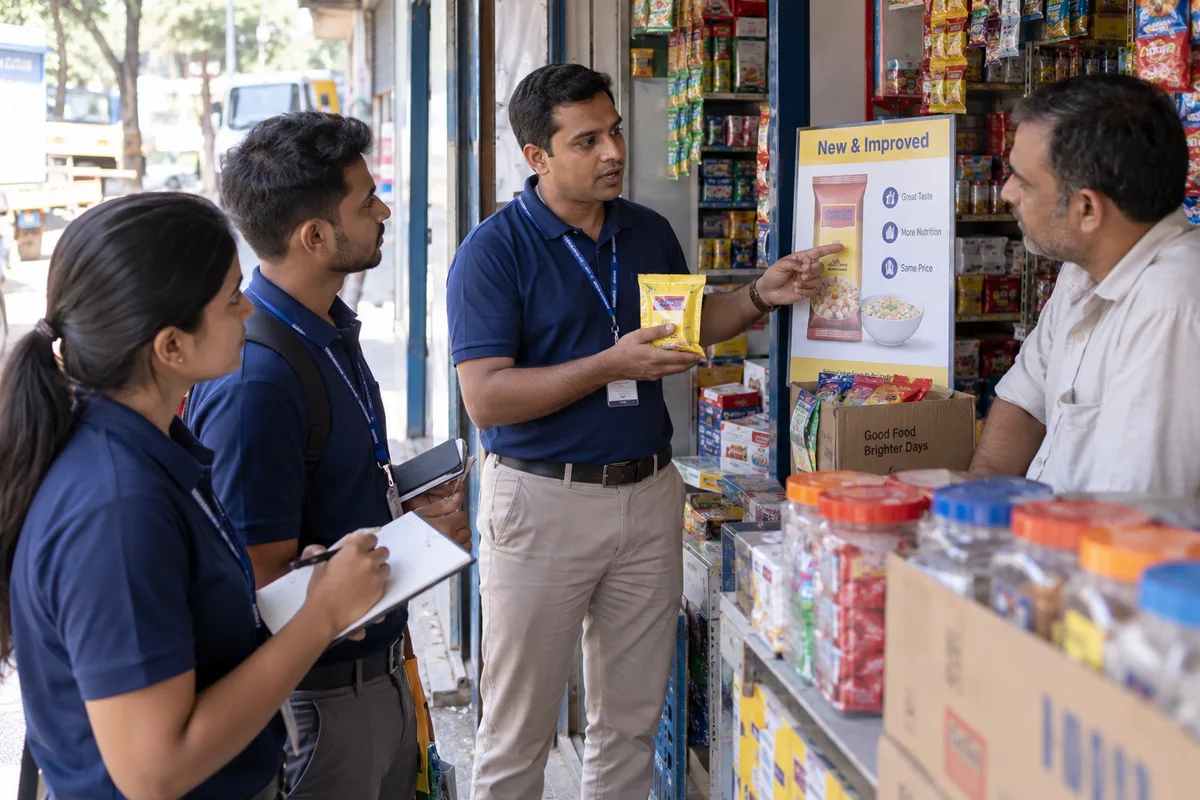
Learning in FMCG is largely on the job and happens in the field, at the plant and in the depot. Field salespeople learn products and schemes from briefings and circulars that change often, and selling skills from the person they ride with. Merchandisers learn display standards from photographs. Plant staff learn operations and quality from their line supervisor, and are certified for safety. Training is difficult to schedule, since the field cannot leave its beats and the plant cannot stop its lines. Managers are promoted for results and are rarely taught to coach. Records of who has been trained and in what are patchy.
Common challenges
Where it goes wrong in fmcg and consumer goods
Scheme changes are circulated, not taught
New schemes arrive as a circular and are understood differently by each person.
Selling skills depend on who rides along
The quality of coaching varies with the senior person.
Managers do not coach
They are promoted for results and left to learn how to develop people.
Records are patchy
Who has been taught what is not recorded reliably.
A better process
What a working version looks like
- 01
Teach new schemes in a short session
A brief practical briefing with examples and a check, not only a circular. The learning and development process holds the plan.
- 02
Standardise the ride-along
A checklist for what a supervisor observes and teaches, with notes.
- 03
Train managers to coach
A short programme on observation, feedback and one-to-ones.
- 04
Record training by person
What each person has been taught and when.
What to check this week
- Ask three salespeople to explain the current scheme and compare.
- Look at what a supervisor does on a ride-along and whether it is recorded.
- Check whether managers have been taught how to coach.
- Find a record of safety training for a plant operator.
- Ask what learning the best salesperson had last year.
Confirm with a qualified professional. What applies depends on your establishment, your state and your sector, and it changes. This page describes a practice; it does not state a legal position.
What this looks like in fmcg and consumer goods
The parts of learning and development that are specific to this sector, rather than general.
Training Plant, Depot and Field
Three populations, three delivery models.
What this coversHide
Training Plant, Depot and Field
Three populations, three delivery models.
What this coversHideFMCG development spans machine operators who train on the line, depot teams who train in short blocks, and a field force that can only be trained in periodic gatherings.
Plant and depot
- Skill matrix driven training on the line
- Safety, quality and hygiene training
- Supervisor and line lead capability
- Multi-skilling development
Field force
- Product, scheme and pricing knowledge
- Selling and negotiation skills
- Distributor and outlet handling
- Digital tools and reporting discipline
Field training works best when it is short, frequent and tied to what is launching, rather than delivered as an annual event that competes with the month's targets.
Questions on this, in fmcg and consumer goods
By using short formats: a briefing before a launch, a session at a regular regional meeting, a ride-along with a checklist. We plan around the sales cycle and keep sessions short and practical.
We can deliver selected sessions and we can train your own managers or trainers to run them. Which route is better depends on your size and the regions involved.
We build the skill matrix and the plan for multi-skilling and record who is certified on what. Technical content on machines and processes should come from your own engineers or the equipment supplier, and we help organise it.
We agree a check for each session, such as a short explanation to a supervisor or an observed call, and look at the matching measure in the work afterwards. We report what we see and do not claim more.
We can place safety training in the calendar and keep the records. The content and frequency required for your plant should be confirmed with a qualified professional, as GullyHR does not give legal advice.
Teach them in a short session with examples and a check, and let people ask questions. A circular is read by few and understood by fewer.
The beat plan, outlet conversations, execution at the outlet and record-keeping, with feedback on the day. A standard checklist makes it consistent.
Yes. A short programme on observation and feedback improves results across the team and is cheap compared with attrition.
In short, practical sessions in the beat, such as ride-alongs and brief calls, with a periodic gathering for new schemes.
Short enough to fit around a beat: an hour or two for a new scheme, with a practical element. Longer sessions are for skills and are held less often.
Teach People Where and When They Can Learn
Tell us what your field force, depots and plants need to learn, and what gets in the way. We will discuss a training plan that fits your calendar.
Prefer to talk first? Call +91 80958 58589 or write to hello@gullyhr.com.
The general method — what learning and development covers, the questions it answers and what an engagement produces — is the same whatever the sector, and is set out on the learning and development process page. What is above is the part that differs for fmcg and consumer goods.
To run this in a system rather than on paper, see learning and development software.
Other HR topics for fmcg and consumer goods
Where to start
Most engagements begin with a review of how this runs in your business today, then a written process and the sequence to implement it.
See all HR topics for fmcg and consumer goods, or another industry.