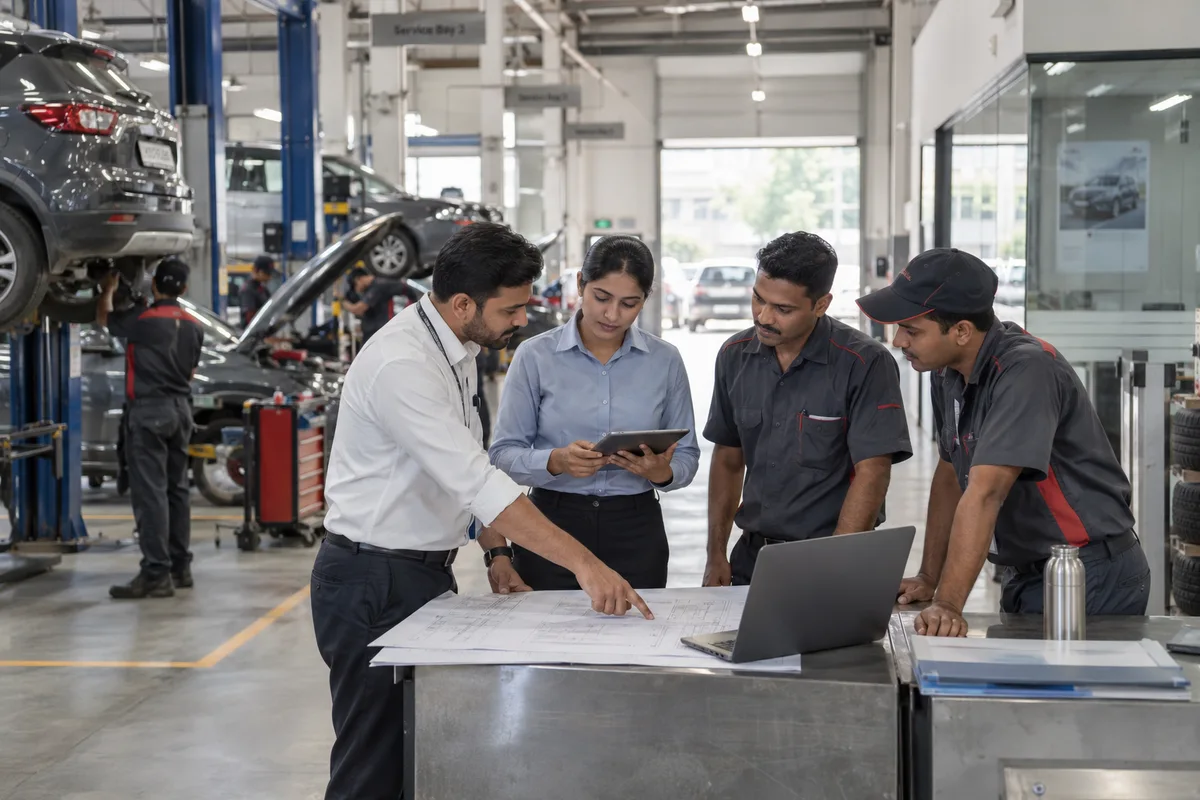
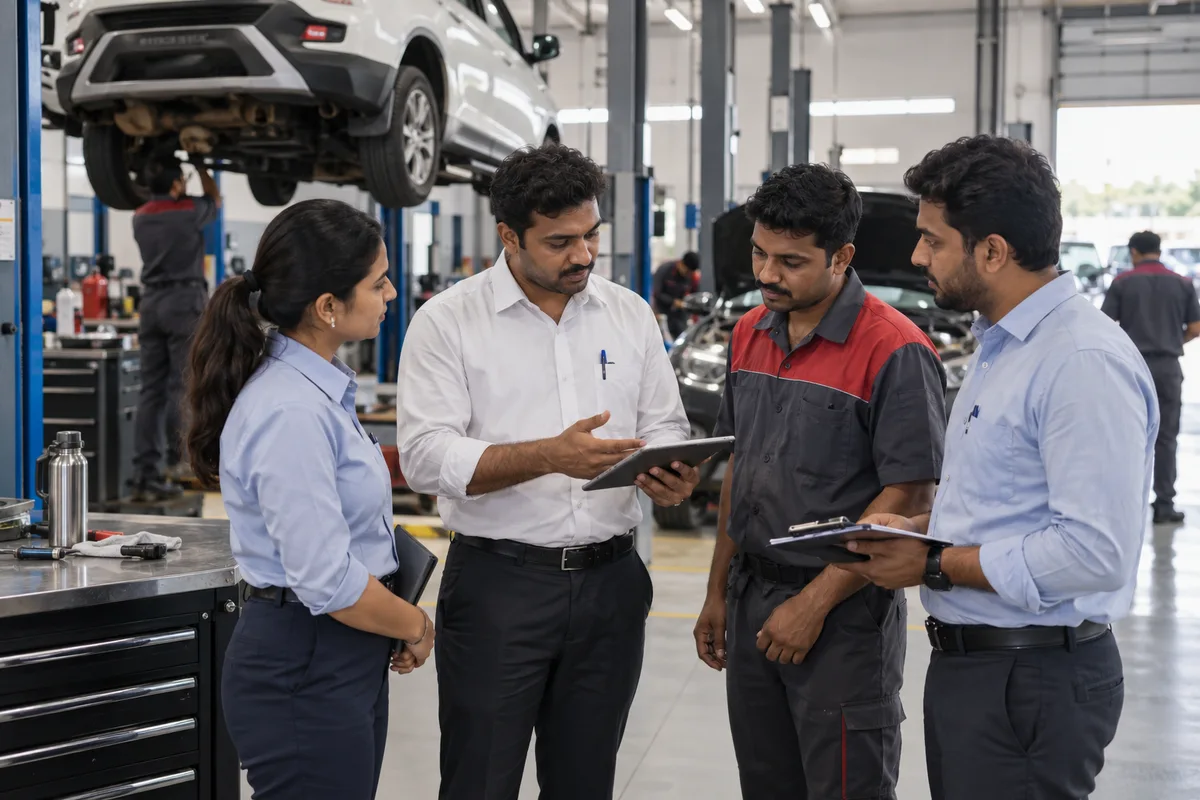
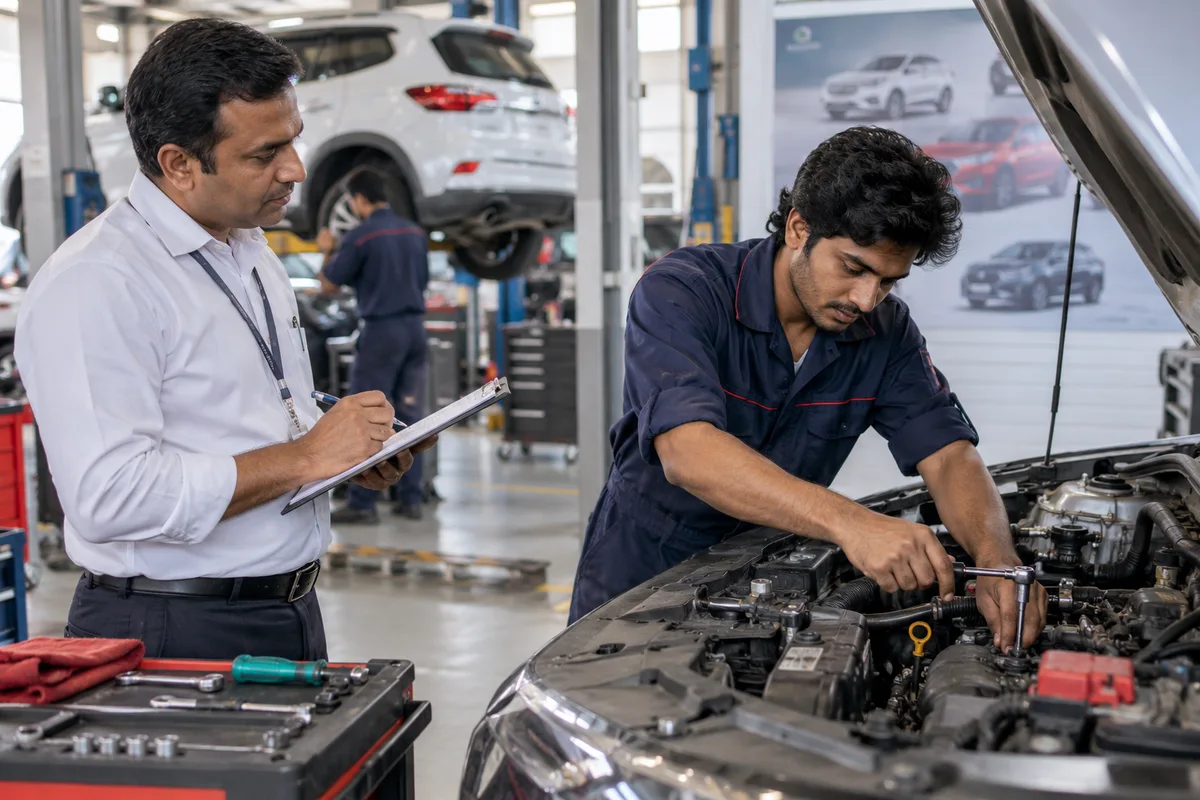
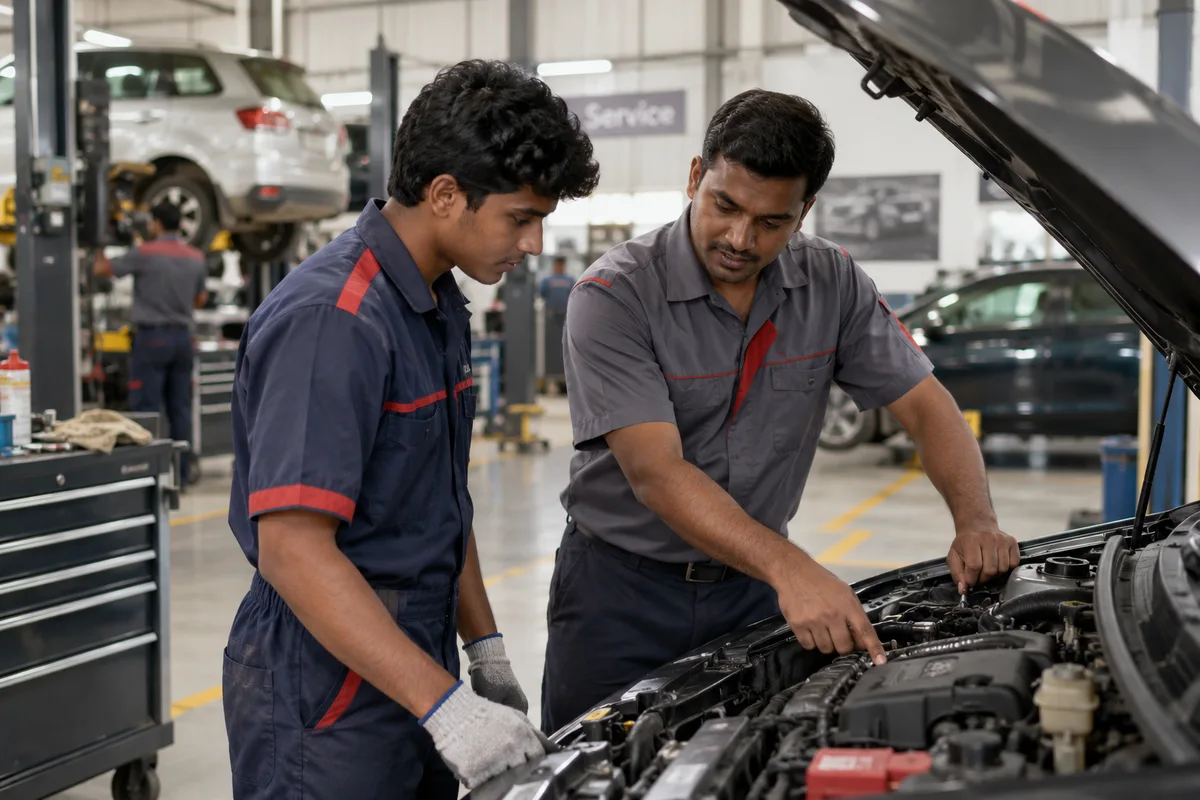
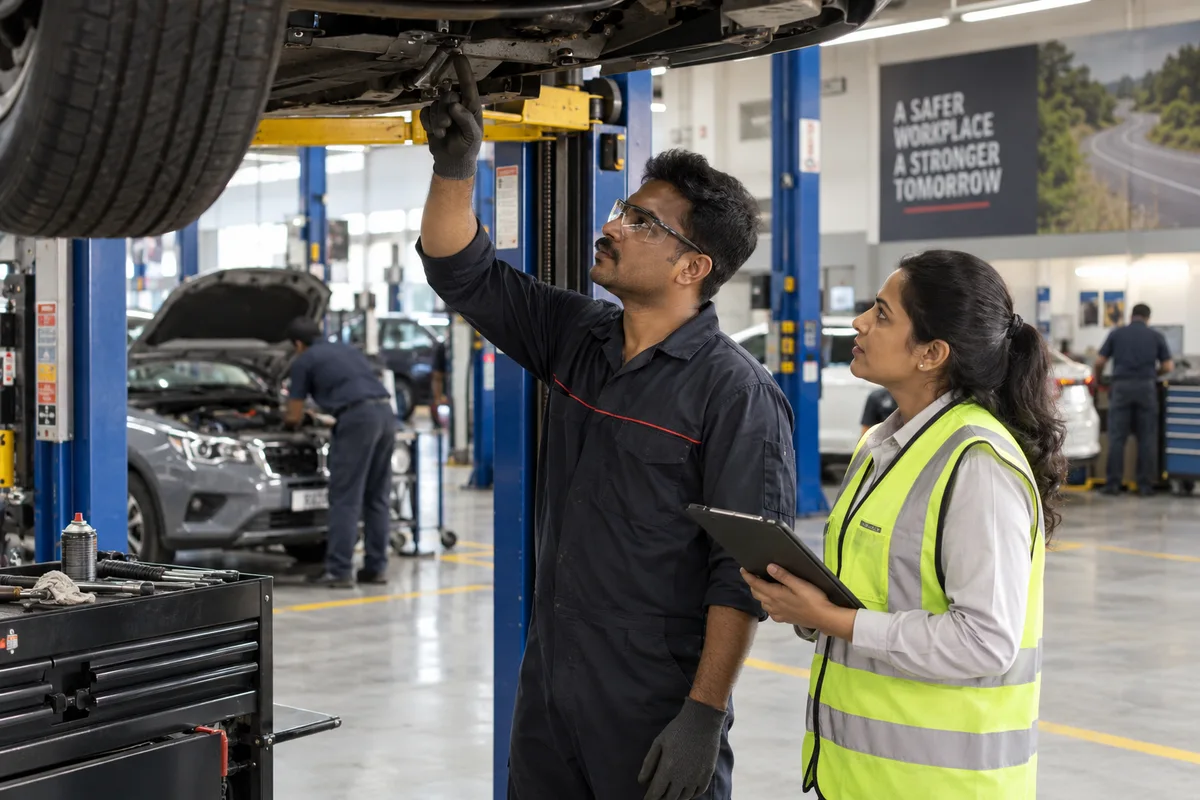
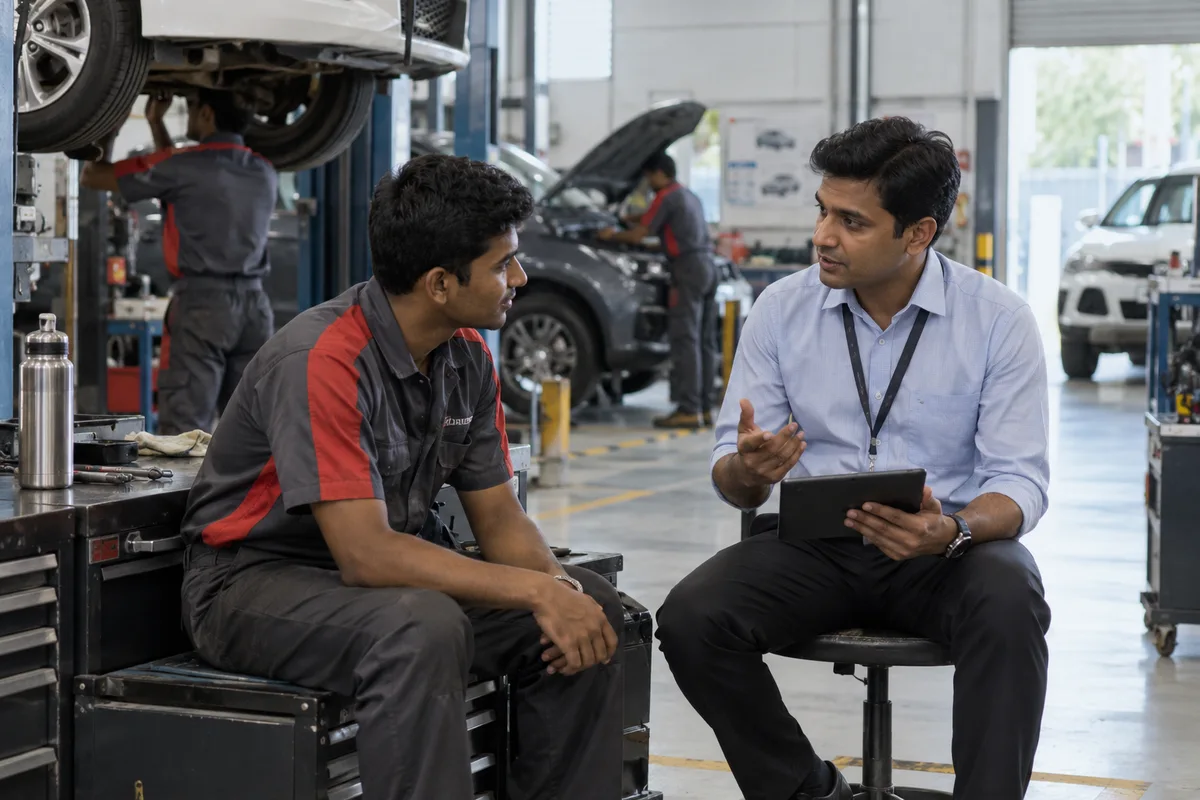
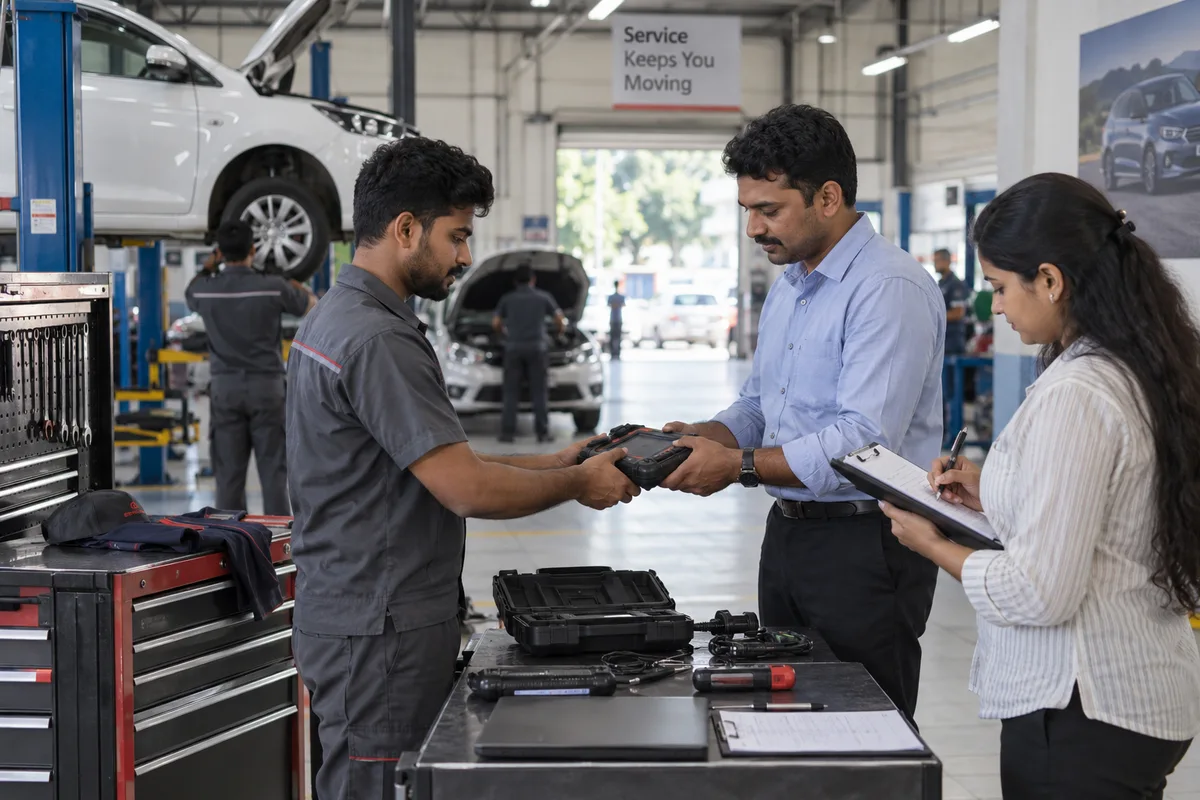
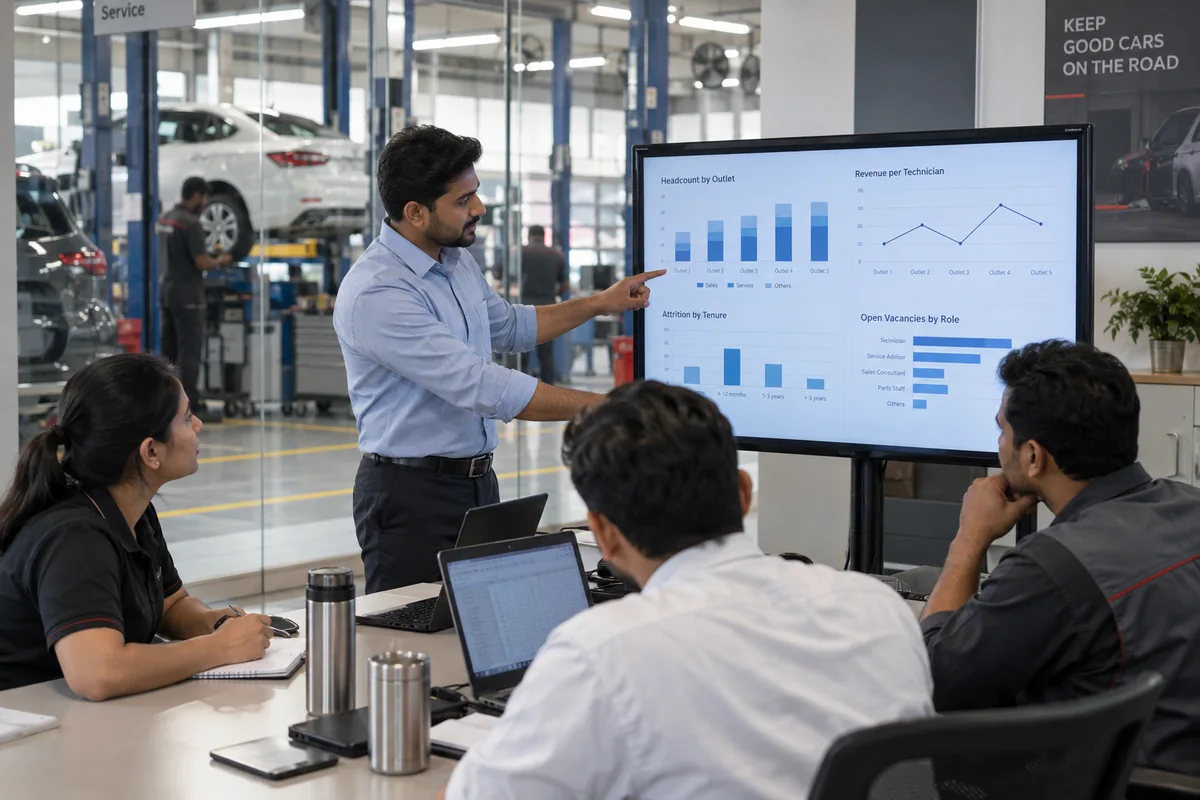
HR for automotive plants, dealerships and workshops
Set clear roles, skill levels, incentives and reviews for production, sales and workshop teams. Plan technician cover and build a path for helpers to learn.
Make this work for your business. Share your team size, priorities and what you need help with. We’ll use your brief to prepare for the first conversation.
Automotive businesses run showrooms, workshops, parts operations and sometimes plants, each with its own rhythm. Sales consultants, service advisors, technicians, parts staff and support teams are measured on entirely different things.
Plan→
Hire→
Onboard→
Manage→
Develop→
Perform→
Engage→
Retain→
Exit→
Improve
When HR processes are weak, you may see
Technician shortage and poaching
Service advisor turnover
Sales incentive disputes
Workshop productivity not measured
Skill certification lapses
Multi-outlet inconsistency
Attendance across showroom and workshop
Warranty and process training gaps
We help automotive businesses build hiring, skill-certification and productivity processes across every outlet.
Why GullyHR for automotive
Service advisors and technicians measured on what they actually control.
For dealership and workshop owners whose sales consultants, service advisors, technicians and parts staff are judged on different things. What changes is that each role gets its own clear measures, records and incentive rules.
01
Technician productivity you can actually read
We set up a job-card based routine that shows hours booked against hours worked per technician, giving workshop managers a fair view before incentive or poaching conversations begin.
02
Incentive rules written before the month starts
Sales consultants and advisors receive a plain incentive sheet with eligibility, timing and dispute steps, so arguments over deals closed on the last day stop recurring.
03
Skill certificates tracked per technician
A register of manufacturer training, certification dates and renewals sits beside each technician's record, so a lapse is seen months ahead rather than at an audit.
04
Same standards across every outlet
One induction pack, one attendance routine and one set of service-advisor scripts are rolled out to each showroom and workshop, replacing the habits each branch invented for itself.
Our services for automotive
Start with any one of these. Scope and fee are agreed in writing after a free first conversation.
HR audit
The audit is read from job cards and showroom records. We would take technician job-card hours and compare booked hours with hours worked, review attendance across showroom and workshop, test how sales and service incentives are calculated, and check the certificate record that decides who may work on which vehicle or warranty claim. Each outlet gets its own list of findings, with the workshop first, because that is where cost and customer risk sit.
What you receive
Technician hours review comparing job-card bookings with hours worked, by outlet
Certification register check showing who may work on which vehicle or warranty claim
Outlet-by-outlet findings list ranked with the workshop first
An example, not a client storySuppose an owner sees workshop bills rising but cannot tell whether technicians are slow or jobs are under-booked. An audit compares job cards with hours on site, shows where the gap sits and says whether it is a booking habit, a training gap or a pay structure issue.
Process design here focuses on the areas where outlets drift apart. Technician onboarding is written step by step, from tools issued to first supervised job. Service advisers get a routine for handling a customer complaint, with who to inform and when. The incentive process states eligibility, timing and dispute steps before the month begins. Each is written once and used at every showroom and workshop in the group, replacing habits invented outlet by outlet.
What you receive
Technician onboarding checklist from tools issued to the first supervised job
Customer complaint handling routine for service advisers, with escalation points
Incentive process sheet setting eligibility, payment timing and dispute steps for each role
An example, not a client storyPicture outlets in the same group handling a warranty complaint in different ways, one fixing it on the spot and another sending the customer away. A single complaint routine gives advisers the same first steps and the same escalation point at every outlet.
Weekly management keeps the owner informed without a daily call. We would review attendance by outlet, open technician and advisor vacancies, incentive disputes and certificate expiry dates, and discuss any workshop where productivity looks out of line with job-card records. Each outlet manager hears the same short summary at the start of the week. Poaching risk is watched through resignations and rival offers, and retention conversations are held before a technician leaves.
What you receive
Weekly outlet summary sent on the same day to every outlet manager
Certificate expiry calendar for technicians, reviewed each week with workshop managers
Open incentive dispute list with owner, status and the rule applied
An example, not a client storySay a workshop's productivity slips for several weeks while the manager says the team is busy. A weekly review of job cards beside attendance shows whether jobs are being booked or time is lost between tasks. A conversation follows with facts on the table.
Qualified technicians, service advisors and workshop supervisors are hard to find and easy to lose to a rival garage. We write each role with the vehicles, tools and warranty work involved, and test technicians with a practical task on a real fault. Advisors are scored on a customer scenario. Every interview uses one scorecard across outlets, so candidates are compared the same way. These are permanent roles; we do not supply contract technicians.
What you receive
Role write-ups naming the vehicles, tools and warranty work for each workshop post
Practical test for technicians on a real fault, scored the same way at every outlet
Common interview scorecard for advisors and supervisors, used across the whole group
An example, not a client storyTake a workshop supervisor vacancy where the strongest technician is promoted by default and struggles to allocate jobs. A scorecard that tests job allocation and coaching, as well as technical skill, shows who is ready to supervise. The business promotes on the evidence.
Training is job-specific. Service advisors learn to explain an estimate in plain words, handle a customer who disagrees and complete warranty paperwork correctly. Workshop supervisors learn job allocation and coaching a technician who is stuck. Sales consultants learn documentation discipline and an honest handover to the service department, so a buyer meets the workshop with the right expectations. Technicians keep manufacturer training dates in view through a simple schedule kept by the workshop manager.
What you receive
Estimate explanation and complaint handling session for service advisors
Job allocation and coaching session for workshop supervisors
Sales-to-service handover routine with documentation checklist for sales consultants
An example, not a client storyPicture a sales consultant who promises a first service at a time the workshop cannot offer. Training gives a handover routine that checks workshop capacity first and passes accurate notes across. The buyer arrives to a workshop that already knows what was said.
Written rules cover the incentive plan, workshop attendance, handling of tools and vehicles, and conduct with customer vehicles. Software holds certificates, attendance and incentive records for each employee, with an alert before a certificate lapses, so the training that technicians must keep is renewed on time. The rules apply the same way at every outlet. The owner's own adviser confirms any clause that touches employment law before it is issued.
What you receive
Incentive plan document with eligibility, timing and dispute steps in plain words
Tool and customer vehicle handling policy for workshop staff, with a sign-off sheet
Certificate and attendance records in HR software with expiry alerts for technicians
An example, not a client storySuppose a technician's manufacturer certificate lapses unnoticed and a warranty claim is rejected. A record with an expiry alert would have raised the renewal months earlier. The policy states who owns the renewal, the software reminds them, and the workshop manager sees the list each week.
Adapted to dealership count, workshop capacity, brand standards and whether manufacturing is in scope.
Automobile Manufacturers
Auto Component Companies
Car Dealerships
Two-Wheeler Dealerships
Commercial Vehicle Dealers
Automobile Service Centres
Garages
Vehicle Rental Companies
Fleet Management Companies
Roles we help you hire in automotive
GullyHR runs talent acquisition for permanent roles in automotive. For each role we agree the job description with you, find and screen candidates against it, and support the offer through to joining. Tell us the role and the number of people, and we start there.
An exit means something different in each part of an automotive business, and a single process written for the plant will not hold at a dealership.
Plant and production
Shift backfill before release
Skill matrix gap identified
Tool and locker return
Safety training record closed
Dealership and sales
Customer enquiries and follow-ups handed over
Pending bookings and deliveries transferred
Incentive and commission settled
Demo vehicle and fuel card returned
Workshop and service
Open job cards reassigned
Customer vehicles accounted for
Special tools returned
Technician certification record closed
We build one exit process with three variants, so the plant is not made to run a dealership's checklist and the workshop does not release a technician with vehicles still on the ramp.
Engagement Across Four Workforces
A plant operator and a showroom executive do not want the same things.
Automotive businesses run very different populations under one brand, and a single engagement programme designed in head office lands with one of them and misses the rest.
Plant and workshop
Shift-level recognition and team boards
Skill progression visible and rewarded
Canteen, transport and rest facilities
Safety participation as engagement, not compliance
Dealership and sales
Incentive clarity - the top engagement issue in sales
Target fairness across locations
Career route beyond sales into management
Customer feedback shared with the person named in it
We measure engagement separately by population rather than reporting one company figure, because the combined number consistently hides whichever group is struggling.
Segment the workforce→
Ask separately→
Act locally→
Report by group
Career Routes Across the Group
Movement between plant, dealership and workshop as a retention lever.
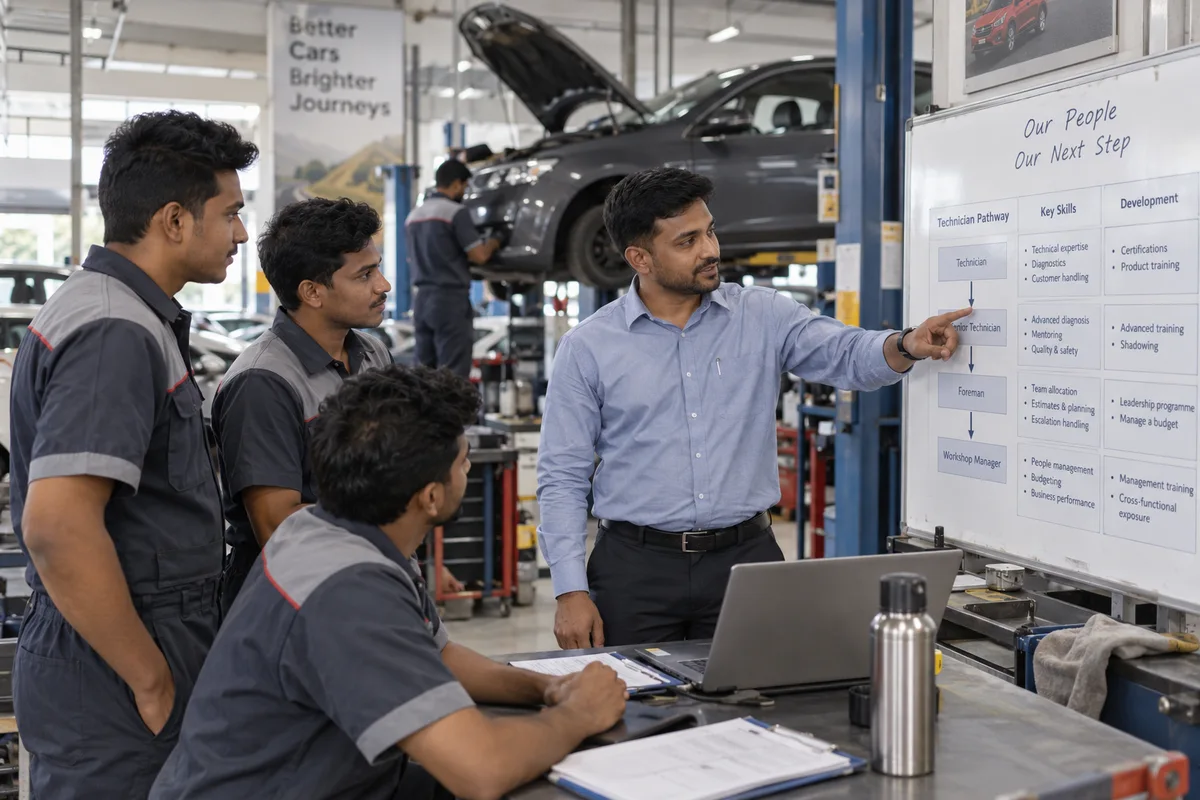
Automotive groups hold several career ladders that rarely connect. A service advisor with ten years of customer knowledge has no visible route into anything else, so they move to a competitor instead.
Within function
Technician to senior technician to workshop supervisor
Sales executive to team lead to showroom manager
Operator to line lead to production supervisor
Across function
Workshop to service management
Sales to customer experience or training
Plant quality to dealership technical support
We map cross-function moves explicitly and identify successors for every dealership principal, workshop manager and shift in-charge - the roles where an unplanned exit costs most.
One System Across Plant, Dealership and Workshop
Four workforces that each need something different.
Automotive groups commonly run separate systems per location and reconcile by spreadsheet at head office, which is where the consolidated headcount stops being trustworthy.
What must be common
Employee master and reporting structure
Payroll input assembly
Policy and document centre
Group-level reporting
What must differ
Plant shift and skill capture
Dealership incentive and target data
Workshop job-card linked productivity
Sales roster and showroom coverage
We define the common layer first and let each location's operational capture sit on top, rather than forcing one configuration on four very different operations.
Induction Across Four Workforces
A technician, an operator and a sales executive need different first weeks.
A single group induction deck does not serve an automotive business. What a plant operator must know on day one has almost nothing in common with what a showroom executive must know.
Plant and workshop
Safety induction before floor access
Machine or bay familiarisation and authorisation
Tool and PPE issue
Quality and process standards
Dealership and sales
Product and model training
Customer process and CRM access
Incentive structure explained in full
Showroom and test-drive protocols
Explaining the incentive structure completely on day one is the highest-value induction item in any dealership, because misunderstanding it is the leading cause of first-quarter sales exits.
Common induction→
Function-specific induction→
Probation objectives set→
Review at the stated date
Relations Across Plant and Dealership
Two very different relations environments in one group.
An automotive group commonly holds an organised industrial relations environment at the plant and an entirely individual one at dealerships, and the two require different competence.
Plant
Structured grievance and disciplinary process
Consistency across shifts and lines
Union or works committee engagement where present
Supervisor capability in handling issues early
Dealership and workshop
Individual grievance handling
Incentive and target disputes
Customer complaint handling that involves staff conduct
Consistency across locations
Consistency across locations is the recurring failure. The same conduct handled differently at two dealerships creates a precedent problem that surfaces at the worst moment.
An automotive group carries plant hazards - presses, robots, material handling - and workshop hazards, which are different and frequently less well managed because a workshop feels ordinary.
Plant
Machine guarding and lockout procedures
Material handling and forklift safety
Noise, fume and ergonomic exposure
Shift-level safety accountability
Workshop and service
Lifting equipment and ramp safety
Chemical, paint and solvent handling
Electrical and EV-specific hazards
Test drive and road safety
Electric vehicle work introduces hazards that traditional workshop training does not cover, and the training record needs to reflect who is authorised on what.
HR Operations Across a Group
One function serving plant, dealerships and workshops.
Automotive groups commonly run HR administration separately at each location, which means the group cannot answer basic questions about itself without a week of collection.
Single employee master across all locations
Common payroll input calendar with location-level owners
Policy ownership held centrally, applied locally
Service levels defined for joiners, exits and queries
Location HR accountable to a defined standard
Consolidated headcount and cost reporting without manual assembly
Statutory calendar maintained per establishment
Internal audit of HR records on a stated cycle
A common payroll input calendar with named location owners is the change that most reduces month-end effort, because the cost is currently paid in chasing rather than in processing.
An automotive group operates a plant, dealerships and workshops that may sit under different establishment types, in different states, with different applicable requirements.
Single policy framework with location-specific annexures
Establishment-wise register of applicable obligations
Named owner per obligation, with a dated calendar
Conduct, conflict of interest and gift policy across dealerships
Workshop and plant safety policies maintained distinctly
Data handling policy covering customer information
Version control so all locations use the current policy
Acknowledgement records maintained per employee
A register of what applies to each establishment is the foundation. Groups that maintain one policy set without it routinely discover a gap at a location nobody was tracking.
Reporting Across a Group
Numbers that reconcile between plant and dealership.
Automotive groups struggle to answer basic questions about themselves because each location reports separately and nothing reconciles without a week of collection.
Consolidated headcount by location, function and employment type
Attrition by dealership, workshop and plant, compared
Cost per head by location and function
Sales staff productivity alongside attrition, viewed together
Workshop technician utilisation and skill coverage
Plant absenteeism and overtime by shift
Recruitment cost and time to fill by location
Group dashboard produced without manual assembly
Viewing sales attrition alongside productivity is the comparison that changes decisions, because high-performing dealerships with high attrition are a different problem from low-performing ones.
Automotive workforce planning is driven by product and volume cycles. A model launch, a capacity change or a new dealership each move headcount in different parts of the group at different times.
Plant headcount against production volume and shift pattern
Dealership staffing against sales targets and footfall
Workshop capacity against service load and bay count
Skill requirements ahead of technology change, including EV
Contract and permanent mix decided deliberately per location
Lead times for technical and specialist roles
Succession for dealership and plant leadership
Cost of the workforce plan against the business plan
Planning EV skill requirements ahead of the vehicles arriving is the one most groups defer, and the training lead time is longer than the product timeline allows.
Automotive HR maturity assessment
Each area is scored on the same five-level scale, so management can see where HR stands today and what to improve first.
Processes exist but depend heavily on individual employees.
3
Documented
Processes and responsibilities are written down.
4
Implemented and measured
Processes are followed and performance is measured.
5
Automated and continuously improved
Technology-enabled, measured and improved deliberately.
Training and performance review, role by role
For each role that matters in automotive: what a new joiner, an independent worker and a senior should be able to do, how to train them at each stage, and how to review them.
Tell us your industry, team size and the issue you want to address. Bring one example of where work gets delayed or ownership is unclear, and the deadline or decision you are working towards.