










Industries
Why automotive employees leave and how to understand why
Technicians, service advisors and sales consultants leave for different reasons. How to ask what shaped their decision and act on it across every outlet.
8 min readRead articleCoil springs, leaf springs, stabiliser bars and control arms must survive years of load cycles. The people who coil, quench, weld and press them decide whether a batch passes the fatigue rig.

Not sure what you need? Tell us about your business in six short steps and we will come to the first meeting prepared.
Share your requirementsA suspension plant makes coil and leaf springs, stabiliser bars, control arms, shock absorber tubes and rods, bushes and links. Bar or sheet is cut, heated, coiled or pressed, quenched, tempered, shot blasted, welded, painted and assembled. Spring shops run hot forming and oil quench lines; arm and link shops run presses and weld cells. Parts are heavy and sharp, and crews carry them all shift. Vehicle makers pull samples for fatigue and load tests, so a poor weld or a missed temper shows up late and costly. Coilers and welders are scarce, and a trained hot-line hand can be lured to a rival spring shop. See also HR for automotive businesses.
These are the places the people side of this kind of business tends to give way. The rest of this page works through them.
HR here has to work for each of these groups, not only the office. The set-up below is written with all of them in mind.
GullyHR runs talent acquisition for permanent roles in suspension component makers. For each role we agree the job description with you, find and screen candidates against it, and support the offer through to joining. Tell us the role and the number of people, and we start there.
We recruit permanent employees. We do not supply contract or temporary staff.
Every business interviews, but few have a written process that works the same way for every role and every interviewer. GullyHR designs yours, from the role brief to the offer, trains your managers to run it, and can run it for you on the roles you hand us.
We agree what the role must deliver, the must-have and nice-to-have skills, and how each will be scored.
Screening call, assessment, interview rounds and decision points, sized to the role and the number of people you hire.
Structured questions for each role family and a rating guide, so two interviewers judge the same answer the same way.
A short briefing for your managers on what to ask, what to avoid and how to give a clear yes or no.
Who approves, how the offer is made, and how candidates are kept informed from first call to joining.
Sound welds on thick control arms rest with a handful of welders. When one is off, the cell slows, and nobody else can be moved in.
Standing near furnaces and oil quench tanks, lifting hot coils, drives new hires out within weeks. Trained hands leave before they become useful.
Leaf packs and arms bite hands and strain backs. Gloves, hooks and lifting aids exist but are used unevenly from bay to bay.
A senior quench operator reads colour, smoke and tank temperature and knows when a batch is wrong. None of it is written anywhere.
Pay per piece speeds the press, yet die cleaning and first-piece checks get skipped. The rejects surface later at the weld cell or the rig.
A trainee needs weeks of bead practice on test plates, but pressure on the line pushes them onto production arms before they are ready.
Start with the topics that matter most here: Compensation, Payroll and Benefits; Health, Safety and Wellbeing; Learning and Development. Then work through the rest. Each topic is written for automotive, not in general.
Salary structure, payroll inputs and a month that closes on time.
Induction, records, incident reporting and follow-through.
Training planned from need rather than from the calendar.
How many people, in which roles, by when, and what they will cost.
Structure, reporting lines and who is allowed to decide what.
Requisition to joining, the same way every time.
A first day that is the same for the fifth joiner as the first.
Records, attendance, leave and the day-to-day HR that must simply work.
Goals, reviews and ratings that hold up in a conversation.
Named backups for the roles that cannot be vacant.
Communication, recognition and the conditions people actually work in.
Two routes, one for complaints, one for conduct, kept separate.
Policies a manager can apply, and obligations with owners and dates.
Who leaves, when, why, and which of them mattered.
Resignation to relieving letter, in a defined order.
Records that survive people, and approvals that do not queue.
A short monthly pack management actually reads.
An HR function that runs the same way every month.
The pieces a suspension component makers business puts in place, in an order that makes each easier. Open any card for the detail.
Set a test plate for each grade, judged by a senior welder, with a pay step for passing.
Set a test plate for each grade, judged by a senior welder, with a pay step for passing. Skill then shows on the pay slip. See compensation benchmarking.
Keep the per-piece rate, but count only pieces that clear first-piece and in-line checks, and make die cleaning part of the shift routine.
Keep the per-piece rate, but count only pieces that clear first-piece and in-line checks, and make die cleaning part of the shift routine. The performance management work covers the design.
Sit beside the senior quench and furnace operators, note what they see and hear and what they change, and turn the notes into a training card for each line.
Sit beside the senior quench and furnace operators, note what they see and hear and what they change, and turn the notes into a training card for each line.
Hooks, tongs, gloves, guards and rotation for the heaviest leaf packs, checked before each shift starts.
Hooks, tongs, gloves, guards and rotation for the heaviest leaf packs, checked before each shift starts. See health, safety and wellbeing.
A bay away from production with set joint exercises on scrap arms.
A bay away from production with set joint exercises on scrap arms. A senior welder reviews each piece before the trainee is allowed near a live part.
Before changing anything, find out what is true today. Work through the checks using a recent operating period. The time needed depends on the records you hold; note missing evidence and use the findings to choose a priority.
Share your requirementsConfirm with a qualified professional. What applies to you depends on your business, your state and your arrangements, and it changes. This page describes practice. It does not state a legal position.
The services below fit this kind of business best. Each starts by recording where you stand, and every later report compares against that. We do not promise outcomes.
Welder and furnace-crew grades with pay steps, so skilled hands stay rather than drift to a rival spring shop.
Piece-rate for press and weld crews that pays on parts passing line checks, not just parts counted.
Hot-part handling, guarding and lifting routines for heavy springs and arms.
A trainee path with a practice bay for new welders and coiling operators.
Start with a free conversation, or see the paid HR Diagnostic.
Understand the business, its workforce, current processes and HR challenges.
Find the missing, weak, inconsistent or person-dependent processes.
Create the structure, processes, policies, SOPs, dashboards and systems needed.
Help HR and department managers actually adopt the new system.
Digitise repetitive and approval-based workflows where it is worth doing.
Track hiring, attendance, employee cost, performance, training and attrition.
Strengthen the people-management system continuously, not once.
From the GullyHR blog: one on HR in automotive, and one on each of the topics this page points to.
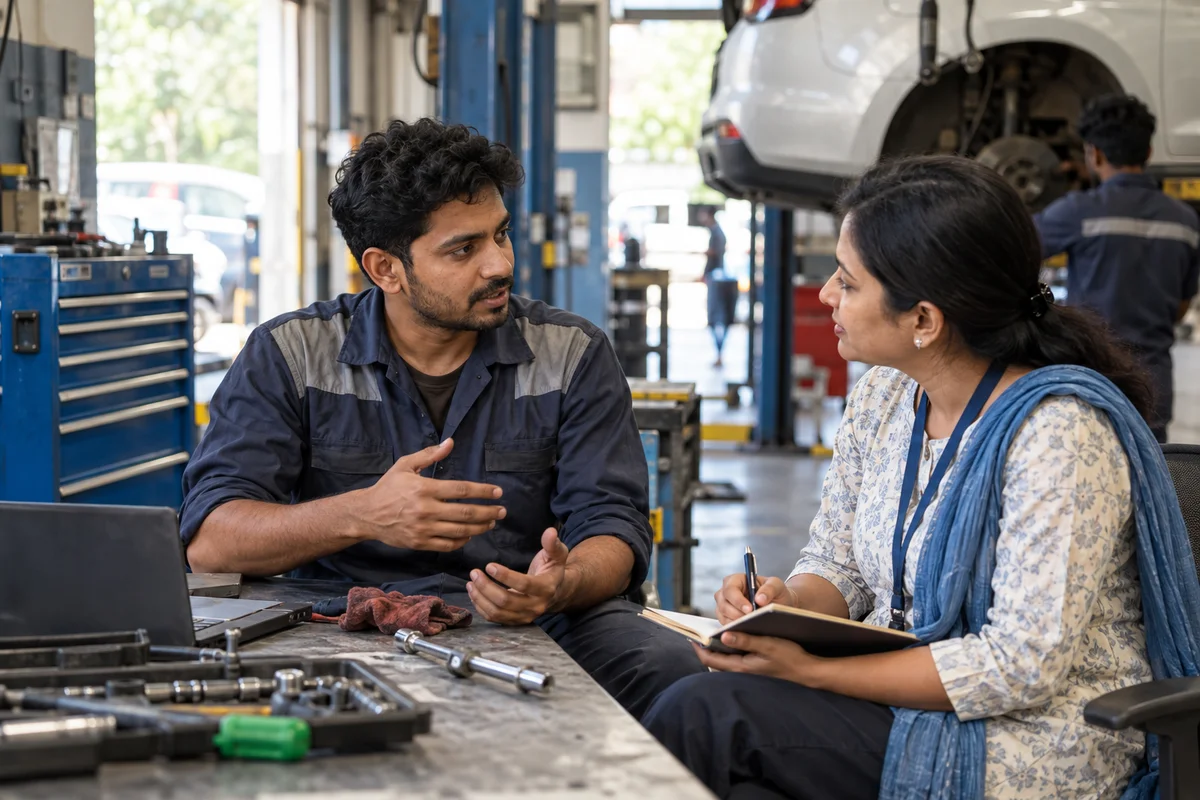
Technicians, service advisors and sales consultants leave for different reasons. How to ask what shaped their decision and act on it across every outlet.
8 min readRead article
Simple variable pay structures for product and engineering teams: four options, why individual metrics backfire, a build plan and a one page outline to adapt.
6 min readRead article
A shift, weekly and monthly safety routine for rubber plants that names who checks platen guards, mill trip bars, autoclave doors, burst-test cages and slings, and who acts on near misses.
7 min readRead article
A founder's guide to hiring freshers and running a first-year programme: campus or open drives, a screening round, a training plan by quarter, mentors and checkpoints.
6 min readRead articleMore on the GullyHR blog.
Set test plates matching your real joints, judged by a senior welder. Tie each grade to a pay step, so the effort of learning is visible in the wage.
Heat, weight and repetition hit newcomers hardest. Rotation, rest breaks, a route to cooler work and a proper first-week induction slow the exits.
It works when the passed-part count is what gets paid. Otherwise die cleaning and first-piece checks are skipped, and rejects appear later.
Sit with them during a few batches, write down what they watch and change, and build the training card from it while they are still on the floor.
It depends on the joint, so use stages reviewed by a senior welder instead of a fixed day count. Keep them off load-bearing arms until they clear the last stage.
We would list welders by what each can weld, ask your quench lead what they watch, and read injury and reject logs by crew. A welder grading scheme with test plates makes a sound opening task. Terms are put in writing after we talk.
All 8 business types in automotive components · Find another business type
Tell us your industry, team size and the issue you want to address. Bring one example of where work gets delayed or ownership is unclear, and the deadline or decision you are working towards.