



Industries
Why retail employees leave and how to understand why
Why store staff and managers leave retail jobs, and how to ask about rosters, weekends, targets and incentives in an exit conversation that leads to action.
7 min readRead articleA flower shop works on stock that dies in days. Staff buy at the market before dawn, arrange by hand and deliver to events, so the rota, the skill of the florist and the speed of the team decide the day.

Not sure what you need? Tell us about your business in six short steps and we will come to the first meeting prepared.
Share your requirementsA flower shop may be a street-corner stall, a retail florist with a cold room or a larger shop that decorates weddings and events. The team includes florists who arrange and design, helpers who clean, cut and condition stems, a market buyer who goes at dawn, delivery riders and a counter person who takes orders and bills. Fresh flowers lose value each day, so buying, arranging and delivery follow a tight clock. Valentine's week, Mother's Day, festivals and the wedding season bring surges that need late nights and extra hands. A sister counter handles garlands and temple orders as well. The wider retail hub and the specialty retail group cover what shops share.
These are the places the people side of this kind of business tends to give way. The rest of this page works through them.
HR here has to work for each of these groups, not only the office. The set-up below is written with all of them in mind.
GullyHR runs talent acquisition for permanent roles in flower shops. For each role we agree the job description with you, find and screen candidates against it, and support the offer through to joining. Tell us the role and the number of people, and we start there.
We recruit permanent employees. We do not supply contract or temporary staff.
Every business interviews, but few have a written process that works the same way for every role and every interviewer. GullyHR designs yours, from the role brief to the offer, trains your managers to run it, and can run it for you on the roles you hand us.
We agree what the role must deliver, the must-have and nice-to-have skills, and how each will be scored.
Screening call, assessment, interview rounds and decision points, sized to the role and the number of people you hire.
Structured questions for each role family and a rating guide, so two interviewers judge the same answer the same way.
A short briefing for your managers on what to ask, what to avoid and how to give a clear yes or no.
Who approves, how the offer is made, and how candidates are kept informed from first call to joining.
Market runs and stem preparation begin in the small hours, and staff who travel far struggle to be on time without being exhausted by noon.
If the buyer or a helper is late, flowers wilt or the order misses its time, and the loss is immediate.
The best arrangers have a style customers ask for by name, and when they leave, clients may follow.
Decor teams work overnight at venues, then return for the morning rush, and rest and travel arrangements are patchy.
A late or careless delivery spoils an occasion, and riders are paid per trip without much structure for waiting time.
Cold storage, cutting tools, water and slippery floors cause small injuries, and helpers rarely get a safe-handling briefing.
A new helper picks up arrangement skill from whoever is nearby, with no steps and no way to show progress.
Start with the topics that matter most here: Health, Safety and Wellbeing; Learning and Development; Retention and Attrition Management. Then work through the rest. Each topic is written for retail, not in general.
Induction, records, incident reporting and follow-through.
Training planned from need rather than from the calendar.
Who leaves, when, why, and which of them mattered.
How many people, in which roles, by when, and what they will cost.
Structure, reporting lines and who is allowed to decide what.
Requisition to joining, the same way every time.
A first day that is the same for the fifth joiner as the first.
Records, attendance, leave and the day-to-day HR that must simply work.
Salary structure, payroll inputs and a month that closes on time.
Goals, reviews and ratings that hold up in a conversation.
Named backups for the roles that cannot be vacant.
Communication, recognition and the conditions people actually work in.
Two routes, one for complaints, one for conduct, kept separate.
Policies a manager can apply, and obligations with owners and dates.
Resignation to relieving letter, in a defined order.
Records that survive people, and approvals that do not queue.
A short monthly pack management actually reads.
An HR function that runs the same way every month.
The pieces a flower shops business puts in place, in an order that makes each easier. Open any card for the detail.
Start times by task, a limit on consecutive early days and a rotation for market runs.
Start times by task, a limit on consecutive early days and a rotation for market runs. See attendance, shift and leave.
The buyer, florist and counter share one sheet of orders, delivery times and stock so nothing is left to memory.
The buyer, florist and counter share one sheet of orders, delivery times and stock so nothing is left to memory.
Steps from helper to junior arranger to lead florist with sample arrangements for each rung, and pay tied to them.
Steps from helper to junior arranger to lead florist with sample arrangements for each rung, and pay tied to them.
Named teams, travel, meals and rest after night work, agreed before the event.
Named teams, travel, meals and rest after night work, agreed before the event. Safety and wellbeing supports it.
Delivery windows, waiting time, handling of fragile orders and fair pay for peak days, written once.
Delivery windows, waiting time, handling of fragile orders and fair pay for peak days, written once.
How to use knives, store stems in the cold room and move safely on wet floors, shown once and repeated each season.
How to use knives, store stems in the cold room and move safely on wet floors, shown once and repeated each season.
Before changing anything, find out what is true today. Work through the checks using a recent operating period. The time needed depends on the records you hold; note missing evidence and use the findings to choose a priority.
Share your requirementsConfirm with a qualified professional. What applies to you depends on your business, your state and your arrangements, and it changes. This page describes practice. It does not state a legal position.
The services below fit this kind of business best. Each starts by recording where you stand, and every later report compares against that. We do not promise outcomes.
Early-start rosters, event nights and fair leave planned around peaks.
Safe handling, cold-room routine and rest after night work for florists and helpers.
A skill ladder from stem preparation to lead arrangement.
Why florists and riders leave and what the shop can do about it.
Start with a free conversation, or see the paid HR Diagnostic.
Understand the business, its workforce, current processes and HR challenges.
Find the missing, weak, inconsistent or person-dependent processes.
Create the structure, processes, policies, SOPs, dashboards and systems needed.
Help HR and department managers actually adopt the new system.
Digitise repetitive and approval-based workflows where it is worth doing.
Track hiring, attendance, employee cost, performance, training and attrition.
Strengthen the people-management system continuously, not once.
From the GullyHR blog: one on HR in retail, and one on each of the topics this page points to.
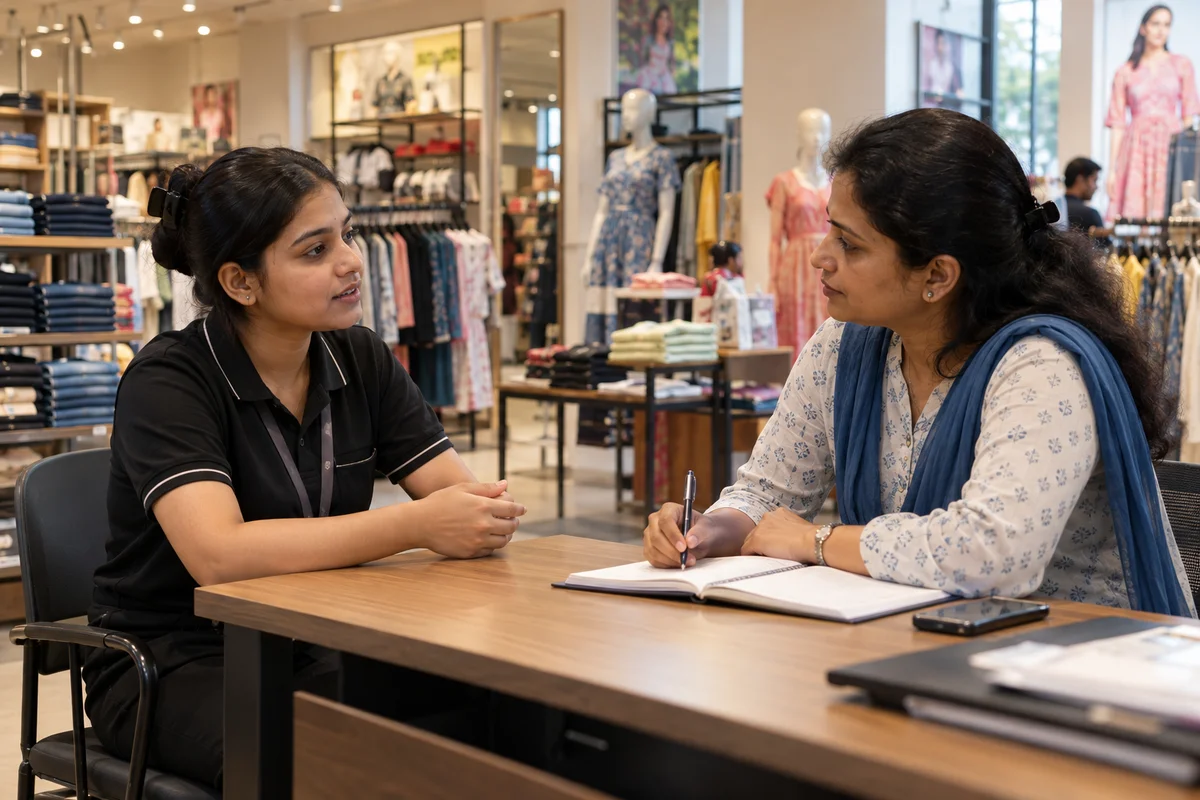
Why store staff and managers leave retail jobs, and how to ask about rosters, weekends, targets and incentives in an exit conversation that leads to action.
7 min readRead article
A shift, weekly and monthly safety routine for rubber plants that names who checks platen guards, mill trip bars, autoclave doors, burst-test cages and slings, and who acts on near misses.
7 min readRead article
A founder's guide to hiring freshers and running a first-year programme: campus or open drives, a screening round, a training plan by quarter, mentors and checkpoints.
6 min readRead article
What really keeps mobile app and web developers in a small firm: stay conversations, growth paths, fair release rules and a risk sheet an owner can use this month.
6 min readRead articleMore on the GullyHR blog.
Rotate the market run, give a clear finish time and a proper break, and avoid long chains of early days. Help with travel for those who live far if you can.
Document your styles with photographs, train a second arranger on the popular designs and share customer relationships across the team. Recognise the lead florist for teaching, not only for arranging.
Plan the next day's roster before the event so crew members have a real rest, a safe way home and a late start. Say the rule in advance, so it is not argued after the fact.
Use a clear rate for trips and waiting, agree peak-day rules in advance and pay on a fixed day. Riders accept busy days when pay is predictable and the route list is sensible.
Start with stem care and cleaning, then simple bunches, then supervised arrangements. Use sample photographs for each step and have the lead florist sign off each rung.
We would ask your lead florist what a helper must learn, map the working day from the market run to the last delivery and look at how wedding nights are staffed. A rota and a florist ladder are a natural first job, with scope written for your sign-off.
All 9 business types in specialty retail · Find another business type
See all HR topics for retail, or another industry.
Tell us your industry, team size and the issue you want to address. Bring one example of where work gets delayed or ownership is unclear, and the deadline or decision you are working towards.