

Industries
Why hospitality employees leave and how to understand why
Hotel, restaurant and banquet staff leave for reasons that vary by department and season. How to ask what sits behind the first answer and act on it.
7 min readRead articleA hotel or guest house runs all day and night and moves with occupancy. This page looks at departments, shifts and staff housing, so guests meet a settled, trained team.
Make this work for your business. Share your team size, priorities and what you need help with. We’ll use your brief to prepare for the first conversation.
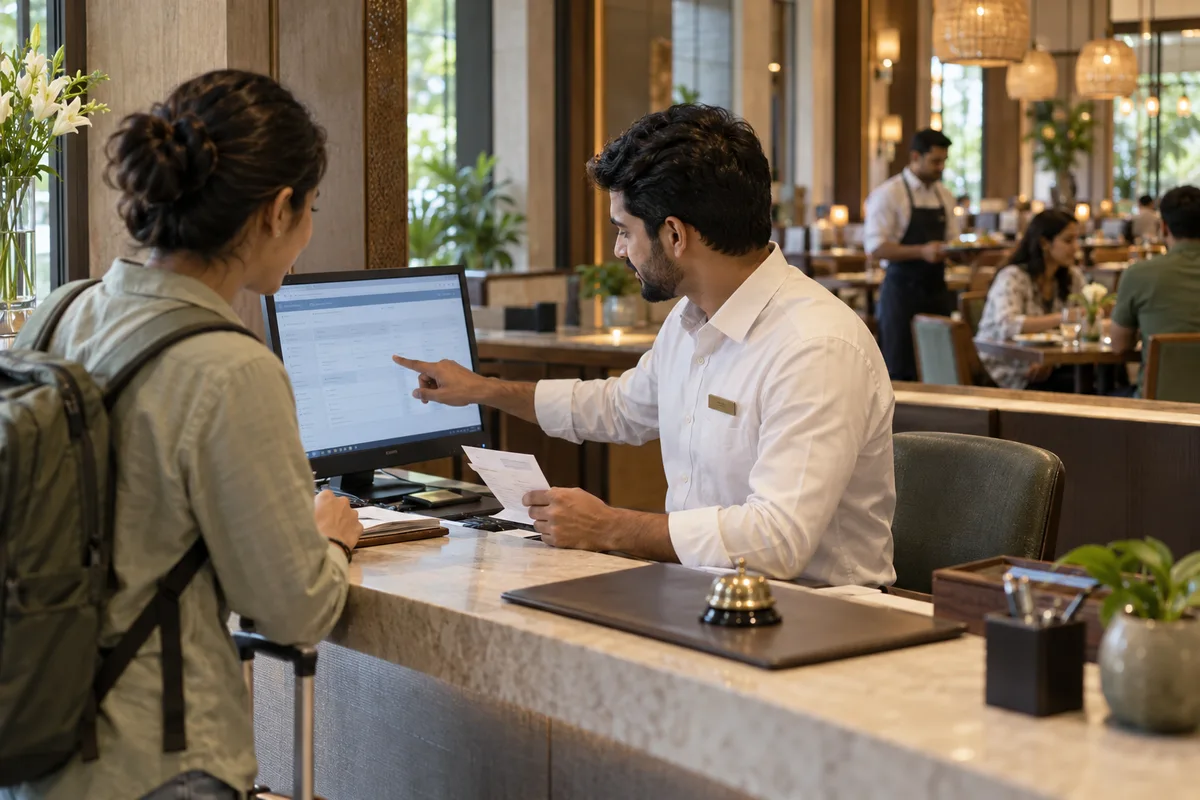
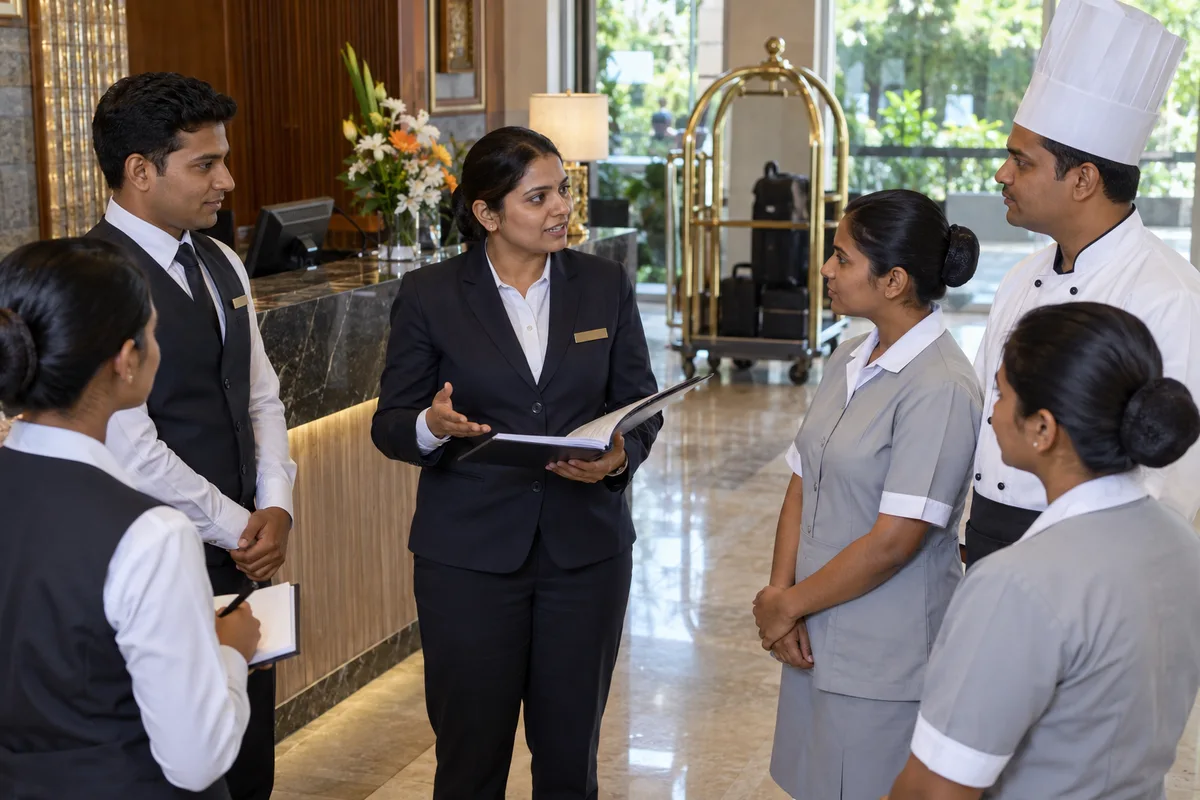
Share your requirementsA hotel or guest house sells rooms, meals and service around the clock. The front desk checks guests in and out and takes reservations, housekeeping turns rooms and public areas, the kitchen and restaurant serve food, and maintenance, security and a night team keep the building running. A small guest house folds several of these jobs into a handful of people, while a larger hotel has departments with heads, supervisors and trainees. Guests judge the stay by who they meet, and a late room turnover or an unanswered bell shows at once. Occupancy swings with holidays, weddings, conferences and the tourist season, so the people needed can double and then drop. Some staff come from other towns and live on site or in rented rooms nearby. Related reading: hospitality HR. The team lives with the business, and that shapes everything. Rotas cover nights, split shifts and weekly rest days, a bed is part of the job, and a visible path from trainee to supervisor decides who stays and who joins the hotel down the road.
These are the places the people side of this kind of business tends to give way. The rest of this page works through them.
Why GullyHR for hotels and guest houses
For owners of hotels and guest houses who want front desk, housekeeping and kitchen teams that stay through the season. Staffing follows occupancy, rotas are fair and staff rooms have written terms.
A core team for the low season, a list of trained extra hands for festival and wedding weeks, and bookings tied to rotas, so peaks are covered and quiet weeks are not idle.
Night duty, split shifts and weekly offs spread evenly across front desk, housekeeping and kitchen, with swaps agreed through the supervisor, so the willing few stop carrying the load.
Who gets a bed, any charge, house rules, visitors and what happens on leaving, set down once, so custom stops deciding disputes.
Named steps and sign-offs from room attendant or commis to supervisor, so good people see a road at your property and not at the hotel down the road.
Start with any one of these. Scope and fee are agreed in writing after a free first conversation.
The audit begins with last year's weekly occupancy laid beside the number of people on duty, which shows at once where the team was idle and where it was stretched. We read each department's rota for who carried nights, split shifts and weekly offs. We look at what is written about staff rooms and what rests on custom. Then we sit with a new attendant, a new receptionist and a commis to hear how they were trained and by whom. The report names the gaps by department.
What you receive
An example, not a client storyTake a guest house that fills every room in wedding week and then has idle staff for a month. The owner wants to know why good cooks keep leaving. We lay occupancy beside the rota, find that two people carried every night shift, and show how an even spread and a core team would change that.
How the hr audit works →We start with the rota, because it is the thing staff notice first. Night duty, split shifts and rest days are written as rules, with a swap route through the supervisor. Then the staff room terms: eligibility, charge, house rules, visitors, safety and exit. Then a simple standard for each department, built with its head, covering check-in, room finish and table service. Complaint handling follows, so a fix at the desk also gets noted against the department. Each document is tried for one season before it is locked.
What you receive
An example, not a client storyPicture a hotel where the front desk, kitchen and housekeeping each run their own people by different standards. The owner wants one way of working that still respects each department. We write a short common policy, add a standard sheet for each team with its head, and test it through one festival week.
How the hr process design works →A fractional HR lead works with the general manager and duty managers. Before each peak the booking sheet is turned into a rota, with named extra hands drawn from the trained list. During the week, swaps and rest days are kept fair and night duty is rotated. Trainees and interns are checked against their sign-off sheets, and no one works alone before the head agrees. At month end, guest feedback is read by department, patterns are noted, and the next training topic is chosen from it. Staff room allocations are kept current.
What you receive
An example, not a client storySuppose a hotel has two cooks and a supervisor resign in the same month, each citing night duty. A fractional HR lead reads the rota, sees the uneven spread, redraws it with department heads and starts a monthly check so the load stays shared. The owner sees the change before the next busy week.
How the hr management works →We write each role so a candidate knows the shift pattern, the staff room terms and the route to supervisor before they apply. Cooks cook, receptionists handle a mock check-in and a difficult guest, attendants turn a room against a clock, and each is scored on a shared sheet. For seasonal peaks we build a bench of trained extra hands who return each year. We also plan the step from trainee or intern into a permanent post. All of this is for permanent roles. Contract staff are not supplied.
What you receive
An example, not a client storySay a guest house has lost its head cook to the property down the road, just before wedding season. We would rewrite the role to show the ladder and the staff room terms, set a practical cooking trial with a scored sheet, and decide fairly between the shortlisted cooks, with the owner at the final table.
How the recruitment for permanent roles works →Training follows the departments. Front desk staff practise check-in, a late arrival and an upset guest. Housekeeping learns the room finish sequence and a fair way to share a heavy turnover day. Kitchen and restaurant teams learn the table service and hygiene routine. Heads learn how to give feedback on a busy shift and how to record a complaint so a trend appears. Interns and new joiners follow a sign-off sheet and work with a named buddy before they work alone. A short refresher runs before each peak season.
What you receive
An example, not a client storyTake a room attendant who finishes early and is simply handed more rooms, so she slows down. A session for housekeeping supervisors on fair allocation and recognition, with a clear turnover standard, changes the habit. The attendant has a reason to work well and the supervisor has a way to reward it.
How the manager and team training works →The handbook is written around how a property runs. It covers who is eligible for a staff bed and what it costs, house rules and visitors, rota and swap rules, grooming and conduct at the desk and in the dining room, how complaints are logged, and leave in peak weeks. The HR system then holds the rota, room allocations, training sign-offs and trainee progress in one place. Heads can see who is signed off on what before they plan a shift. Your own adviser confirms the licensing, working-hours and accommodation duties that apply to your property.
What you receive
An example, not a client storyPicture a hotel where three staff dispute who owes what for their rooms, and nothing is written down. The owner asks for terms. We draft eligibility, charge, house rules and exit steps, share them with the heads, and place the signed copies in the system. The owner's adviser confirms the legal side.
How the policies, handbook and hr software works →We would build a workforce plan with a core team for the low season and a list of trained extra hands for festival and wedding weeks, tied to your booking sheet. Terms for seasonal and part-time helpers are written so they return each year. We do not supply contract staff, and your adviser confirms the engagement rules that apply to your property.
We would write a fair way to allocate rooms, a clear turnover standard and a recognition routine, so finishing early earns credit and not extra rooms. We would train supervisors on fair allocation and feedback during a busy shift. We do not set pay levels as a legal matter, and any working-hour questions go to your own adviser.
Yes, we draft the terms: who is eligible, any charge, house rules, visitors, safety and what happens on leaving. We test the draft with your heads of department, so it fits how the property runs. We do not give legal advice, so your own adviser confirms the accommodation and licensing duties that apply before the terms are signed.
We would set up a simple complaint log that records the department and the likely training link, and read it with you each month. The pattern points to what to teach next, whether check-in, room finish or table service. We train the heads to record complaints in the same way. We do not run guest relations, which stays with your general manager.
GullyHR runs talent acquisition for permanent roles in hotels and guest houses. For each role we agree the job description with you, find and screen candidates against it, and support the offer through to joining. Tell us the role and the number of people, and we start there.
We recruit permanent employees. We do not supply contract or temporary staff.
Festival weeks and wedding dates fill every room, off-season weeks leave the team idle, and neither is planned.
Night duty, split shifts and weekly offs fall unevenly on the willing, and tiredness shows in service.
Room turnover is physical and timed, and an attendant who finishes early is simply given more rooms.
Who gets a bed, what is charged, which rules apply and what happens at exit are settled by custom, and disputes grow.
Front desk, kitchen and housekeeping run their own people on different standards and no common policy.
Interns and new joiners go on shift quickly, and the standard depends on whoever is supervising that day.
Neighbouring properties bid for the same cooks, receptionists and supervisors, and the loss is felt the next busy week.
A complaint is settled at the desk, but nobody sees the pattern that points to a training gap.
Start with the topics that matter most here: HR Strategy and Workforce Planning; Learning and Development; Employee Engagement and Experience. Then work through the rest. Each topic is written for hospitality, not in general.
How many people, in which roles, by when, and what they will cost.
Training planned from need rather than from the calendar.
Communication, recognition and the conditions people actually work in.
Structure, reporting lines and who is allowed to decide what.
Requisition to joining, the same way every time.
A first day that is the same for the fifth joiner as the first.
Records, attendance, leave and the day-to-day HR that must simply work.
Salary structure, payroll inputs and a month that closes on time.
Goals, reviews and ratings that hold up in a conversation.
Named backups for the roles that cannot be vacant.
Two routes, one for complaints, one for conduct, kept separate.
Policies a manager can apply, and obligations with owners and dates.
Induction, records, incident reporting and follow-through.
Who leaves, when, why, and which of them mattered.
Resignation to relieving letter, in a defined order.
Records that survive people, and approvals that do not queue.
A short monthly pack management actually reads.
An HR function that runs the same way every month.
The pieces a hotels and guest houses business puts in place, in an order that makes each easier. Open any card for the detail.
A core team for the low season, a list of trained extra hands for peaks and a way to tie bookings to rotas.
A core team for the low season, a list of trained extra hands for peaks and a way to tie bookings to rotas. Hold it in the workforce plan.
Night duty, split shifts and rest days spread evenly, with swaps agreed through the supervisor.
Night duty, split shifts and rest days spread evenly, with swaps agreed through the supervisor. The shift and leave rules hold the detail.
Who is eligible, any charge, house rules, visitors, safety and what happens on leaving.
Who is eligible, any charge, house rules, visitors, safety and what happens on leaving. Your policy set holds them.
Checklists for check-in, room finish and table service, with sign-off before a trainee works alone.
Checklists for check-in, room finish and table service, with sign-off before a trainee works alone. The learning plan carries it.
Named steps and the skills for each, so a room attendant or commis can see the road to supervisor.
Named steps and the skills for each, so a room attendant or commis can see the road to supervisor.
A monthly look at complaints and praise by department, used to choose what to teach next.
A monthly look at complaints and praise by department, used to choose what to teach next.
Confirm with a qualified professional. What applies to you depends on your business, your state and your arrangements, and it changes. This page describes practice. It does not state a legal position.
A staffing plan tied to occupancy, with a core team and extra hands for peaks.
Fair rotas for nights, split shifts and rest days across departments.
Department standards, sign-offs and a ladder from trainee to supervisor.
Written terms for staff rooms, conduct and everyday house rules.
Start with a free conversation, or see the paid HR Diagnostic.
Understand the business, its workforce, current processes and HR challenges.
Find the missing, weak, inconsistent or person-dependent processes.
Create the structure, processes, policies, SOPs, dashboards and systems needed.
Help HR and department managers actually adopt the new system.
Digitise repetitive and approval-based workflows where it is worth doing.
Track hiring, attendance, employee cost, performance, training and attrition.
Strengthen the people-management system continuously, not once.
From the GullyHR blog: one on HR in hospitality, and one on each of the topics this page points to.

Hotel, restaurant and banquet staff leave for reasons that vary by department and season. How to ask what sits behind the first answer and act on it.
7 min readRead article
How a D2C founder can decide which digital marketing work to hire for, which to buy from an agency, and which to split, with a worksheet and a five step plan.
6 min readRead article
A founder's guide to hiring freshers and running a first-year programme: campus or open drives, a screening round, a training plan by quarter, mentors and checkpoints.
6 min readRead article
Eighty per cent responded, the report was thorough, and six months later trust was lower than before. What went wrong between the survey and the silence.
8 min readRead articleMore on the GullyHR blog.
Tie past occupancy by week to the people you had, set a core team that covers the quiet weeks and keep a list of trained extra hands for peaks. Check the temporary staff arrangements with a qualified professional.
With a written rota that rotates the heavier duties, rest after a night and clear rules for swaps. Unwritten sharing lands on the same few people.
Who may stay, any charge or deduction, house rules, safety arrangements and what happens when someone leaves or changes department. Confirm the terms and their effects with a qualified professional.
Use a room standard checklist, a supervised first few days and a sign-off before a new attendant works alone. Spot checks by the supervisor keep the standard.
Write the basics once: terms of work, rota, house rules, a short induction and a record for each person. A simple routine does most of what a department would.
Pay fairly, show the next step and give them a say in the rota, and ask what would keep them before a neighbour does. Review who left and why each quarter.
Give them a plan of what they will learn, a named supervisor and a review at the end. Treating them only as spare hands wastes the chance to find future staff.
We would look at how headcount follows occupancy, how night duty and rest days were shared last month and what is written about staff rooms. A staffing plan against occupancy with fair department rotas, or a short accommodation terms note, is a likely opener.
All 143 business types in hospitality · Find another business type
Tell us your industry, team size and the issue you want to address. Bring one example of where work gets delayed or ownership is unclear, and the deadline or decision you are working towards.