















Industries
Why automotive employees leave and how to understand why
Technicians, service advisors and sales consultants leave for different reasons. How to ask what shaped their decision and act on it across every outlet.
8 min readRead articleA truck and bus dealer sells to fleet owners on long relationships and keeps those vehicles earning through service. A sales cycle can take months, and a breakdown call can arrive at midnight.

Not sure what you need? Tell us about your business in six short steps and we will come to the first meeting prepared.
Share your requirementsA commercial vehicle dealership sells trucks, tippers, buses and light goods carriers to transporters, contractors and institutions. Sales executives visit fleet owners at depots and often wait months to close, with finance and body-building in between. The workshop is large, handles heavy repairs and sends mobile units to roadside breakdowns. Customers measure the dealer by uptime, not showroom comfort. Branches may be spread across highways and towns. See also HR for the automotive sector and the dealership hub.
These are the places the people side of this kind of business tends to give way. The rest of this page works through them.
HR here has to work for each of these groups, not only the office. The set-up below is written with all of them in mind.
A fleet deal may take months to close and then land all at once, so a variable-pay executive sees months of nothing followed by a rush.
A truck stuck on a highway needs a mechanic now, and the on-call person is often chosen by who picks up the phone.
Experienced fitters are hard to find and easy to poach, and juniors take years to reach the same standard.
Fleet owners trust their executive. When that person leaves, the account can follow them to a rival.
Highway outlets run with little supervision and few ways to see how people are working or feeling.
Service staff learn of a customer's pain points first, but the sales executive may never hear.
The best salesperson or fitter becomes branch head without any preparation for managing a team.
Start with the topics that matter most here: Retention and Attrition Management; Compensation, Payroll and Benefits; Career and Succession Management. Then work through the rest. Each topic is written for automotive, not in general.
Who leaves, when, why — and which of them mattered.
Salary structure, payroll inputs and a month that closes on time.
Named backups for the roles that cannot be vacant.
How many people, in which roles, by when — and what they will cost.
Structure, reporting lines and who is allowed to decide what.
Requisition to joining, the same way every time.
A first day that is the same for the fifth joiner as the first.
Records, attendance, leave and the day-to-day HR that must simply work.
Goals, reviews and ratings that hold up in a conversation.
Training planned from need rather than from the calendar.
Communication, recognition and the conditions people actually work in.
Two routes — one for complaints, one for conduct — kept separate.
Policies a manager can apply, and obligations with owners and dates.
Induction, records, incident reporting and follow-through.
Resignation to relieving letter, in a defined order.
Records that survive people, and approvals that do not queue.
A short monthly pack management actually reads.
An HR function that runs the same way every month.
The pieces a commercial vehicle dealers business puts in place, in an order that makes each easier. Open any card for the detail.
Use a base that covers the quiet months, a share of variable pay on milestones as well as on delivery, and a clear rule for deals that straddle a change of executive.
What this coversHideUse a base that covers the quiet months, a share of variable pay on milestones as well as on delivery, and a clear rule for deals that straddle a change of executive.
A published rota with fair rest and a pay or time-off rule for night and highway calls.
What this coversHideA published rota with fair rest and a pay or time-off rule for night and highway calls. The attendance, shift and leave process can include this.
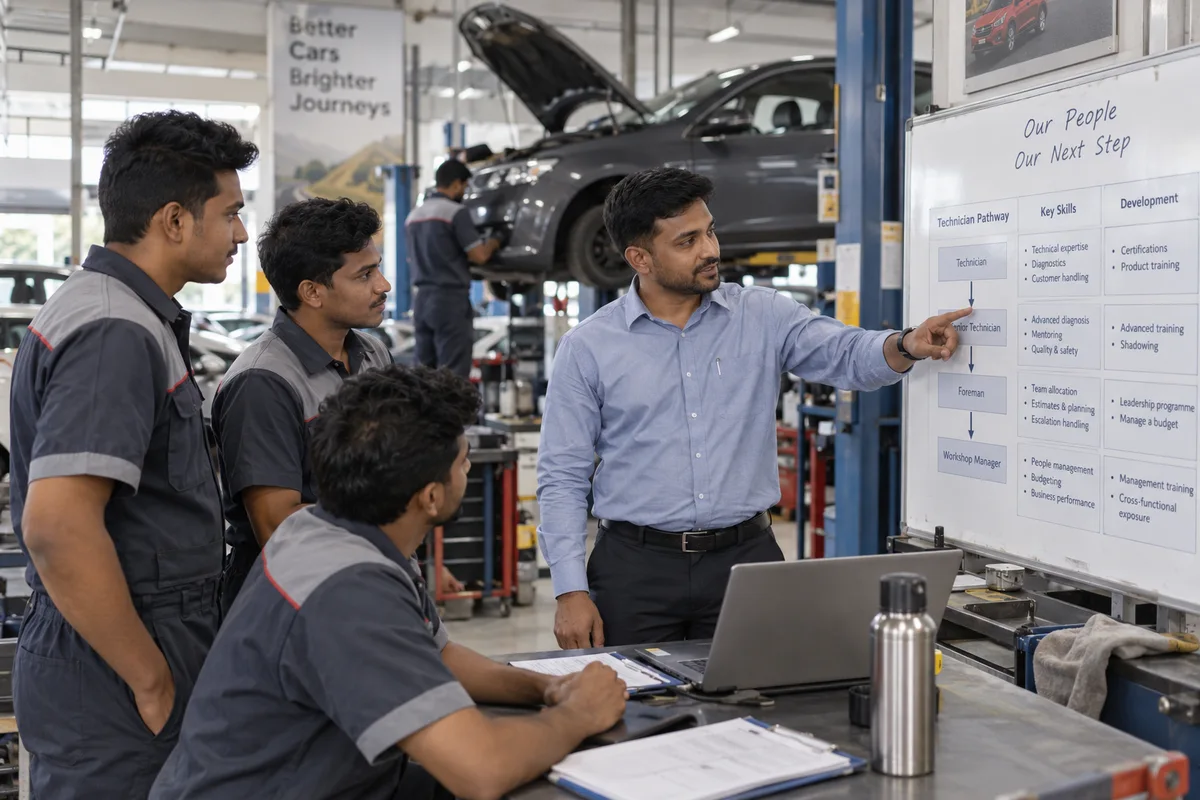
Junior, fitter, senior fitter and workshop lead, each with a list of jobs signed off.
What this coversHideJunior, fitter, senior fitter and workshop lead, each with a list of jobs signed off. Juniors then see how long the road is and what is at the end of it.
Give each major fleet account a primary and a secondary contact, with account notes kept in the dealership's own record, so a departure does not break the relationship.
What this coversHideGive each major fleet account a primary and a secondary contact, with account notes kept in the dealership's own record, so a departure does not break the relationship.
A short programme for new branch and workshop heads covering rotas, feedback, difficult conversations and reading simple people numbers.
What this coversHideA short programme for new branch and workshop heads covering rotas, feedback, difficult conversations and reading simple people numbers. See the manager development programme.
Sales executives and service planners meet to share what customers are saying and which accounts are at risk.
What this coversHideSales executives and service planners meet to share what customers are saying and which accounts are at risk.
Before changing anything, find out what is true today. These checks take an afternoon and tell you which of the topics above to start with.
Share your requirementsConfirm with a qualified professional. What applies to you depends on your business, your state and your arrangements, and it changes. This page describes practice. It does not state a legal position.
The services below fit this kind of business best. Each starts by recording where you stand, and every later report compares against that. We do not promise outcomes.
A look at who leaves, from which branch and role, and what long-service technicians and executives value.
A comparison of base and variable pay against nearby dealers, so key technicians and executives are not lost by default.
Simple monthly numbers on exits, absence and vacancies by branch, readable by the owner in ten minutes.
Training for new branch and workshop heads so promoted fitters and salespeople can run teams.
Start with a free conversation, or see the paid HR Diagnostic.
Understand the business, its workforce, current processes and HR challenges.
Find the missing, weak, inconsistent or person-dependent processes.
Create the structure, processes, policies, SOPs, dashboards and systems needed.
Help HR and department managers actually adopt the new system.
Digitise repetitive and approval-based workflows where it is worth doing.
Track hiring, attendance, employee cost, performance, training and attrition.
Strengthen the people-management system continuously, not once.
From the GullyHR blog: one on HR in automotive, and one on each of the topics this page points to.

Technicians, service advisors and sales consultants leave for different reasons. How to ask what shaped their decision and act on it across every outlet.
8 min readRead article
How to spot an unmanageable workload before it becomes an exit or an error, what to look at, how to talk about it and what to change, without guessing.
5 min readRead article
How to design incentives for operators, setters and inspectors in fastener, gear, spring and valve units so that accepted lots, not piece counts, earn the bonus.
7 min readRead article
A two-hour exercise that names the roles you could not fill quickly, who could cover them, and what readiness would actually require.
7 min readRead articleMore on the GullyHR blog.
Pay a base that covers the quiet months, then add variable pay at agreed milestones such as order booking and delivery. Write down who gets credit when a deal changes hands, since long cycles often do.
Publish a rota, agree what is paid or given as time off for night and highway calls and keep records of who answered. Fairness is judged by comparison, so transparency matters more than the exact rate.
Fair pay compared with nearby dealers, a visible ladder, decent working conditions and a manager who listens. Ask the long-serving ones what they would miss if they left, then protect those things.
You cannot fully, but you can reduce the risk by sharing account ownership and keeping notes in your own records. Seek advice from a qualified professional on any contractual restrictions.
A common core is wise, but allow local adjustment for distance and traffic. Keep a few non-negotiables on attendance, safety and conduct, and review exceptions together every quarter.
We would ask how pay behaves across a long sales cycle, who covers breakdown calls and how many technicians are close to leaving. A technician ladder and a breakdown rota are common first jobs, with scope agreed in writing for you to accept or change.
All 5 business types in automobile dealerships · Find another business type
Tell us what is slowing your team down. We’ll help you find a practical way forward, starting with a conversation.