



















GullyHR
Education · Creches and day care centres

HR for Creches, Day Care and Child Care Centres: Caregivers, Ratios and Trust

A child care centre is trusted with the youngest children for long hours. Here is how to select, train, roster and keep the caregivers and teachers that parents rely on.

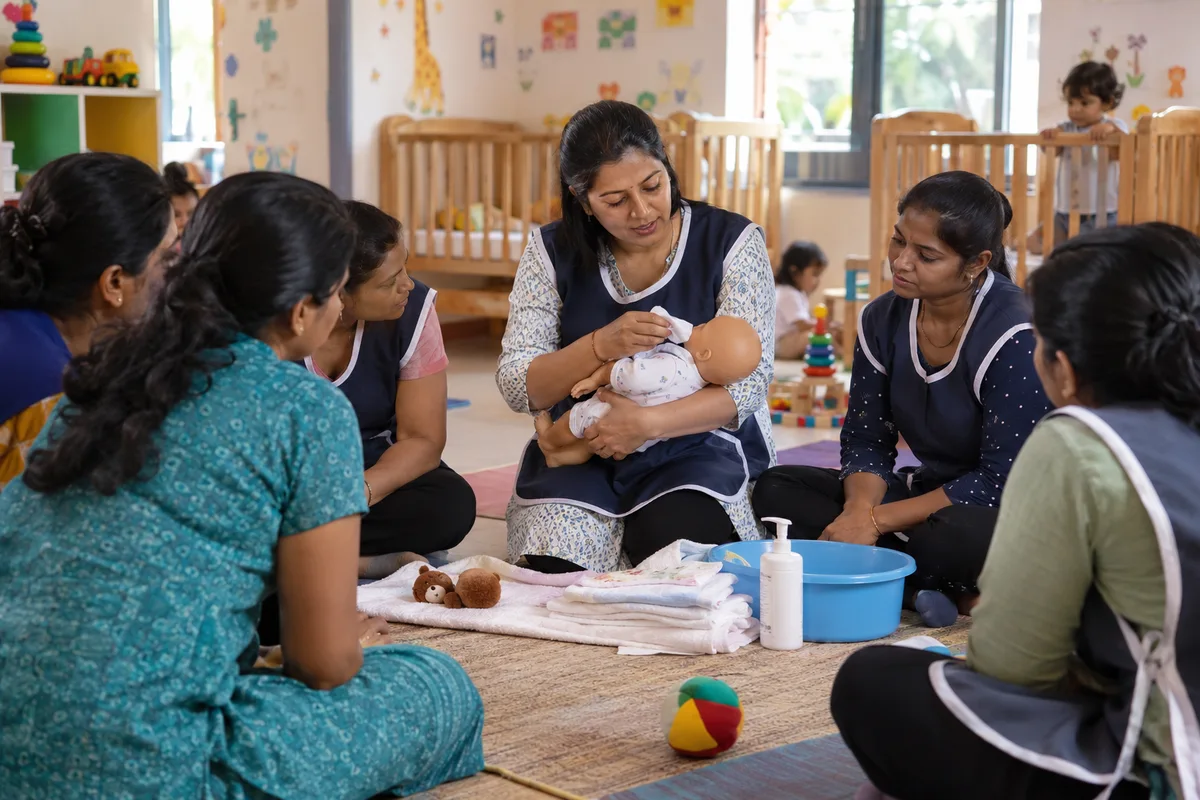
Childcare trainer demonstrating infant care using a practice doll

Not sure what you need? Tell us about your business in six short steps and we will come to the first meeting prepared.

Share your requirements

A creche, day care or preschool-style child care centre looks after babies, toddlers and young children while their parents work, often from early morning until evening and through much of the year. The team includes caregivers, teachers or facilitators, helpers, a cook, drivers or attendants if there is transport, and a centre head who deals with parents. Children need constant, attentive supervision, with enough adults present at every hour, including during meals, toilet breaks and the hand-over at either end of the day. Parents judge the centre on whether they trust the adults who hold their child. See also HR for education. What marks HR out here is that trust is the product. Careful selection, clear conduct expectations, honest rostering so that cover is never thin and training in how to handle young children make the centre safe, and keep the people who do tiring, modestly paid work from drifting away.

  1. Plan
  2. Hire
  3. Onboard
  4. Manage
  5. Develop
  6. Perform
  7. Engage
  8. Retain
  9. Exit
  10. Improve

When HR is weak in creches and day care centres, you may see

  • Hiring is quick and informal
  • Cover thins out at the edges of the day
  • Conduct expectations are unwritten
  • Pay is modest and the work is tiring
  • Training is thin
  • Parent complaints are handled on the spot
  • Illness spreads and absence follows
  • Seasonal admissions swing the numbers

These are the places the people side of this kind of business tends to give way. The rest of this page works through them.

Who does the work in creches and day care centres

HR here has to work for each of these groups, not only the office. The set-up below is written with all of them in mind.

  • Caregivers and day care attendants
  • Teachers and early-years facilitators
  • Helpers and ayahs
  • Cooks and kitchen helpers
  • Drivers and transport attendants
  • Centre heads and coordinators
  • Front desk and parent relations staff

Where HR strains in creches and day care centres

  • Hiring is quick and informal

    Helpers are taken on by recommendation and put with children after little checking of background or temperament.

  • Cover thins out at the edges of the day

    Early arrivals, late pick-ups, meal times and sick children mean fewer adults at the moments when it matters.

  • Conduct expectations are unwritten

    How to handle a crying child, a biting incident or a parent's complaint is passed on by example, so practice differs between people.

  • Pay is modest and the work is tiring

    Caregivers spend long hours on their feet, are paid little for it and leave when a school or another centre offers slightly more.

  • Training is thin

    Basic first aid, hygiene, nap and feeding routines and child development are not taught in a structured way.

  • Parent complaints are handled on the spot

    A message to the centre head leads to a hurried reply, with no record of what was said or agreed.

  • Illness spreads and absence follows

    Staff catch what the children carry, and leave rules are unclear when many are away together.

  • Seasonal admissions swing the numbers

    Intake peaks at the start of a term and falls away at holidays, so the number of staff needed moves.

HR topics for creches and day care centres

Start with the topics that matter most here: Recruitment and Talent Acquisition; Health, Safety and Wellbeing; Learning and Development. Then work through the rest. Each topic is written for education, not in general.

Recruitment and Talent Acquisition

Requisition to joining, the same way every time.

Health, Safety and Wellbeing

Induction, records, incident reporting and follow-through.

Learning and Development

Training planned from need rather than from the calendar.

HR Strategy and Workforce Planning

How many people, in which roles, by when — and what they will cost.

Organisation Design

Structure, reporting lines and who is allowed to decide what.

Onboarding and Probation

A first day that is the same for the fifth joiner as the first.

Employee Administration

Records, attendance, leave and the day-to-day HR that must simply work.

Compensation, Payroll and Benefits

Salary structure, payroll inputs and a month that closes on time.

Performance Management

Goals, reviews and ratings that hold up in a conversation.

Career and Succession Management

Named backups for the roles that cannot be vacant.

Employee Engagement and Experience

Communication, recognition and the conditions people actually work in.

Employee Relations

Two routes — one for complaints, one for conduct — kept separate.

Policies, Compliance and Governance

Policies a manager can apply, and obligations with owners and dates.

Retention and Attrition Management

Who leaves, when, why — and which of them mattered.

Exit and Alumni Management

Resignation to relieving letter, in a defined order.

HR Technology and Automation

Records that survive people, and approvals that do not queue.

HR Analytics and Management Reporting

A short monthly pack management actually reads.

HR Operations and Governance

An HR function that runs the same way every month.

What a working HR set-up looks like

The pieces a creches and day care centres business puts in place, in an order that makes each easier. Open any card for the detail.

Make selection careful

Structured interviews, identity and reference checks and a trial period with close supervision before a caregiver is alone with a group.

What this covers

Structured interviews, identity and reference checks and a trial period with close supervision before a caregiver is alone with a group. The recruitment process sets the steps.

Write conduct expectations

How adults speak to and handle children, what is not acceptable and how concerns are raised, explained in induction and signed.

What this covers

How adults speak to and handle children, what is not acceptable and how concerns are raised, explained in induction and signed. The HR policies hold them.

Roster for every hour

A rota that shows who is with the children at opening, meals, naps and closing, with named relievers.

What this covers

A rota that shows who is with the children at opening, meals, naps and closing, with named relievers. The attendance, shift and leave process covers it.

Teach the routines

Hygiene, feeding, naps, toileting, first aid and handling a distressed child, taught and refreshed.

What this covers

Hygiene, feeding, naps, toileting, first aid and handling a distressed child, taught and refreshed. The learning and development process holds the plan.

Record parent concerns

A simple log of the concern, who replied and what was agreed, reviewed by the head.

What this covers

A simple log of the concern, who replied and what was agreed, reviewed by the head. Communication skills helps staff handle the conversation.

Plan for the admissions cycle

Staffing sized to each term's intake, with agreed terms for seasonal and part-time helpers.

What this covers

Staffing sized to each term's intake, with agreed terms for seasonal and part-time helpers.

Start by checking where you stand

Before changing anything, find out what is true today. These checks take an afternoon and tell you which of the topics above to start with.

Share your requirements
  • Look at how your last few caregivers were selected and what checks were made before they were alone with children.
  • Draw the day by half hour and mark when the number of adults is thinnest.
  • Ask a new caregiver what they were told about conduct and handling children, and by whom.
  • Check what first aid and hygiene training each person has had and when.
  • Read the last few parent complaints and see whether the reply and outcome were recorded.
  • Confirm with a qualified professional the registration, child safeguarding and staffing obligations that apply to your centre.

Confirm with a qualified professional. What applies to you depends on your business, your state and your arrangements, and it changes. This page describes practice. It does not state a legal position.

How GullyHR helps

The services below fit this kind of business best. Each starts by recording where you stand, and every later report compares against that. We do not promise outcomes.

Start with a free conversation, or see the paid HR Diagnostic.

Our HR transformation approach

  1. 1

    Assess

    Understand the business, its workforce, current processes and HR challenges.

  2. 2

    Identify gaps

    Find the missing, weak, inconsistent or person-dependent processes.

  3. 3

    Design

    Create the structure, processes, policies, SOPs, dashboards and systems needed.

  4. 4

    Implement

    Help HR and department managers actually adopt the new system.

  5. 5

    Automate

    Digitise repetitive and approval-based workflows where it is worth doing.

  6. 6

    Measure

    Track hiring, attendance, employee cost, performance, training and attrition.

  7. 7

    Improve

    Strengthen the people-management system continuously, not once.

Blogs worth reading first

From the GullyHR blog: one on HR in education, and one on each of the topics this page points to.

HR Management

The safety poster nobody reads

A laminated notice, an annual drill, and an incident register with three entries in two years. What workplace health and safety looks like when it is real.

7 min readRead article

More on the GullyHR blog.

Questions owners ask

With a structured interview, identity and verified reference checks, a supervised trial and a conversation about attitude to children. Confirm which checks apply to you with a qualified professional.

Let’s find your next step

Is your HR process ready to scale?

Identify payroll leaks, record gaps and hiring bottlenecks in a free first conversation, and leave knowing what to fix first.

Book a free consultation

Know what you need? Share your requirements in four short steps.

Want the full picture? See the paid HR Diagnostic.

Prefer a quick message? Chat on WhatsApp

Talk to an HR consultant

Tell us where to reach you. All fields are required unless marked optional.

10-digit Indian mobile, without +91.

Your details stay private. Privacy policy


