












GullyHR

Manufacturing · Textile mills

HR for Textile Mills: Spinning Shifts, Loom Sheds and Migrant Workforces

Spinning, weaving and processing mills run noisy, dusty shop floors across shifts, often with many migrant workers. This page covers machine attendants, jobbers, doffers, hostel living and the supervisors who hold a mill together.

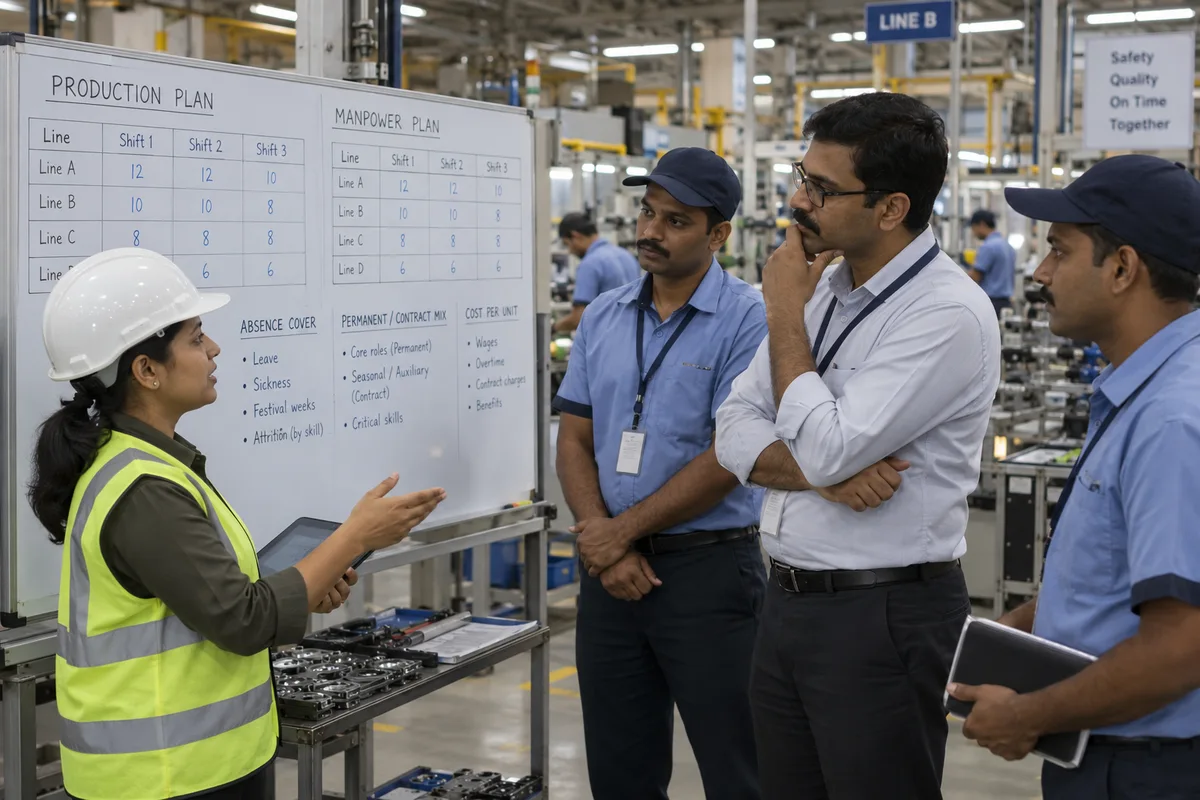
A plant HR officer and production colleagues planning shift coverage at a factory briefing station

Not sure what you need? Tell us about your business in six short steps and we will come to the first meeting prepared.

Share your requirements

A textile mill converts fibre to yarn and yarn to fabric. In spinning, workers handle bales, blow room and carding, drawing, roving and ring frames, then winding. In weaving, warpers, sizers and loom operators set up and run machines. Mills run in shifts, often all day and night, with loud machines and fibre dust in the air. Many workers are young migrants staying in company hostels, far from home, on contracts or training schemes. Jobbers and supervisors keep machines in order, and loss of a good one hits efficiency quickly. Absences peak around festivals and travel home. Related reading: HR for manufacturing.

  1. Plan
  2. Hire
  3. Onboard
  4. Manage
  5. Develop
  6. Perform
  7. Engage
  8. Retain
  9. Exit
  10. Improve

When HR is weak in textile mills, you may see

  • Noise and fibre dust harm health
  • Migrant workers leave suddenly
  • Hostel life shapes work life
  • Machine allocation is a daily dispute
  • Jobbers are hard to replace
  • Night shifts weaken supervision
  • Training schemes are patchy
  • Contract and trainee status causes confusion

These are the places the people side of this kind of business tends to give way. The rest of this page works through them.

Who does the work in textile mills

HR here has to work for each of these groups, not only the office. The set-up below is written with all of them in mind.

  • Blow room and carding attendants
  • Ring frame operators and doffers
  • Winding and packing workers
  • Loom operators and weavers
  • Warpers and sizers
  • Jobbers and mechanics
  • Shift supervisors and line leaders

Roles we help you hire in textile mills

GullyHR runs talent acquisition for permanent roles in textile mills. For each role we agree the job description with you, find and screen candidates against it, and support the offer through to joining. Tell us the role and the number of people, and we start there.

We recruit permanent employees. We do not supply contract or temporary staff.

We set up the interview and hiring process for textile mills

Every business interviews, but few have a written process that works the same way for every role and every interviewer. GullyHR designs yours, from the role brief to the offer, trains your managers to run it, and can run it for you on the roles you hand us.

  1. 1. Role brief and scorecard

    We agree what the role must deliver, the must-have and nice-to-have skills, and how each will be scored.

  2. 2. Stages and sequence

    Screening call, assessment, interview rounds and decision points, sized to the role and the number of people you hire.

  3. 3. Question bank and scoring

    Structured questions for each role family and a rating guide, so two interviewers judge the same answer the same way.

  4. 4. Interviewer readiness

    A short briefing for your managers on what to ask, what to avoid and how to give a clear yes or no.

  5. 5. Offer and follow-up

    Who approves, how the offer is made, and how candidates are kept informed from first call to joining.

Where HR strains in textile mills

  • Noise and fibre dust harm health

    Hearing and breathing suffer over years, and protection is used unevenly.

  • Migrant workers leave suddenly

    Homesickness, festivals and family needs cause exits, and replacements need weeks to be useful.

  • Hostel life shapes work life

    Food, safety, curfews and privacy in hostels affect attendance and morale, especially for young women.

  • Machine allocation is a daily dispute

    The number of looms or frames per worker affects load and pay, and workers compare.

  • Jobbers are hard to replace

    A mechanic who keeps a shed efficient takes his expertise to a rival.

  • Night shifts weaken supervision

    Waste and breakage rise when seniors are away, and fatigue grows.

  • Training schemes are patchy

    Trainees are put on machines with brief instruction and leave before they become productive.

  • Contract and trainee status causes confusion

    Workers do not understand their terms, and grievances build quietly.

HR topics for textile mills

Start with the topics that matter most here: Retention and Attrition Management; Employee Engagement and Experience; Health, Safety and Wellbeing. Then work through the rest. Each topic is written for manufacturing, not in general.

Retention and Attrition Management

Who leaves, when, why — and which of them mattered.

Employee Engagement and Experience

Communication, recognition and the conditions people actually work in.

Health, Safety and Wellbeing

Induction, records, incident reporting and follow-through.

HR Strategy and Workforce Planning

How many people, in which roles, by when — and what they will cost.

Organisation Design

Structure, reporting lines and who is allowed to decide what.

Recruitment and Talent Acquisition

Requisition to joining, the same way every time.

Onboarding and Probation

A first day that is the same for the fifth joiner as the first.

Employee Administration

Records, attendance, leave and the day-to-day HR that must simply work.

Compensation, Payroll and Benefits

Salary structure, payroll inputs and a month that closes on time.

Performance Management

Goals, reviews and ratings that hold up in a conversation.

Learning and Development

Training planned from need rather than from the calendar.

Career and Succession Management

Named backups for the roles that cannot be vacant.

Employee Relations

Two routes — one for complaints, one for conduct — kept separate.

Policies, Compliance and Governance

Policies a manager can apply, and obligations with owners and dates.

Exit and Alumni Management

Resignation to relieving letter, in a defined order.

HR Technology and Automation

Records that survive people, and approvals that do not queue.

HR Analytics and Management Reporting

A short monthly pack management actually reads.

HR Operations and Governance

An HR function that runs the same way every month.

What a working HR set-up looks like

The pieces a textile mills business puts in place, in an order that makes each easier. Open any card for the detail.

Protect hearing and lungs

Earplugs, masks, dust control, regular checks as advised and a log of complaints.

What this covers

Earplugs, masks, dust control, regular checks as advised and a log of complaints. See health, safety and wellbeing.

Support migrant workers through the year

Joining briefing, festival leave plans, a returning-worker list and clear payment records.

What this covers

Joining briefing, festival leave plans, a returning-worker list and clear payment records. See employee information management.

Run hostels as part of HR

A warden, simple rules, safe food and a complaint channel, reviewed monthly.

What this covers

A warden, simple rules, safe food and a complaint channel, reviewed monthly. See grievance process.

Settle machine allocation rules

A written load per worker by machine type, shared and revised openly.

What this covers

A written load per worker by machine type, shared and revised openly. See payroll process management.

Build a jobber pipeline

Assistants trained in stages, with pay and title steps.

What this covers

Assistants trained in stages, with pay and title steps. See the learning and development process.

Strengthen night supervision

A named lead and spot checks, with night waste reviewed each morning.

What this covers

A named lead and spot checks, with night waste reviewed each morning.

Start by checking where you stand

Before changing anything, find out what is true today. These checks take an afternoon and tell you which of the topics above to start with.

Share your requirements
  • Count workers who left within three months of joining.
  • Visit the hostel at night and speak to residents.
  • Compare machine allocation between shifts and sheds.
  • Name who would replace each key jobber.
  • Check hearing and dust protection use on a live shift.
  • Ask workers if they understand their terms.
  • Confirm with a qualified professional the labour, trainee, hostel and safety duties that apply to your mill.

Confirm with a qualified professional. What applies to you depends on your business, your state and your arrangements, and it changes. This page describes practice. It does not state a legal position.

How GullyHR helps

The services below fit this kind of business best. Each starts by recording where you stand, and every later report compares against that. We do not promise outcomes.

Start with a free conversation, or see the paid HR Diagnostic.

Our HR transformation approach

  1. 1

    Assess

    Understand the business, its workforce, current processes and HR challenges.

  2. 2

    Identify gaps

    Find the missing, weak, inconsistent or person-dependent processes.

  3. 3

    Design

    Create the structure, processes, policies, SOPs, dashboards and systems needed.

  4. 4

    Implement

    Help HR and department managers actually adopt the new system.

  5. 5

    Automate

    Digitise repetitive and approval-based workflows where it is worth doing.

  6. 6

    Measure

    Track hiring, attendance, employee cost, performance, training and attrition.

  7. 7

    Improve

    Strengthen the people-management system continuously, not once.

Blogs worth reading first

From the GullyHR blog: one on HR in manufacturing, and one on each of the topics this page points to.

HR Management

The engagement survey that made things worse

Eighty per cent responded, the report was thorough, and six months later trust was lower than before. What went wrong between the survey and the silence.

8 min readRead article

More on the GullyHR blog.

Questions owners ask

Brief them well, offer decent hostel life, plan festival leave and keep payment records clear.

Your next chapter

Let’s make HR work better.

Tell us what is slowing your team down. We’ll help you find a practical way forward, starting with a conversation.

  • A free first conversation with an HR practitioner
  • A clear scope and fee before any paid work
  • A practical next step for your business

Let’s start with your business

Share your contact details and the HR challenge on your mind. We’ll help you find the right starting point.

10-digit Indian mobile, without +91.

Your details stay private. Privacy policy