



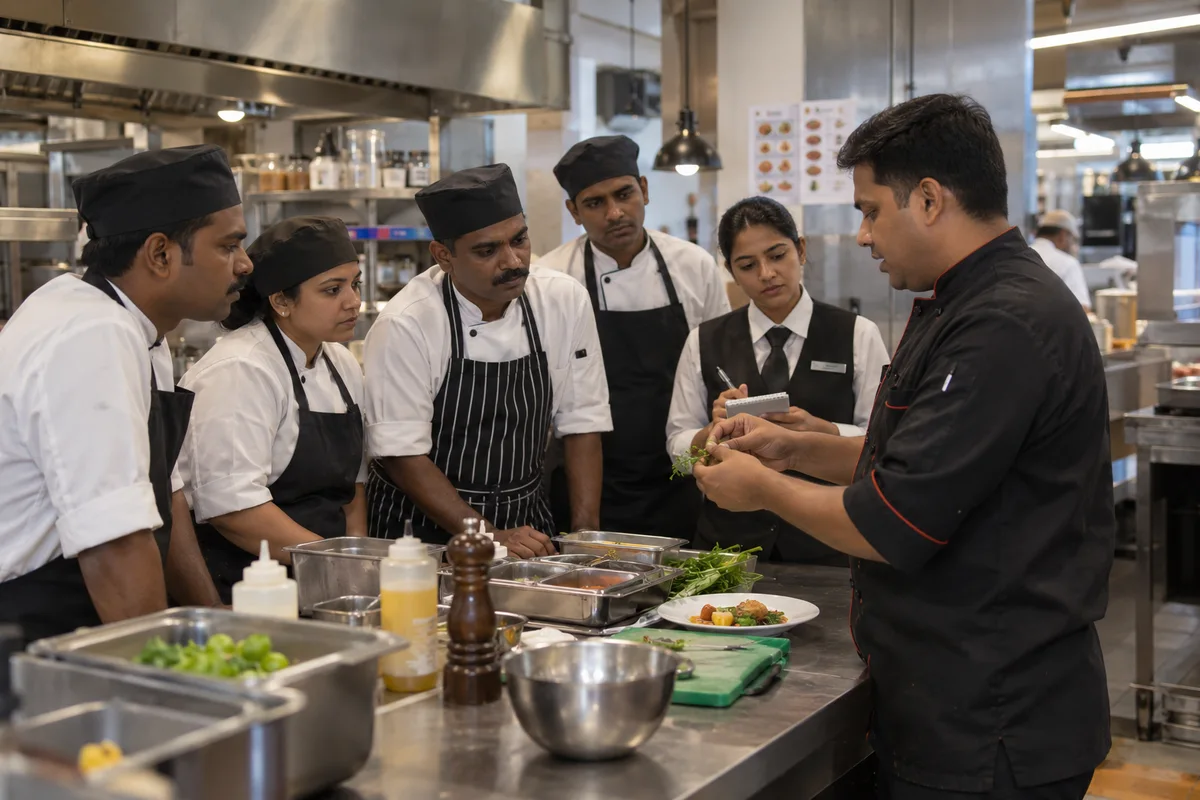













Why food and beverage staff leave and how to understand why
Kitchen, service and outlet staff leave quickly in food and beverage. How to ask what lies behind the first answer, compare outlets and act on what you learn.
7 min readRead articleA packaged food maker cooks or blends a recipe, fills pouches, jars or bottles, and prints a best-before on every pack. The people strain is hygiene on the line, taste that varies by cook, and promotion-driven order spikes.

Not sure what you need? Tell us about your business in six short steps and we will come to the first meeting prepared.
Share your requirementsA packaged food maker turns raw material into branded packs: ready mixes, sauces, pickles, sweets or heat-and-eat items. The plant runs from receiving and weighing, through kettle or blender, to a filling and sealing line, then date coding, cartoning and dispatch. Distributors and modern trade buyers set pack sizes and shelf-life windows, and a festival or retailer promotion can double a week's orders. Every flavour or pack-size switch means a wash-down and a line clearance before the next run. Supervisors keep the line moving and watch hygiene, while helpers do most of the handling. Related reading: HR for food and beverage.
These are the places the people side of this kind of business tends to give way. The rest of this page works through them.
HR here has to work for each of these groups, not only the office. The set-up below is written with all of them in mind.
GullyHR runs talent acquisition for permanent roles in packaged food makers. For each role we agree the job description with you, find and screen candidates against it, and support the offer through to joining. Tell us the role and the number of people, and we start there.
We recruit permanent employees. We do not supply contract or temporary staff.
Every business interviews, but few have a written process that works the same way for every role and every interviewer. GullyHR designs yours, from the role brief to the offer, trains your managers to run it, and can run it for you on the roles you hand us.
We agree what the role must deliver, the must-have and nice-to-have skills, and how each will be scored.
Screening call, assessment, interview rounds and decision points, sized to the role and the number of people you hire.
Structured questions for each role family and a rating guide, so two interviewers judge the same answer the same way.
A short briefing for your managers on what to ask, what to avoid and how to give a clear yes or no.
Who approves, how the offer is made, and how candidates are kept informed from first call to joining.
Moving from one flavour or pack size needs a wash-down and a clear line, but pressure to restart cuts the clearance short.
The right salt, spice or cooking time is kept by experienced hands, and batches drift when that cook is on leave or gone.
A retailer campaign arrives with days to spare, so extra hands and overtime are arranged in a scramble.
Sorters and carton packers move on quickly, and each newcomer must learn glove, cap and handling rules from scratch.
A missed best-before or smudged print is caught in the retailer's warehouse, and the whole lot is held or returned.
Judged on output, they drop wash-downs and checks first when a shift runs behind.
Start with the topics that matter most here: Onboarding and Probation; Performance Management; Learning and Development. Then work through the rest. Each topic is written for food and beverage, not in general.
A first day that is the same for the fifth joiner as the first.
Goals, reviews and ratings that hold up in a conversation.
Training planned from need rather than from the calendar.
How many people, in which roles, by when, and what they will cost.
Structure, reporting lines and who is allowed to decide what.
Requisition to joining, the same way every time.
Records, attendance, leave and the day-to-day HR that must simply work.
Salary structure, payroll inputs and a month that closes on time.
Named backups for the roles that cannot be vacant.
Communication, recognition and the conditions people actually work in.
Two routes, one for complaints, one for conduct, kept separate.
Policies a manager can apply, and obligations with owners and dates.
Induction, records, incident reporting and follow-through.
Who leaves, when, why, and which of them mattered.
Resignation to relieving letter, in a defined order.
Records that survive people, and approvals that do not queue.
A short monthly pack management actually reads.
An HR function that runs the same way every month.
The pieces a packaged food makers business puts in place, in an order that makes each easier. Open any card for the detail.
One clean-and-clear list per changeover, signed by the supervisor, with the wash-down time placed in the schedule.
One clean-and-clear list per changeover, signed by the supervisor, with the wash-down time placed in the schedule. Performance management can reward supervisors who keep to it.
Weights, kettle temperature, stirring time and a note on how it should look and smell, then pair a second cook on each.
Weights, kettle temperature, stirring time and a note on how it should look and smell, then pair a second cook on each. Taste then survives a day of absence.
When sales passes on campaign dates early, extra helpers and shifts are fixed before the purchase order.
When sales passes on campaign dates early, extra helpers and shifts are fixed before the purchase order. Shift and attendance design covers the roster side.
Hand-washing, gloves, hair covers and how to lift a tray, then a buddy through week one and a short check.
Hand-washing, gloves, hair covers and how to lift a tray, then a buddy through week one and a short check. See onboarding and probation.
A different person confirms the printed date and batch at start-up and each hour, and initials the batch sheet.
Before changing anything, find out what is true today. Work through the checks using a recent operating period. The time needed depends on the records you hold; note missing evidence and use the findings to choose a priority.
Share your requirementsConfirm with a qualified professional. What applies to you depends on your business, your state and your arrangements, and it changes. This page describes practice. It does not state a legal position.
The services below fit this kind of business best. Each starts by recording where you stand, and every later report compares against that. We do not promise outcomes.
A first-day briefing and week-one buddy for packers who leave quickly.
Supervisor measures that count wash-downs and checks alongside tonnes packed.
Recipe handover between cooks and hygiene teaching with practical checks.
Rosters that cover a retailer promotion peak without wearing out the line crew.
Start with a free conversation, or see the paid HR Diagnostic.
Understand the business, its workforce, current processes and HR challenges.
Find the missing, weak, inconsistent or person-dependent processes.
Create the structure, processes, policies, SOPs, dashboards and systems needed.
Help HR and department managers actually adopt the new system.
Digitise repetitive and approval-based workflows where it is worth doing.
Track hiring, attendance, employee cost, performance, training and attrition.
Strengthen the people-management system continuously, not once.
From the GullyHR blog: one on HR in food and beverage, and one on each of the topics this page points to.

Kitchen, service and outlet staff leave quickly in food and beverage. How to ask what lies behind the first answer, compare outlets and act on what you learn.
7 min readRead article

A first-week plan for bringing in an outside specialist: what access to give, how to protect client data, and the confidentiality steps to settle on day one.
7 min readRead article
A practical design for an IT services appraisal cycle: when to run it, how to rate fairly across projects, and how to explain hikes so they hold.
7 min readRead article
A founder's guide to hiring freshers and running a first-year programme: campus or open drives, a screening round, a training plan by quarter, mentors and checkpoints.
6 min readRead articleMore on the GullyHR blog.
Put the wash-down minutes into the schedule and ask supervisors to sign each one. A step that has its own time slot is rarely the one cut.
Give them a one-page guide on gloves, hair covers and handling, a buddy for week one and a brief check on day three.
Write the weights, times and appearance notes, keep a retained sample for comparison and let a second cook make each key batch.
Ask sales for the campaign calendar early, line up extra hands and agree the overtime rules before the order lands. Time off afterwards keeps people willing.
Add a second-person check at start-up and every hour, noted on the batch sheet. Explain to helpers what a wrong code costs at the buyer's end.
We would look at packer turnover, whether changeover sheets get signed and which recipes sit with one cook. A sensible opening job is a packer induction with a buddy plan. After that first conversation, we write down the scope together.
All 8 business types in food processing · Find another business type
See all HR topics for food and beverage, or another industry.
Tell us your industry, team size and the issue you want to address. Bring one example of where work gets delayed or ownership is unclear, and the deadline or decision you are working towards.
