



















Why security guards and supervisors leave and how to understand why
Why guards and supervisors leave security agencies, and how to ask about duty hours, relievers, pay timing and site conditions in an exit conversation.
7 min readRead articleInstallers and service firms depend on certified technicians and quick call-outs. Here is how to keep skills current, rotas fair and records provable.

Not sure what you need? Tell us about your business in six short steps and we will come to the first meeting prepared.
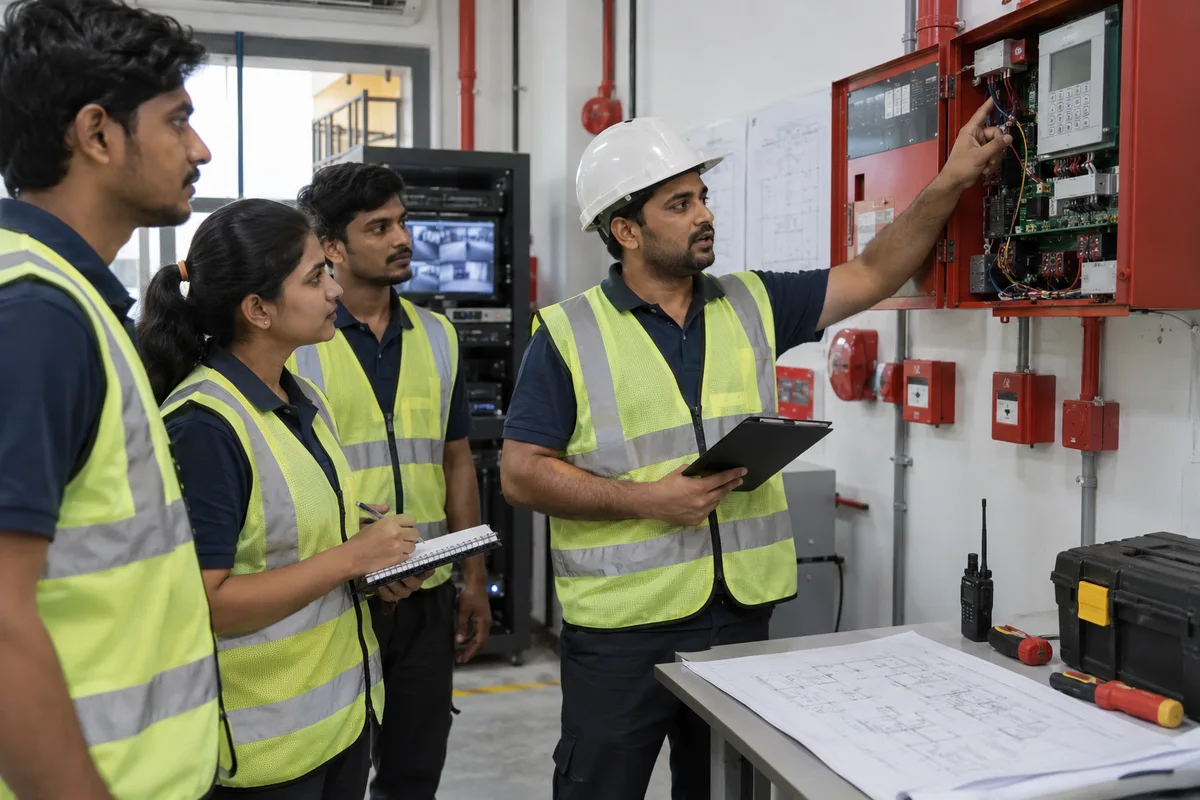
Share your requirementsA security systems and fire protection firm designs, installs and services CCTV, alarms, access control, fire alarms, sprinklers and extinguishers for homes, offices, factories and institutions. Work splits between installation projects and recurring service contracts, with emergency call-outs. Technicians work on live premises, at height and on electrical systems. Some work needs certification, and clients and insurers sometimes ask to see it. Sales and design staff win the work, project engineers plan it, and technicians and helpers carry it out. Skills are specialised and scarce, and the firm's reputation rests on systems that work when needed. See also HR for security services.
These are the places the people side of this kind of business tends to give way. The rest of this page works through them.
HR here has to work for each of these groups, not only the office. The set-up below is written with all of them in mind.
Technician certificates, product training and approvals expire without alert, and a job gets assigned to someone whose approval has run out.
Emergency calls fall to the same few people, and the rota is informal.
Ladders, ceiling work and live wiring are routine, and safety instruction and equipment vary by team.
People are borrowed from service teams for installations, and each side feels short.
The person who understands a particular system or a customer's site is not always documented.
A recurring maintenance contract needs the same competent people to visit on schedule, and turnover disrupts it.
Helpers learn by observation, with no route to becoming technicians.
Start with the topics that matter most here: Learning and Development; Health, Safety and Wellbeing; Employee Administration. Then work through the rest. Each topic is written for security services, not in general.
Training planned from need rather than from the calendar.
Induction, records, incident reporting and follow-through.
Records, attendance, leave and the day-to-day HR that must simply work.
How many people, in which roles, by when — and what they will cost.
Structure, reporting lines and who is allowed to decide what.
Requisition to joining, the same way every time.
A first day that is the same for the fifth joiner as the first.
Salary structure, payroll inputs and a month that closes on time.
Goals, reviews and ratings that hold up in a conversation.
Named backups for the roles that cannot be vacant.
Communication, recognition and the conditions people actually work in.
Two routes — one for complaints, one for conduct — kept separate.
Policies a manager can apply, and obligations with owners and dates.
Who leaves, when, why — and which of them mattered.
Resignation to relieving letter, in a defined order.
Records that survive people, and approvals that do not queue.
A short monthly pack management actually reads.
An HR function that runs the same way every month.
The pieces a security systems and fire protection companies business puts in place, in an order that makes each easier. Open any card for the detail.
Each technician's certificates, product approvals and refreshers on one record with alerts, and assignments blocked when a required one has lapsed.
What this coversHideEach technician's certificates, product approvals and refreshers on one record with alerts, and assignments blocked when a required one has lapsed. The employee information management holds it.
A fair rotation, a rule for rest after a night call and an agreed allowance, shared with the team.
What this coversHideA fair rotation, a rule for rest after a night call and an agreed allowance, shared with the team.
Instruction, equipment issue, a check before starting and a way to stop a job.
What this coversHideInstruction, equipment issue, a check before starting and a way to stop a job. The health, safety and wellbeing work builds them.
A view of installation and service demand by month, so people are not borrowed in a hurry.
What this coversHideA view of installation and service demand by month, so people are not borrowed in a hurry. The workforce plan shows the load.
A short record per customer site and system type, so a service visit does not depend on one person's memory.
What this coversHideA short record per customer site and system type, so a service visit does not depend on one person's memory.
Defined steps from helper to technician to senior, with skills to be signed off at each.
What this coversHideDefined steps from helper to technician to senior, with skills to be signed off at each.
Before changing anything, find out what is true today. These checks take an afternoon and tell you which of the topics above to start with.
Share your requirementsConfirm with a qualified professional. What applies to you depends on your business, your state and your arrangements, and it changes. This page describes practice. It does not state a legal position.
The services below fit this kind of business best. Each starts by recording where you stand, and every later report compares against that. We do not promise outcomes.
A certificate and approval record with alerts, so jobs go only to people who are cleared.
Routines for work at height and on live systems, with equipment issue and a way to stop a job.
A combined view of installation projects and service contracts, so skills are planned, not borrowed.
A route from helper to technician to project lead, so scarce skills are grown inside the firm.
Start with a free conversation, or see the paid HR Diagnostic.
Understand the business, its workforce, current processes and HR challenges.
Find the missing, weak, inconsistent or person-dependent processes.
Create the structure, processes, policies, SOPs, dashboards and systems needed.
Help HR and department managers actually adopt the new system.
Digitise repetitive and approval-based workflows where it is worth doing.
Track hiring, attendance, employee cost, performance, training and attrition.
Strengthen the people-management system continuously, not once.
From the GullyHR blog: one on HR in security services, and one on each of the topics this page points to.

Why guards and supervisors leave security agencies, and how to ask about duty hours, relievers, pay timing and site conditions in an exit conversation.
7 min readRead article

A calendar of courses, a budget spent by March and no record of what any of it changed. What a learning and development process contains when it starts from need rather than from the catalogue.
7 min readRead article
A laminated notice, an annual drill, and an incident register with three entries in two years. What workplace health and safety looks like when it is real.
7 min readRead article
Payroll says one joining date, the personal file says another and the manager remembers a third. How to establish a single trustworthy employee record and keep it that way.
7 min readRead articleMore on the GullyHR blog.
Keep certificates on a record with expiry alerts and make a current certificate a condition of assignment. Prevention is cheaper than discovering it after an incident or an audit.
By a written rota that rotates fairly, with rest after a night call and an agreed allowance. Informal sharing overloads the most willing.
Record site and system knowledge, pair juniors with seniors and give people a reason to stay. Confirm any restrictive terms with a qualified professional.
Plan installation and service demand together by month, and hire or train ahead of a known peak. Borrowing people in a hurry hurts both sides.
Defined steps, with skills to be learnt and signed off at each, and a rough timeline. People stay when they can see the next step.
Our opening talk would cover how certificates and training are tracked, how out-of-hours call-outs are shared, and what safety routines exist for work at height and on electrics. We would also ask where site knowledge is kept. A natural first piece of work is a certificate register with expiry dates and a written call-out rota. We then confirm scope in writing before starting.
Who visited, what was tested, what was found and what was done, with the customer's acknowledgement, kept centrally. Clients and insurers sometimes ask for it, so it needs to be retrievable quickly.
All 6 business types in security services · Find another business type
See all HR topics for security services, or another industry.
Identify payroll leaks, record gaps and hiring bottlenecks in a free first conversation, and leave knowing what to fix first.
Know what you need? Share your requirements in four short steps.
Want the full picture? See the paid HR Diagnostic.
Prefer a quick message? Chat on WhatsApp
