











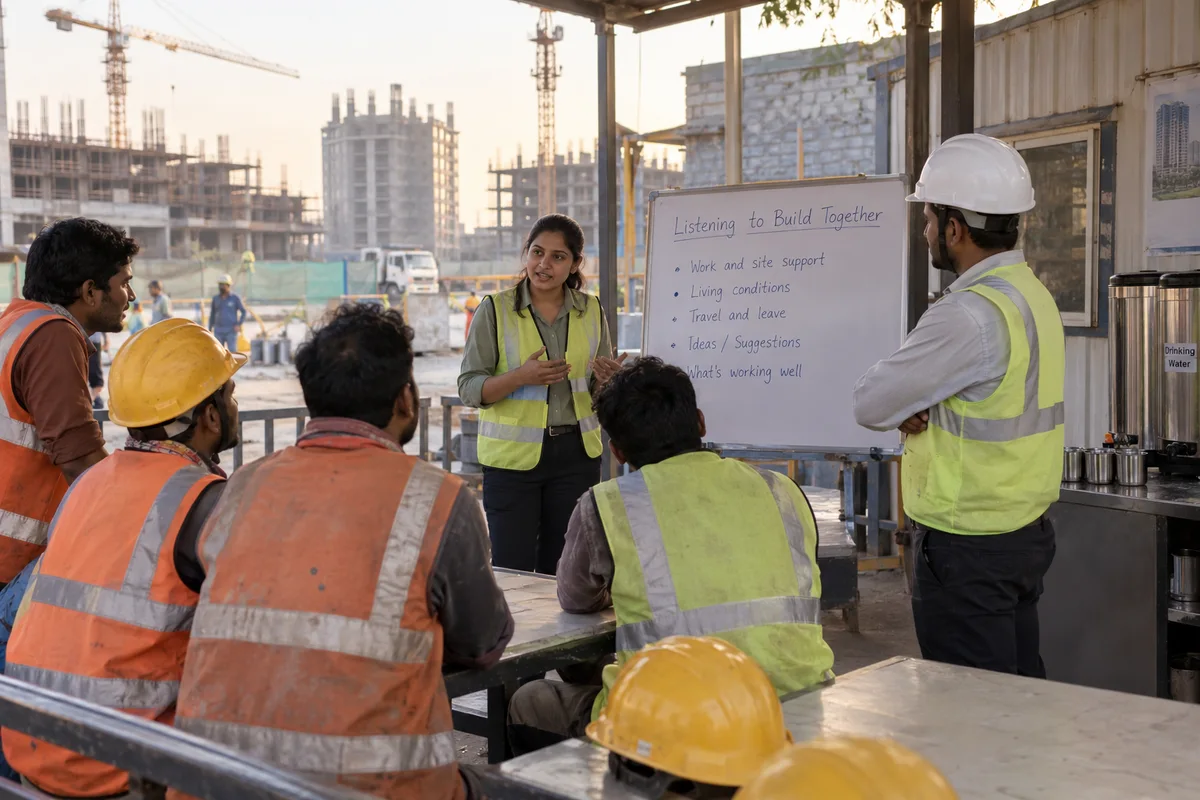







Why construction and real estate employees leave and how to understand why
Site engineers, supervisors, crews and sales teams leave for different reasons. How to ask what shaped their decision and act on it between projects.
8 min readRead articleA water infrastructure contractor lays pipelines, builds tanks and pump houses and commissions treatment plants for public bodies and industry. Work is outdoors, seasonal and spread along a route, so the crew is always moving.

Not sure what you need? Tell us about your business in six short steps and we will come to the first meeting prepared.
Share your requirementsA water infrastructure contractor wins tenders to lay supply and sewer pipelines, build overhead and underground tanks, set up pump houses and erect treatment plants. A project may run for a year or more along a route or across a scattered set of villages. The firm keeps a core of engineers and supervisors and engages gangs of diggers, pipe layers, welders and masons who move along the work. The rains stop the digging, and pay of the gangs stops with it. Payments from public clients can arrive late. The construction and real estate hub covers the wider sector, and the infrastructure contractors hub the neighbouring trades.
These are the places the people side of this kind of business tends to give way. The rest of this page works through them.
HR here has to work for each of these groups, not only the office. The set-up below is written with all of them in mind.
GullyHR runs talent acquisition for permanent roles in water infrastructure contractors. For each role we agree the job description with you, find and screen candidates against it, and support the offer through to joining. Tell us the role and the number of people, and we start there.
We recruit permanent employees. We do not supply contract or temporary staff.
Every business interviews, but few have a written process that works the same way for every role and every interviewer. GullyHR designs yours, from the role brief to the offer, trains your managers to run it, and can run it for you on the roles you hand us.
We agree what the role must deliver, the must-have and nice-to-have skills, and how each will be scored.
Screening call, assessment, interview rounds and decision points, sized to the role and the number of people you hire.
Structured questions for each role family and a rating guide, so two interviewers judge the same answer the same way.
A short briefing for your managers on what to ask, what to avoid and how to give a clear yes or no.
Who approves, how the offer is made, and how candidates are kept informed from first call to joining.
Trenches fill, roads wash out and gangs sit idle, so workers drift away to other jobs and may not return in the dry months.
Public bodies pay in stages, so wages and camp costs are carried by the contractor, and a delay strains trust with the gangs.
A single mestri brings thirty people and takes them elsewhere if the mestri is unhappy, so the firm's hold on labour is thin.
Camps and offices are shifted every few weeks, and records, stores and welfare are left behind.
Deep trenches, heavy pipes and live water mains need careful instruction, and new workers can be put on tasks with little introduction.
Plant technicians who test pumps and treatment units work to a handover date and are managed like labour gangs.
Billing depends on quantities measured on the route, so the supervisor's daily note matters as much as the engineer's drawing.
Start with the topics that matter most here: Organisation Design; Health, Safety and Wellbeing; Employee Relations. Then work through the rest. Each topic is written for construction and real estate, not in general.
Structure, reporting lines and who is allowed to decide what.
Induction, records, incident reporting and follow-through.
Two routes, one for complaints, one for conduct, kept separate.
How many people, in which roles, by when, and what they will cost.
Requisition to joining, the same way every time.
A first day that is the same for the fifth joiner as the first.
Records, attendance, leave and the day-to-day HR that must simply work.
Salary structure, payroll inputs and a month that closes on time.
Goals, reviews and ratings that hold up in a conversation.
Training planned from need rather than from the calendar.
Named backups for the roles that cannot be vacant.
Communication, recognition and the conditions people actually work in.
Policies a manager can apply, and obligations with owners and dates.
Who leaves, when, why, and which of them mattered.
Resignation to relieving letter, in a defined order.
Records that survive people, and approvals that do not queue.
A short monthly pack management actually reads.
An HR function that runs the same way every month.
The pieces a water infrastructure contractors business puts in place, in an order that makes each easier. Open any card for the detail.
Meet each gang leader, agree terms in writing, note the gang's people by name and skills, and review once a month.
Meet each gang leader, agree terms in writing, note the gang's people by name and skills, and review once a month. The recruitment process can widen the sources beyond a single mestri.
Decide which staff stay, which go on leave and who is offered work elsewhere, and tell them before the rains begin.
A set pay date for gangs and staff, with a plan for how delays in client payment are bridged, so workers are not left guessing.
A short talk and demonstration on trench safety, lifting and the day's hazards.
A short talk and demonstration on trench safety, lifting and the day's hazards. The health and safety work sets the routine and the record.
Different job descriptions for route supervisors and plant technicians, with clear duties and decision rights.
Different job descriptions for route supervisors and plant technicians, with clear duties and decision rights. See role design.
A simple form for the supervisor with quantities done, people present and problems found, shared with the engineer and the billing clerk.
Before changing anything, find out what is true today. Work through the checks using a recent operating period. The time needed depends on the records you hold; note missing evidence and use the findings to choose a priority.
Share your requirementsConfirm with a qualified professional. What applies to you depends on your business, your state and your arrangements, and it changes. This page describes practice. It does not state a legal position.
The services below fit this kind of business best. Each starts by recording where you stand, and every later report compares against that. We do not promise outcomes.
Separate roles for route supervisors, gang leaders and plant technicians, with clear duties.
Trench, lifting and live main briefings for new workers, with simple records.
Practical help for site engineers and supervisors who lead gangs and talk to clients.
A daily record that follows the gang along the route and supports measurement and billing.
Start with a free conversation, or see the paid HR Diagnostic.
Understand the business, its workforce, current processes and HR challenges.
Find the missing, weak, inconsistent or person-dependent processes.
Create the structure, processes, policies, SOPs, dashboards and systems needed.
Help HR and department managers actually adopt the new system.
Digitise repetitive and approval-based workflows where it is worth doing.
Track hiring, attendance, employee cost, performance, training and attrition.
Strengthen the people-management system continuously, not once.
From the GullyHR blog: one on HR in construction and real estate, and one on each of the topics this page points to.

Site engineers, supervisors, crews and sales teams leave for different reasons. How to ask what shaped their decision and act on it between projects.
8 min readRead article

A founder's guide to building job grades, titles and billing levels for a growing IT services firm, with a step-by-step method and a grade description outline.
6 min readRead article
A shift, weekly and monthly safety routine for rubber plants that names who checks platen guards, mill trip bars, autoclave doors, burst-test cages and slings, and who acts on near misses.
7 min readRead article
An employee brings you a complaint about their supervisor. What happens next should not depend on who is in the room. A grievance procedure a small company can actually run.
8 min readRead articleMore on the GullyHR blog.
Treat them as partners, with clear terms, regular talks and respect. Learn the names and skills of the people who work for them, so you are not dependent on one man. Add sources of workers over time.
Decide early which staff stay, which go on leave and who can be placed at other work. Tell people before the rains. Those who are treated fairly in the wet months are more likely to return when the weather clears.
Yes. A route supervisor manages people, measurements and site problems, while a technician tests equipment to a handover date. Their skills, pay and career steps differ, and separate roles stop confusion.
Brief them before the first shift, show the task, name who watches them and keep a record. Do not let a new worker dig deep trenches unsupervised. The record also shows that the briefing was given.
Fix a pay date, build a reserve in the project budget where you can, and tell workers the plan. Uncertainty hurts trust more than a modest delay that has been explained.
We would ask for your gang leaders and the people under each, last monsoon's workforce record, and your current supervisor job description. Role design for supervisors and technicians with a monsoon plan is a natural first job, and scope is written for your sign-off.
All 6 business types in infrastructure & engineering contractors · Find another business type
See all HR topics for construction and real estate, or another industry.
Tell us your industry, team size and the issue you want to address. Bring one example of where work gets delayed or ownership is unclear, and the deadline or decision you are working towards.