















Why construction and real estate employees leave and how to understand why
Site engineers, supervisors, crews and sales teams leave for different reasons. How to ask what shaped their decision and act on it between projects.
8 min readRead articleHardscaping builds the paths, patios, steps, walls and paved areas around a building. Here is how to run the designers, stone crews and helpers who build them.

Not sure what you need? Tell us about your business in six short steps and we will come to the first meeting prepared.
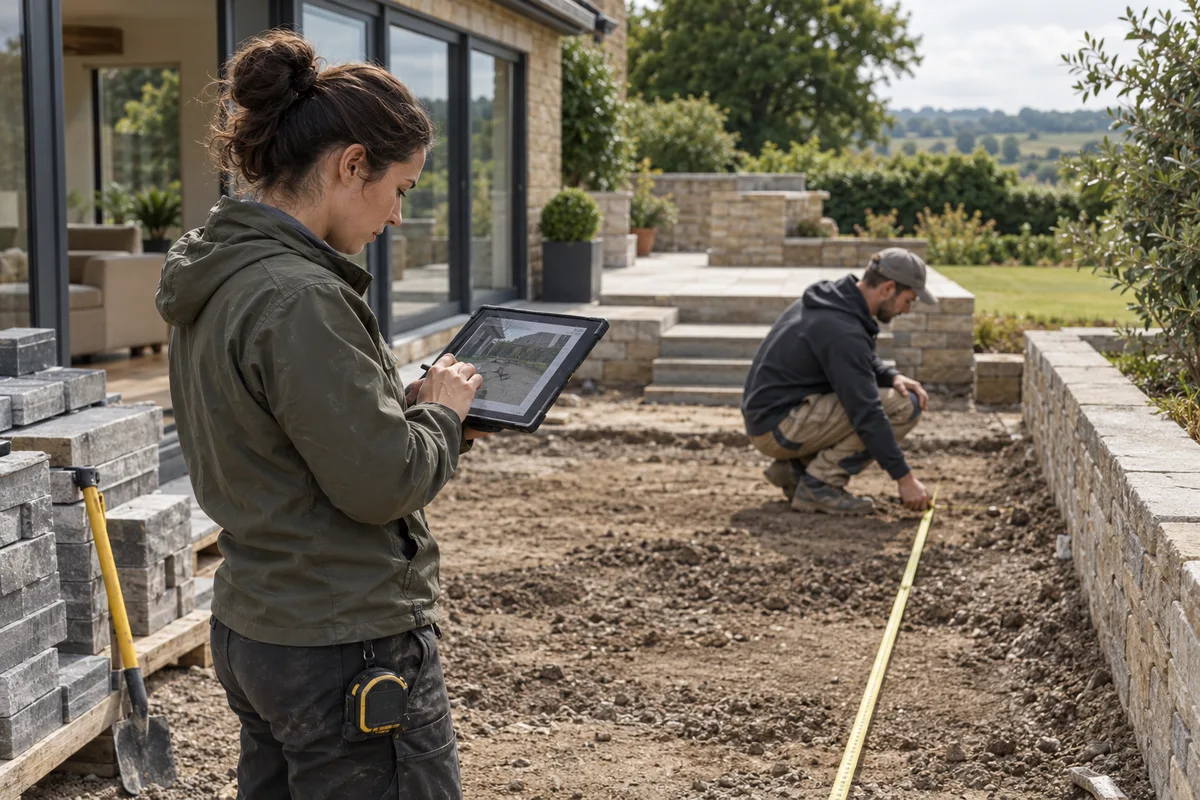
Share your requirementsA hardscaping contractor builds the non-plant parts of outdoor spaces: paved paths and driveways, patios, steps, retaining walls, stone cladding, kerbs, fountains and water features, and drainage around them. Work moves from design and quotation through excavation, base preparation, laying, jointing and finishing. Crews include skilled stone and paver layers, masons, helpers who carry and cut heavy material, and equipment operators who handle compactors and small machines. Jobs run for days or weeks at villas, resorts, parks and corporate campuses, and design intent matters: the client expects the lines and levels in the drawing. Weather, material delivery and lifting loads shape both timing and injuries. See also HR for construction and real estate.
These are the places the people side of this kind of business tends to give way. The rest of this page works through them.
HR here has to work for each of these groups, not only the office. The set-up below is written with all of them in mind.
GullyHR runs talent acquisition for permanent roles in hardscaping contractors. For each role we agree the job description with you, find and screen candidates against it, and support the offer through to joining. Tell us the role and the number of people, and we start there.
We recruit permanent employees. We do not supply contract or temporary staff.
Every business interviews, but few have a written process that works the same way for every role and every interviewer. GullyHR designs yours, from the role brief to the offer, trains your managers to run it, and can run it for you on the roles you hand us.
We agree what the role must deliver, the must-have and nice-to-have skills, and how each will be scored.
Screening call, assessment, interview rounds and decision points, sized to the role and the number of people you hire.
Structured questions for each role family and a rating guide, so two interviewers judge the same answer the same way.
A short briefing for your managers on what to ask, what to avoid and how to give a clear yes or no.
Who approves, how the offer is made, and how candidates are kept informed from first call to joining.
A designer's drawing is read loosely by the crew, so levels, patterns and joints drift from the plan and the client notices.
Carrying stone, kerbs and bags of aggregate all day wears people out, yet injuries and strain are rarely recorded.
Experienced stone and paver layers set the standard, but the skill is rarely passed on, and one departure lowers the finish.
Work is heavy in dry months and slows in the rains, leaving crews idle or sent home without a clear plan.
Some crews come from a labour supplier or a head mason, and the company does not know who they are or how they are paid.
Compactors, cutters and small excavators are run by people taught informally, with little record of competence.
Start with the topics that matter most here: Career and Succession Management; Health, Safety and Wellbeing; HR Strategy and Workforce Planning. Then work through the rest. Each topic is written for construction and real estate, not in general.
Named backups for the roles that cannot be vacant.
Induction, records, incident reporting and follow-through.
How many people, in which roles, by when, and what they will cost.
Structure, reporting lines and who is allowed to decide what.
Requisition to joining, the same way every time.
A first day that is the same for the fifth joiner as the first.
Records, attendance, leave and the day-to-day HR that must simply work.
Salary structure, payroll inputs and a month that closes on time.
Goals, reviews and ratings that hold up in a conversation.
Training planned from need rather than from the calendar.
Communication, recognition and the conditions people actually work in.
Two routes, one for complaints, one for conduct, kept separate.
Policies a manager can apply, and obligations with owners and dates.
Who leaves, when, why, and which of them mattered.
Resignation to relieving letter, in a defined order.
Records that survive people, and approvals that do not queue.
A short monthly pack management actually reads.
An HR function that runs the same way every month.
The pieces a hardscaping contractors business puts in place, in an order that makes each easier. Open any card for the detail.
A short start-of-job walk-through with the designer or supervisor on levels, patterns and key finishes, with the crew leader signing off the plan.
Lifting aids, team-lift rules, rotation of heavy tasks and an injury log, as part of the health, safety and wellbeing work.
Pair each senior layer with a junior, assess progress on a standard checklist and recognise teachers.
Pair each senior layer with a junior, assess progress on a standard checklist and recognise teachers. The competency and talent management work helps structure it.
A forward view of jobs by month with a rain-season plan for indoor-adjacent or maintenance work, so people are not sent home without notice.
A daily list of all workers, own and supplied, with the employer of record and basic details, tied to the employee information management records.
Before changing anything, find out what is true today. Work through the checks using a recent operating period. The time needed depends on the records you hold; note missing evidence and use the findings to choose a priority.
Share your requirementsConfirm with a qualified professional. What applies to you depends on your business, your state and your arrangements, and it changes. This page describes practice. It does not state a legal position.
The services below fit this kind of business best. Each starts by recording where you stand, and every later report compares against that. We do not promise outcomes.
A way to record who can lay what, and to pass skill from senior layers to juniors.
Practical routines for heavy lifting, cutting dust and small-machine use.
One record of own and supplied workers on each site.
Matching crew size to the seasonal pattern of jobs.
Start with a free conversation, or see the paid HR Diagnostic.
Understand the business, its workforce, current processes and HR challenges.
Find the missing, weak, inconsistent or person-dependent processes.
Create the structure, processes, policies, SOPs, dashboards and systems needed.
Help HR and department managers actually adopt the new system.
Digitise repetitive and approval-based workflows where it is worth doing.
Track hiring, attendance, employee cost, performance, training and attrition.
Strengthen the people-management system continuously, not once.
From the GullyHR blog: one on HR in construction and real estate, and one on each of the topics this page points to.

Site engineers, supervisors, crews and sales teams leave for different reasons. How to ask what shaped their decision and act on it between projects.
8 min readRead article

A two-hour exercise that names the roles you could not fill quickly, who could cover them, and what readiness would actually require.
7 min readRead article
A shift, weekly and monthly safety routine for rubber plants that names who checks platen guards, mill trip bars, autoclave doors, burst-test cages and slings, and who acts on near misses.
7 min readRead article
How a D2C founder can decide which digital marketing work to hire for, which to buy from an agency, and which to split, with a worksheet and a five step plan.
6 min readRead articleMore on the GullyHR blog.
Walk the drawing with the crew leader at the start, mark key levels and patterns on site and check at set stages. Clear briefing prevents most rework.
Use lifting aids and team lifts, rotate heavy tasks and record any strain or injury. Take advice from a qualified occupational health or safety professional.
Offer steady work, on-time pay, a senior grade and recognition for teaching juniors. Ask leavers why they went and act on common reasons.
Plan indoor-adjacent jobs, repairs and training, or agree a clear arrangement for unpaid weeks in advance. Confirm the rules with a qualified professional.
Hold a list of everyone on site, agree terms in writing and keep payment visible. Confirm your obligations with a qualified professional.
We would ask how designs reach the crew, how heavy lifting is handled to protect backs and hands, and how skill passes from senior layers to others. A good first piece of work is a briefing routine linking the drawing to the crew, with a lifting plan. Scope, timing and fees are confirmed in writing after we speak.
All 109 business types in construction and real estate · Find another business type
See all HR topics for construction and real estate, or another industry.
Tell us your industry, team size and the issue you want to address. Bring one example of where work gets delayed or ownership is unclear, and the deadline or decision you are working towards.