
Industries
Why hospitality employees leave and how to understand why
Hotel, restaurant and banquet staff leave for reasons that vary by department and season. How to ask what sits behind the first answer and act on it.
7 min readRead articleA bowling centre mixes a lane counter, shoe rental, a snack bar and machines that must run all evening. A small team covers league nights, parties and weekend crowds with a handful of trained hands.
Make this work for your business. Share your team size, priorities and what you need help with. We’ll use your brief to prepare for the first conversation.
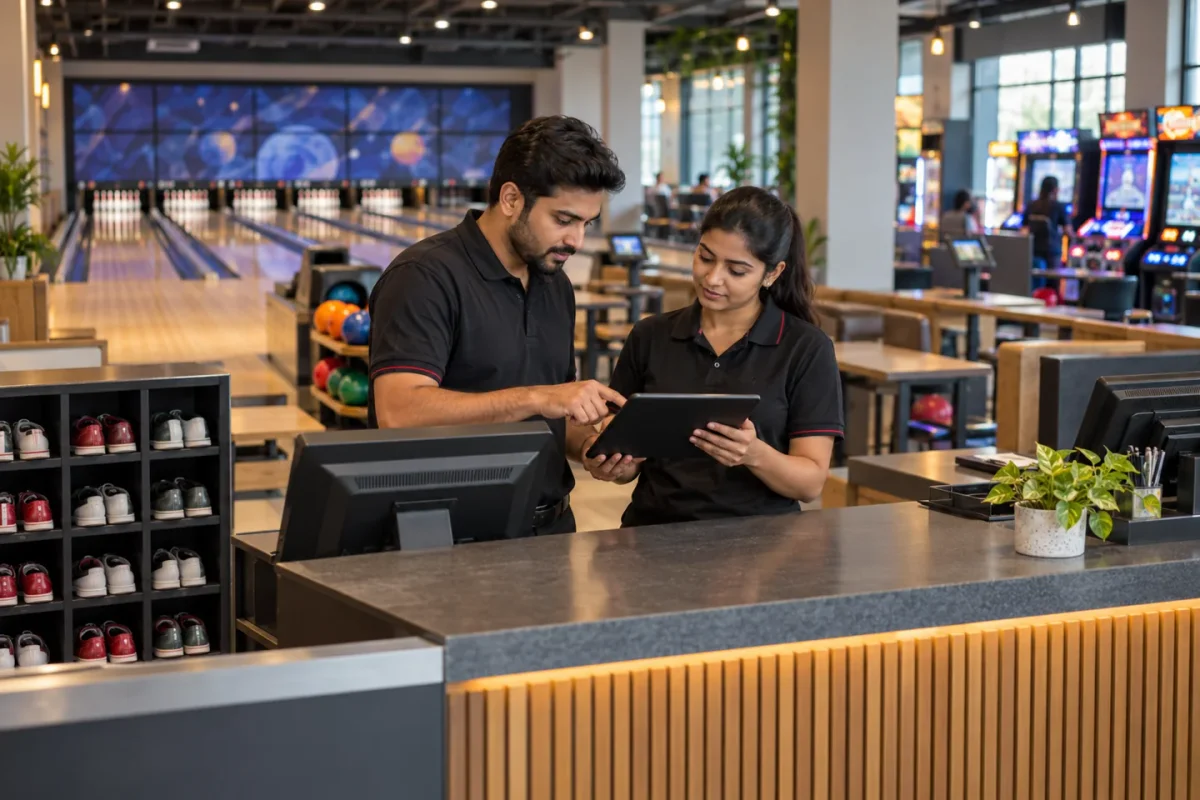
Share your requirementsA bowling centre is a compact business with a few moving parts: lanes and pin machines, shoe rental, a counter for bookings and scoring, a snack or bar area, and party rooms and a few arcade games in some centres. The team is small, so each person covers several jobs in an evening. Demand is heavily timed: league nights, weekend evenings, birthday parties and corporate bookings. A single pin-setting fault or a missing counter person can slow every lane. The owner or manager knows each staff member personally, yet pay, roles and shift rules are rarely written. See also HR for hospitality and the entertainment venues group.
These are the places the people side of this kind of business tends to give way. The rest of this page works through them.
Why GullyHR for bowling centres
For bowling centre owners and managers who rely on a small team doing three jobs each. What changes: every station has a written job, the machines have a second person and party hosts have a run sheet.
A short sheet for the lane desk, shoe counter, snack bar and party host listing what is done before, during and after an evening. Nobody guesses what the other person covers.
A trained backup who can clear the common pin machine faults when the technician is away. One jammed machine stops being the end of league night for a whole row of lanes.
A rota that is thin on quiet weekdays and full for league nights, weekend evenings and party slots, agreed in advance. Packed hours stop catching the team short.
A sheet that takes a host from the group's arrival to its departure, covering lanes, food, cake and payment. Birthday parties stop depending on whoever happens to be free.
Start with any one of these. Scope and fee are agreed in writing after a free first conversation.
We list every task done in an evening and note which person does each, and we ask who can fix a common pin machine fault if the technician is away. We count the staff you had on your last three league nights against the work required. We write down who hosts a birthday party and what they do from arrival to leaving, and list the last six people who left and where they worked in the centre. We also look at how alcohol and younger guests are handled at the bar and the lanes.
What you receive
An example, not a client storyPicture a centre where the pin technician is on holiday and a machine jams on league night. The counter staff do not know the reset, six lanes stand dark and the captain of the league team complains loudly. The audit shows the whole centre rests on one person, and the owner sees why.
How the hr audit works →We begin with the one page job for each station: lane desk, shoe rental, snack bar and arcade floor. Each says what is set up before doors open, what is done during a busy hour and what is closed down. Then the machine fault steps: the simple resets that a second person is trained to do, and when to call the technician. We write the party run sheet from a real booking. Finally opening and closing routines, with a short bar and young-guest handling step. Each is tried on a live evening.
What you receive
An example, not a client storySuppose a birthday party arrives early, the host is on the lane desk and the cake is in the wrong fridge. Nobody has written who does what. With a run sheet and a named host, the family is greeted at the door, and the cake is where it should be before the first game.
How the hr process design works →Each week we build the roster against the booking diary, with extra hands for league nights, parties and weekend evenings, and a thin plan for quiet weekdays. We keep the cross-training plan moving so each person can cover a second station. We check in with part-timers, since they leave for the next shift offer, and keep a simple record of exits and reasons. We confirm who is on call for the pin machines. A short weekly note tells the owner where the roster was tight, who is ready for more and what needs a decision.
What you receive
An example, not a client storySay two part-timers hint that they have been offered more hours elsewhere. Because we check in weekly, the manager hears it on Tuesday, not after the shift is already short. We talk to them, offer a fixed league night slot and a second station to learn, and one of them chooses to stay.
How the hr management works →Pin machine technicians are tested on diagnosing a jammed machine and explaining it to a non-technical colleague, scored with your current technician. Shift supervisors take a role play of a packed league night with a late staff member and an upset customer. Bar leads are tested on handling alcohol service and young guests calmly. Centre managers are asked how they would roster for the week's shape. We tell candidates plainly about evening and weekend hours, noise and the party peaks. We do not supply contract staff or verify backgrounds.
What you receive
An example, not a client storyTake a centre that needs a second technician and has two applicants with similar histories. A diagnosis exercise on a jammed machine shows one explains the fault clearly and the other fixes it silently. The owner wants someone who can train a backup, so the choice is clear and the reason can be written down.
How the recruitment for permanent roles works →We run a short session at the lane desk and shoe counter on the one page jobs, using a real busy hour as the example. A second person is trained alongside the technician on common faults and resets. Party hosts practise a run sheet with a mock booking, including how to handle a late group or a spilled drink. Bar and desk staff learn how to refuse service calmly and how to look after younger guests. Supervisors learn to run a league night, hand over a shift and give a quick correction without a scene.
What you receive
An example, not a client storyPicture a new bar assistant on a Saturday evening who is asked to serve a group where one guest looks too young. She is unsure and serves anyway. A short session on how to ask, refuse and call the supervisor gives her the words, and the next Saturday she uses them.
How the manager and team training works →The job pack collects the one page jobs, so anyone can see what each station involves. The roster policy explains how shifts are set, how swaps are agreed and how league nights are protected. The alcohol and young guest rule says who may serve, how refusals are handled and who is called. The machine cover rule names the backup and the escalation. We add a simple exit record. Everything goes into your HR system with acknowledgements. Your own adviser confirms the licence, safety, working-hours and employment rules that apply to a centre like yours.
What you receive
An example, not a client storySuppose a guest complains that a bar worker refused service and was rude. With a written rule, a refusal script and a signed acknowledgement, the manager can review what was expected and what was said. Without them, it is one account against another, with nothing on paper to show what the worker was told, and nobody learns anything.
How the policies, handbook and hr software works →We list every task done in an evening and who does it, then write a one page job for each station: lane desk, shoe rental, snack bar and parties. The staff review them with us so they match real life. After that, cross-training becomes planned rather than accidental. Nobody is left worrying about being the only one who knows, and the manager stops being asked who does what in the middle of a busy evening.
We ask the technician which faults are common and which resets are safe for a trained colleague, then write a short reset card and train a second person alongside him. We also set a rule for when to call him and when a lane can simply be closed for the night. Any safety duties for machine work are confirmed by your own adviser.
We build the roster against the booking diary: a thin team on quiet weekdays, more hands for league nights, weekend evenings and party slots, and a fixed approach to swaps. Part-timers get the week's roster as early as possible so they can plan their own lives. Your own adviser confirms any working-hours or notice rules that apply to your staff.
We cannot match every offer, but we can give part-timers a fixed league night slot, a second station to learn and a regular check-in. We also keep a simple record of why people leave. Staying then becomes a better choice than drifting to the next offer, and you learn which stations lose people. Pay changes remain your decision, and we only record what you agree.
GullyHR runs talent acquisition for permanent roles in bowling centres. For each role we agree the job description with you, find and screen candidates against it, and support the offer through to joining. Tell us the role and the number of people, and we start there.
We recruit permanent employees. We do not supply contract or temporary staff.
If the person who understands the pin machines is away, a fault can close lanes for hours and nobody else can fix it.
Regular leagues expect the same lanes, scoring and service week after week, and a short staffed night is noticed by every member.
The lane desk person also rents shoes, serves snacks and resets a game, and no one has agreed what comes first in a rush.
Staff hired for weekend peaks stand idle on Tuesday, and staff kept for weekdays are overwhelmed on Saturday.
A birthday group needs timings, food and a host, and the job is given to whoever is free without any preparation.
Bar staff must manage orders and behaviour in a mixed family and adult crowd, with little written guidance.
Evening work suits students and others who move on easily, and each exit takes machine and counter know-how with it.
Start with the topics that matter most here: Organisation Design; Learning and Development; Retention and Attrition Management. Then work through the rest. Each topic is written for hospitality, not in general.
Structure, reporting lines and who is allowed to decide what.
Training planned from need rather than from the calendar.
Who leaves, when, why, and which of them mattered.
How many people, in which roles, by when, and what they will cost.
Requisition to joining, the same way every time.
A first day that is the same for the fifth joiner as the first.
Records, attendance, leave and the day-to-day HR that must simply work.
Salary structure, payroll inputs and a month that closes on time.
Goals, reviews and ratings that hold up in a conversation.
Named backups for the roles that cannot be vacant.
Communication, recognition and the conditions people actually work in.
Two routes, one for complaints, one for conduct, kept separate.
Policies a manager can apply, and obligations with owners and dates.
Induction, records, incident reporting and follow-through.
Resignation to relieving letter, in a defined order.
Records that survive people, and approvals that do not queue.
A short monthly pack management actually reads.
An HR function that runs the same way every month.
The pieces a bowling centres business puts in place, in an order that makes each easier. Open any card for the detail.
Lane desk, shoe counter, snack bar and floor each get a short sheet that says what to do first in a rush.
Lane desk, shoe counter, snack bar and floor each get a short sheet that says what to do first in a rush. The role design work gives the format.
A backup technician or a trained senior attendant who can handle common faults, with a written note of what to check and when to call the mechanic.
A backup technician or a trained senior attendant who can handle common faults, with a written note of what to check and when to call the mechanic.
A pattern that expects league nights, weekends and parties, with a lean weekday crew.
A pattern that expects league nights, weekends and parties, with a lean weekday crew. The attendance and leave process covers swaps and leave.
Each person learns a second station through a short checklist and a supervised shift, so cover is possible without panic.
Each person learns a second station through a short checklist and a supervised shift, so cover is possible without panic. The learning and development process can run it.
Arrival, lane allocation, food timing, cake and closing, with a named host and a backup for every booking.
Arrival, lane allocation, food timing, cake and closing, with a named host and a backup for every booking.
Who left, from which station, after how long, and why.
Who left, from which station, after how long, and why. The retention and attrition work shows how to read it.
Confirm with a qualified professional. What applies to you depends on your business, your state and your arrangements, and it changes. This page describes practice. It does not state a legal position.
A short sheet for each station and each level, so a multi-skilled team still knows who does what first.
Station by station cross-training and a backup for the machines, so the centre does not rely on one person.
A roster that follows league nights, weekends and party bookings, with leave and swaps handled simply.
A record of who leaves and from where, so quiet drift of evening staff can be understood and slowed.
Start with a free conversation, or see the paid HR Diagnostic.
Understand the business, its workforce, current processes and HR challenges.
Find the missing, weak, inconsistent or person-dependent processes.
Create the structure, processes, policies, SOPs, dashboards and systems needed.
Help HR and department managers actually adopt the new system.
Digitise repetitive and approval-based workflows where it is worth doing.
Track hiring, attendance, employee cost, performance, training and attrition.
Strengthen the people-management system continuously, not once.
From the GullyHR blog: one on HR in hospitality, and one on each of the topics this page points to.

Hotel, restaurant and banquet staff leave for reasons that vary by department and season. How to ask what sits behind the first answer and act on it.
7 min readRead article
A founder's guide to building job grades, titles and billing levels for a growing IT services firm, with a step-by-step method and a grade description outline.
6 min readRead article
A founder's guide to hiring freshers and running a first-year programme: campus or open drives, a screening round, a training plan by quarter, mentors and checkpoints.
6 min readRead article
What really keeps mobile app and web developers in a small firm: stay conversations, growth paths, fair release rules and a risk sheet an owner can use this month.
6 min readRead articleMore on the GullyHR blog.
Count the stations running: lane desk, shoes, snacks or bar, floor and technician cover. Add a margin for breaks. Check your last league night to see where waits built up, and plan from that.
On a quiet weekday, yes. On a league night or weekend, two people are safer. Decide the rule for each type of evening and write it down, so the supervisor does not decide it in a rush.
Train a second person on common faults, keep a written checklist, and agree when to call an outside mechanic. Record what the technician does each week so knowledge is shared and not held in one head.
It helps to name a host for each booking and give them a run sheet and a backup. If the host is also watching the lane desk, the party or the desk will suffer.
Give them written guidance on service, age and behaviour, and a clear route to the supervisor. Check the licence and age rules with a qualified professional, and practise a few scenarios together.
We would ask which tasks each person does in a league night, who can fix common machine faults, and how parties are hosted. Station sheets with cross-training are a natural first piece, and scope goes into writing for your approval.
All 8 business types in entertainment venues & leisure businesses · Find another business type
Tell us your industry, team size and the issue you want to address. Bring one example of where work gets delayed or ownership is unclear, and the deadline or decision you are working towards.