
















Industries
Why retail employees leave and how to understand why
Why store staff and managers leave retail jobs, and how to ask about rosters, weekends, targets and incentives in an exit conversation that leads to action.
7 min readRead articleA retail chain runs the same shop many times over, with a floor team, a store manager and a head office that sees only totals. People decisions made in stores decide sales, shrinkage and how long staff stay.

Not sure what you need? Tell us about your business in six short steps and we will come to the first meeting prepared.
Share your requirementsA retail chain sells through a network of stores, from small neighbourhood outlets to large format showrooms and malls. Each store has a store manager, assistant managers, sales associates, cashiers, stock and back-room staff, visual merchandisers and security. Hours are long, weekends and festivals decide the year, and staff are moved between stores as needs shift. Head office wants consistent standards, accurate attendance and a clean view across stores, while each store manager makes daily people calls. See HR for retail businesses.
These are the places the people side of this kind of business tends to give way. The rest of this page works through them.
HR here has to work for each of these groups, not only the office. The set-up below is written with all of them in mind.
GullyHR runs talent acquisition for permanent roles in retail chains. For each role we agree the job description with you, find and screen candidates against it, and support the offer through to joining. Tell us the role and the number of people, and we start there.
We recruit permanent employees. We do not supply contract or temporary staff.
Every business interviews, but few have a written process that works the same way for every role and every interviewer. GullyHR designs yours, from the role brief to the offer, trains your managers to run it, and can run it for you on the roles you hand us.
We agree what the role must deliver, the must-have and nice-to-have skills, and how each will be scored.
Screening call, assessment, interview rounds and decision points, sized to the role and the number of people you hire.
Structured questions for each role family and a rating guide, so two interviewers judge the same answer the same way.
A short briefing for your managers on what to ask, what to avoid and how to give a clear yes or no.
Who approves, how the offer is made, and how candidates are kept informed from first call to joining.
Every store wants more staff in the same weeks, so hiring is rushed and induction is skipped.
Leave, transfers and warnings are settled store by store, and staff hear that another store handled the same case another way.
Some stores use registers, some use devices and some use messages, so head office cannot see who was present.
A person moves from one store to another with no written role, pay or reporting line, and trouble shows later.
A sales associate who has not learnt the billing, return rules or product range meets customers at once.
Strong people wait years for a store of their own, and leave for a competitor which gives them one sooner.
Stock loss and till differences produce blame instead of facts, and records of who worked when are poor.
Start with the topics that matter most here: Employee Administration; Onboarding and Probation; HR Analytics and Management Reporting. Then work through the rest. Each topic is written for retail, not in general.
Records, attendance, leave and the day-to-day HR that must simply work.
A first day that is the same for the fifth joiner as the first.
A short monthly pack management actually reads.
How many people, in which roles, by when, and what they will cost.
Structure, reporting lines and who is allowed to decide what.
Requisition to joining, the same way every time.
Salary structure, payroll inputs and a month that closes on time.
Goals, reviews and ratings that hold up in a conversation.
Training planned from need rather than from the calendar.
Named backups for the roles that cannot be vacant.
Communication, recognition and the conditions people actually work in.
Two routes, one for complaints, one for conduct, kept separate.
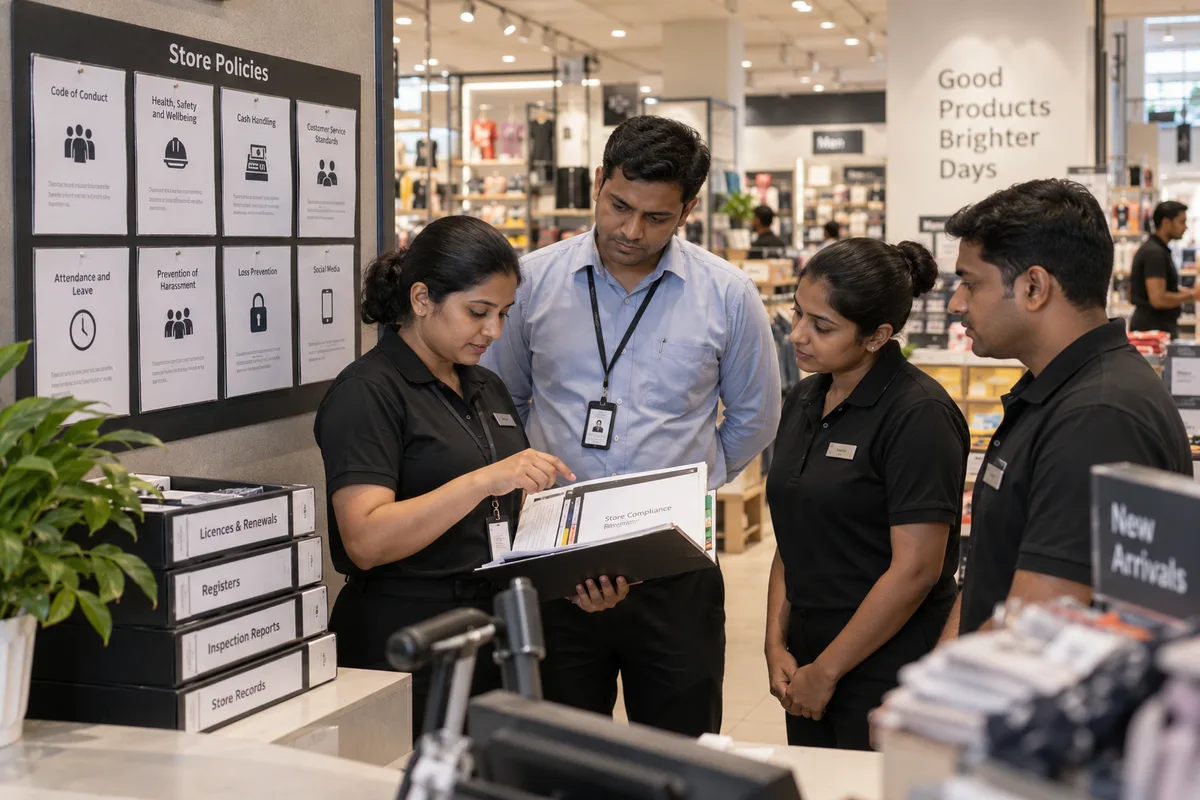
Policies a manager can apply, and obligations with owners and dates.
Induction, records, incident reporting and follow-through.
Who leaves, when, why, and which of them mattered.
Resignation to relieving letter, in a defined order.
Records that survive people, and approvals that do not queue.
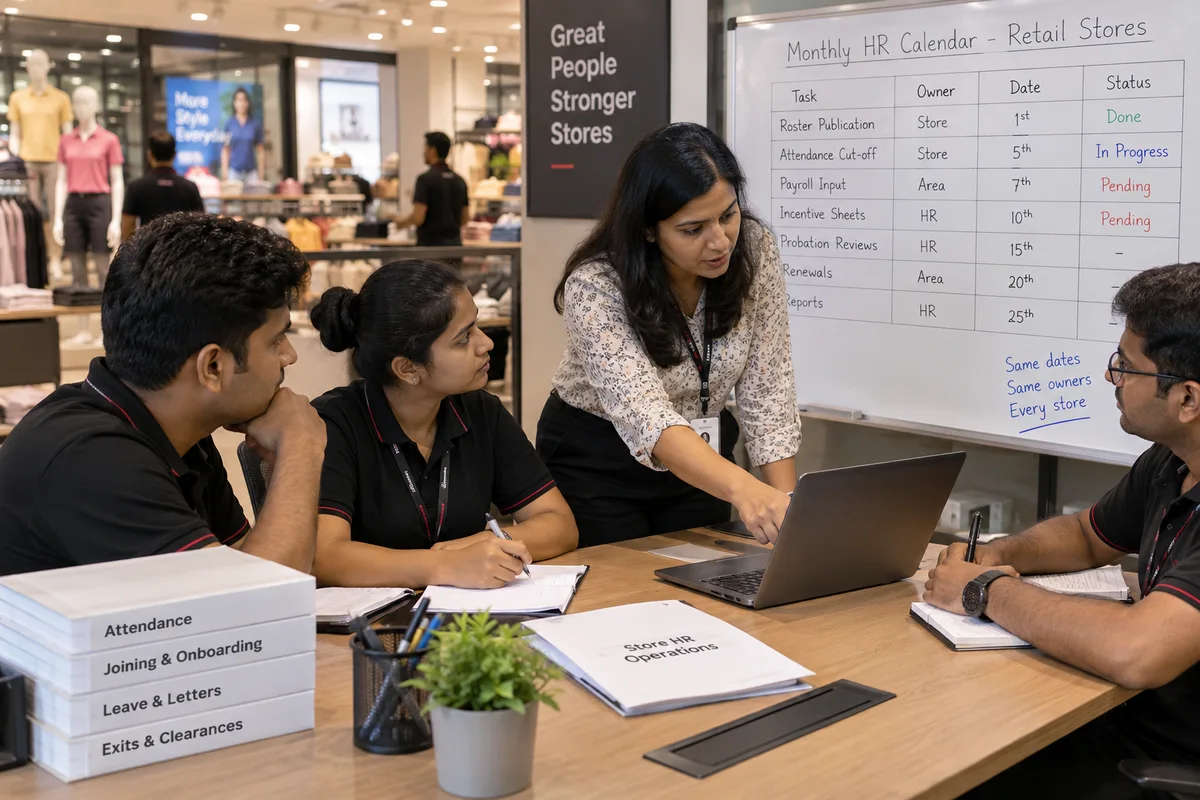
An HR function that runs the same way every month.
The pieces a retail chains business puts in place, in an order that makes each easier. Open any card for the detail.
A single way to record presence in every store, checked weekly against rosters.
A single way to record presence in every store, checked weekly against rosters. The attendance and leave process defines it.
Headcount per store, hiring dates, induction days and leave blocks agreed before the festival season.
Headcount per store, hiring dates, induction days and leave blocks agreed before the festival season.
A common induction for associates and cashiers covering range, billing, returns and customer handling.
A common induction for associates and cashiers covering range, billing, returns and customer handling. See the onboarding process.
A letter stating new store, role, pay, reporting line and date, issued before the move and recorded at head office.
A letter stating new store, role, pay, reporting line and date, issued before the move and recorded at head office.
Criteria, a short course and a trial period, so a manager is made from the floor with clear steps.
Criteria, a short course and a trial period, so a manager is made from the floor with clear steps. The manager development work supports it.
Headcount, absence, exits and vacancies by store in one sheet each month.
Headcount, absence, exits and vacancies by store in one sheet each month. The reporting and analytics work builds it.
Before changing anything, find out what is true today. Work through the checks using a recent operating period. The time needed depends on the records you hold; note missing evidence and use the findings to choose a priority.
Share your requirementsConfirm with a qualified professional. What applies to you depends on your business, your state and your arrangements, and it changes. This page describes practice. It does not state a legal position.
The services below fit this kind of business best. Each starts by recording where you stand, and every later report compares against that. We do not promise outcomes.
One way to record attendance and plan rosters across stores, with leave rules shared by all store managers.
A common first week that readies associates and cashiers before the festival crowds.
A route from assistant to store manager, with the skills taught before the promotion.
A store-wise view of absence, exits and vacancies for head office.
Start with a free conversation, or see the paid HR Diagnostic.
Understand the business, its workforce, current processes and HR challenges.
Find the missing, weak, inconsistent or person-dependent processes.
Create the structure, processes, policies, SOPs, dashboards and systems needed.
Help HR and department managers actually adopt the new system.
Digitise repetitive and approval-based workflows where it is worth doing.
Track hiring, attendance, employee cost, performance, training and attrition.
Strengthen the people-management system continuously, not once.
From the GullyHR blog: one on HR in retail, and one on each of the topics this page points to.

Why store staff and managers leave retail jobs, and how to ask about rosters, weekends, targets and incentives in an exit conversation that leads to action.
7 min readRead article
Payroll says one joining date, the personal file says another and the manager remembers a third. How to establish a single trustworthy employee record and keep it that way.
7 min readRead article
A first-week plan for bringing in an outside specialist: what access to give, how to protect client data, and the confidentiality steps to settle on day one.
7 min readRead article
Six numbers, one page, same format each month. What they are, how to define them so they mean the same thing twice, and what each one tells you.
8 min readRead articleMore on the GullyHR blog.
Work backwards from the peak date. Decide headcount by store, start hiring early, and run a short induction day before the first rush. Use your last peak's records as a guide.
They should propose and release, but head office should record and approve. That prevents hidden poaching between stores and keeps pay and reporting lines clear.
Look at the first month, the rota and the store manager. Most early exits come from poor induction and unfair rosters, which are easier to fix than pay.
Use the same measures for each: headcount against plan, absence, exits, vacancy days and training done. Adjust for store size and format before drawing conclusions.
When they can run the roster, handle cash and stock checks, resolve a customer complaint and coach staff. A trial period as acting manager tests this safely.
We would ask how stores record attendance, how the last peak was staffed and how transfers are documented. A good first project is a common attendance method plus a transfer letter. Scope is agreed in writing after that talk.
All 7 business types in coworking, franchise & Multi-Location businesses · Find another business type
See all HR topics for retail, or another industry.
Tell us your industry, team size and the issue you want to address. Bring one example of where work gets delayed or ownership is unclear, and the deadline or decision you are working towards.