



















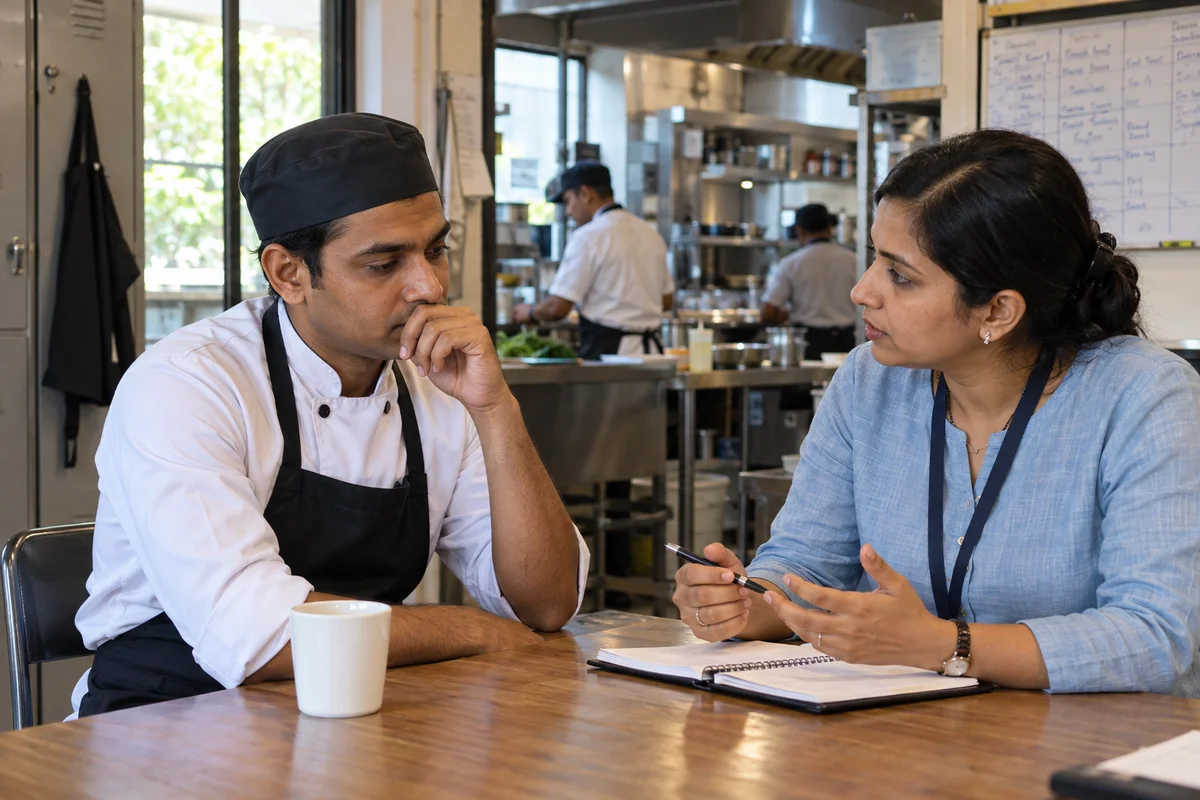
Why food and beverage staff leave and how to understand why
Kitchen, service and outlet staff leave quickly in food and beverage. How to ask what lies behind the first answer, compare outlets and act on what you learn.
7 min readRead articleAn industrial canteen feeds a factory shift by shift, at fixed minutes, for workers who have a short break and strong opinions. The kitchen team works in heat, to a clock, under two employers' eyes.

Not sure what you need? Tell us about your business in six short steps and we will come to the first meeting prepared.
Share your requirementsAn industrial canteen serves a factory or plant, usually on contract, with tea at the start of a shift, a main meal during the break and snacks at night. Meal times are fixed by the plant, so food must be ready on the minute, in the quantity the headcount demands. The kitchen team of cooks, helpers, servers and cleaners works in steam and heat, often before the first shift and after the last. The caterer answers to the plant's HR or admin head, while the workers who eat are the plant's own. A canteen is watched closely: a late lunch affects the production line. The wider food and beverage hub covers what food businesses share.
These are the places the people side of this kind of business tends to give way. The rest of this page works through them.
HR here has to work for each of these groups, not only the office. The set-up below is written with all of them in mind.
The plant's break is fixed, so a late cook or a short crew shows up as a queue of tired workers and a complaint to management.
Kitchens near furnaces of steam and oil are tough in summer, and people with options leave for cooler work.
Production changes, a night shift is added or cut, and the canteen must resize meals and staff within days.
The plant's admin office and the caterer's manager may both direct the team, and staff do not know whose word counts.
Cooks must be in before dawn, but buses start later, so lateness and tiredness appear at the same hour every week.
A night meal for a small shift often runs with one cook and no manager, and standards slip when nobody is watching.
Start with the topics that matter most here: Health, Safety and Wellbeing; Employee Relations; Retention and Attrition Management. Then work through the rest. Each topic is written for food and beverage, not in general.
Induction, records, incident reporting and follow-through.
Two routes — one for complaints, one for conduct — kept separate.
Who leaves, when, why — and which of them mattered.
How many people, in which roles, by when — and what they will cost.
Structure, reporting lines and who is allowed to decide what.
Requisition to joining, the same way every time.
A first day that is the same for the fifth joiner as the first.
Records, attendance, leave and the day-to-day HR that must simply work.
Salary structure, payroll inputs and a month that closes on time.
Goals, reviews and ratings that hold up in a conversation.
Training planned from need rather than from the calendar.
Named backups for the roles that cannot be vacant.
Communication, recognition and the conditions people actually work in.
Policies a manager can apply, and obligations with owners and dates.
Resignation to relieving letter, in a defined order.
Records that survive people, and approvals that do not queue.
A short monthly pack management actually reads.
An HR function that runs the same way every month.
The pieces a industrial canteens business puts in place, in an order that makes each easier. Open any card for the detail.
Match cooks and servers to each shift's meal time and headcount, with a note on who covers a gap.
What this coversHideMatch cooks and servers to each shift's meal time and headcount, with a note on who covers a gap. The attendance and leave process can hold the cover list.
Who the canteen team reports to, who gives day-to-day instructions and who handles the plant's requests.
What this coversHideWho the canteen team reports to, who gives day-to-day instructions and who handles the plant's requests.
Water, breaks, ventilation checks and a short rest rule written in plain words.
What this coversHideWater, breaks, ventilation checks and a short rest rule written in plain words. The health, safety and wellbeing work covers the routine.
One person, cross-trained, who can open the kitchen if the regular cook is absent.
What this coversHideOne person, cross-trained, who can open the kitchen if the regular cook is absent.
People who live close to the plant manage early starts better.
What this coversHidePeople who live close to the plant manage early starts better. The recruitment process page explains how to find and keep them.
One folder per person with joining details, site entry papers and training notes.
What this coversHideOne folder per person with joining details, site entry papers and training notes. See HR documentation.
Before changing anything, find out what is true today. These checks take an afternoon and tell you which of the topics above to start with.
Share your requirementsConfirm with a qualified professional. What applies to you depends on your business, your state and your arrangements, and it changes. This page describes practice. It does not state a legal position.
The services below fit this kind of business best. Each starts by recording where you stand, and every later report compares against that. We do not promise outcomes.
Heat, long standing and safe kitchen habits for a team that works on a clock.
Local hiring for early starters and a trial for cooks and helpers.
A clear route when complaints come from both the plant and the team.
Joining papers, site entry and training records that stand up to a visit.
Start with a free conversation, or see the paid HR Diagnostic.
Understand the business, its workforce, current processes and HR challenges.
Find the missing, weak, inconsistent or person-dependent processes.
Create the structure, processes, policies, SOPs, dashboards and systems needed.
Help HR and department managers actually adopt the new system.
Digitise repetitive and approval-based workflows where it is worth doing.
Track hiring, attendance, employee cost, performance, training and attrition.
Strengthen the people-management system continuously, not once.
From the GullyHR blog: one on HR in food and beverage, and one on each of the topics this page points to.

Kitchen, service and outlet staff leave quickly in food and beverage. How to ask what lies behind the first answer, compare outlets and act on what you learn.
7 min readRead article

A shift, weekly and monthly safety routine for rubber plants that names who checks platen guards, mill trip bars, autoclave doors, burst-test cages and slings, and who acts on near misses.
7 min readRead article
An employee brings you a complaint about their supervisor. What happens next should not depend on who is in the room. A grievance procedure a small company can actually run.
8 min readRead article
How to spot an unmanageable workload before it becomes an exit or an error, what to look at, how to talk about it and what to change, without guessing.
5 min readRead articleMore on the GullyHR blog.
Fix the cause. Check early-morning attendance, the cover list and the prep sequence. A standby cook and a written prep plan usually help more than warnings.
Write it down. The caterer's manager gives work instructions and the plant sends requests through them. Staff then know whose word counts.
Improve ventilation where you can, give water and short rests, and rotate people from the hottest section. Ask staff what helps.
Ask the plant for notice, keep a standby crew and adjust prep. A written headcount review each week helps both sides.
Appoint a named night lead, give a simple checklist and have a manager visit at odd hours. Standards follow attention.
First we would ask the plant HR head about queue delays, list cooks who travel far and note who covers each shift. A reporting line and a standby plan are a natural first piece of work, with scope agreed in writing.
All 6 business types in catering & institutional food services · Find another business type
See all HR topics for food and beverage, or another industry.
Tell us what is slowing your team down. We’ll help you find a practical way forward, starting with a conversation.
