



















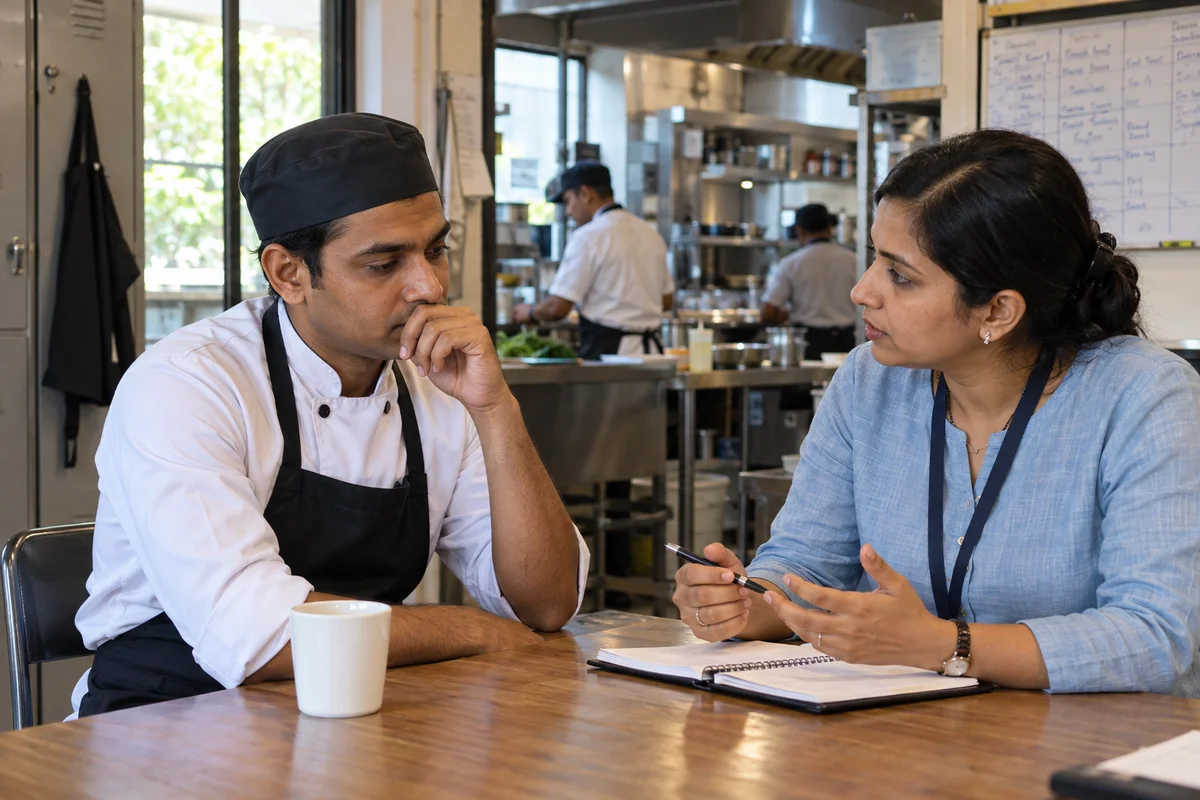
Why food and beverage staff leave and how to understand why
Kitchen, service and outlet staff leave quickly in food and beverage. How to ask what lies behind the first answer, compare outlets and act on what you learn.
7 min readRead articleA meal subscription provider cooks, packs and delivers the same customers every day. A cloud kitchen team and a delivery team must hit tight cutoffs, because a missed lunch is a lost subscriber.

Not sure what you need? Tell us about your business in six short steps and we will come to the first meeting prepared.
Share your requirementsA meal subscription provider sells a plan, not a meal: a daily or weekly tiffin, a diet box or a lunch for a working household, paid in advance. The kitchen cooks in a daily cycle, with prep the evening before, cooking at dawn, packing in a line and loading for the delivery runs. Riders or drivers carry the boxes to homes and offices within a tight window, and customers phone or message at once when something is late. The team is small, work is repetitive and mornings are crowded. A missed day loses the customer's trust, and cancellations arrive by message. The wider food and beverage hub covers what food businesses share.
These are the places the people side of this kind of business tends to give way. The rest of this page works through them.
HR here has to work for each of these groups, not only the office. The set-up below is written with all of them in mind.
Prep, cooking, packing and loading run back to back, so one late cook or packer delays every delivery that follows.
A rider is the face of the brand at the door, with no supervisor around, and manners, timing and honesty rest on one person.
A late box brings calls within minutes, and support staff take the heat for faults made in the kitchen or on the road.
Cooking starts in the dark and people living far away leave within months, so the kitchen is always training someone new.
Pauses, new joiners and diet changes alter numbers every few days, and packing sheets are corrected late.
Delivery people hear of other platforms and fleets, and leave for a few extra rupees, taking route knowledge with them.
Start with the topics that matter most here: Retention and Attrition Management; Recruitment and Talent Acquisition; Performance Management. Then work through the rest. Each topic is written for food and beverage, not in general.
Who leaves, when, why — and which of them mattered.
Requisition to joining, the same way every time.
Goals, reviews and ratings that hold up in a conversation.
How many people, in which roles, by when — and what they will cost.
Structure, reporting lines and who is allowed to decide what.
A first day that is the same for the fifth joiner as the first.
Records, attendance, leave and the day-to-day HR that must simply work.
Salary structure, payroll inputs and a month that closes on time.
Training planned from need rather than from the calendar.
Named backups for the roles that cannot be vacant.
Communication, recognition and the conditions people actually work in.
Two routes — one for complaints, one for conduct — kept separate.
Policies a manager can apply, and obligations with owners and dates.
Induction, records, incident reporting and follow-through.
Resignation to relieving letter, in a defined order.
Records that survive people, and approvals that do not queue.
A short monthly pack management actually reads.
An HR function that runs the same way every month.
The pieces a meal subscription providers business puts in place, in an order that makes each easier. Open any card for the detail.
From prep to last loading, with times and names against each step.
What this coversHideFrom prep to last loading, with times and names against each step. A copy goes up at the kitchen and at the packing line.
Rules for how a rider hands over a box, what to do when a customer is out, how to report a delay and when to call the route coordinator.
What this coversHideRules for how a rider hands over a box, what to do when a customer is out, how to report a delay and when to call the route coordinator.
What to say to a late-box call and how to reach the kitchen and route lead for a fix.
What this coversHideWhat to say to a late-box call and how to reach the kitchen and route lead for a fix. Share the performance management measures openly.
People who can step into more than one role keep the line moving on absent days.
What this coversHidePeople who can step into more than one role keep the line moving on absent days. The HR process consulting work can set the routine.
A short exit talk with each leaver and a monthly tally.
What this coversHideA short exit talk with each leaver and a monthly tally. Retention and attrition management uses it.
Local sources, a short trial and a clear description of the hours.
What this coversHideLocal sources, a short trial and a clear description of the hours. See the recruitment process.
Before changing anything, find out what is true today. These checks take an afternoon and tell you which of the topics above to start with.
Share your requirementsConfirm with a qualified professional. What applies to you depends on your business, your state and your arrangements, and it changes. This page describes practice. It does not state a legal position.
The services below fit this kind of business best. Each starts by recording where you stand, and every later report compares against that. We do not promise outcomes.
Hiring early starters and delivery staff with a practical trial.
Measures for on-time delivery, packing accuracy and customer calls, without punishing honest reporting.
Reasons people leave in the first three months, and what to change.
Clean routines for the morning cycle, handovers and cover for absent days.
Start with a free conversation, or see the paid HR Diagnostic.
Understand the business, its workforce, current processes and HR challenges.
Find the missing, weak, inconsistent or person-dependent processes.
Create the structure, processes, policies, SOPs, dashboards and systems needed.
Help HR and department managers actually adopt the new system.
Digitise repetitive and approval-based workflows where it is worth doing.
Track hiring, attendance, employee cost, performance, training and attrition.
Strengthen the people-management system continuously, not once.
From the GullyHR blog: one on HR in food and beverage, and one on each of the topics this page points to.

Kitchen, service and outlet staff leave quickly in food and beverage. How to ask what lies behind the first answer, compare outlets and act on what you learn.
7 min readRead article

How to spot an unmanageable workload before it becomes an exit or an error, what to look at, how to talk about it and what to change, without guessing.
5 min readRead article
Sources beyond the neighbouring gate for setters, turners, inspectors and leak test hands, plus a one-hour bench trial built from your own rejected parts.
7 min readRead article
Measures that show how reactor, console, lab and gantry staff are really doing, the ones that mislead or bury near misses, and a monthly sheet an in-charge can run in twenty minutes.
7 min readRead articleMore on the GullyHR blog.
Pay on time, give a clear route to senior or coordinator roles and listen to route problems. Ask leavers where they went and why.
Ask where people live, offer a pick-up point or hire closer, and cross-train so one absence does not stop the line. Review who is late and when.
A short briefing, a ride-along with a senior rider and a simple card on greeting, handover and what to do when the customer is out.
Listen, repeat the problem, say what will be done and by when, and call back. A script and a quick line to the kitchen help.
Set a daily cutoff for changes and share the final sheet with the kitchen and packers. Late changes go to the next day.
First we would watch one morning cycle, ask the kitchen head which step runs late and list the riders who left this year. A timetable and a hiring route for early starters are a natural first piece of work, with scope agreed in writing.
All 6 business types in catering & institutional food services · Find another business type
See all HR topics for food and beverage, or another industry.
Tell us what is slowing your team down. We’ll help you find a practical way forward, starting with a conversation.
