Construction and Real Estate · Steel fabrication and welding workshops
HR for Steel Fabrication and Welding Workshops: Welders, Skills and Safety
A fabrication shop turns on welder skill, shift cover and the people who can pass a weld test. Here is how to record that skill, pay for clean work and keep the welders you have trained.
Make this work for your business. Share your team size, priorities and what you need help with. We’ll use your brief to prepare for the first conversation.
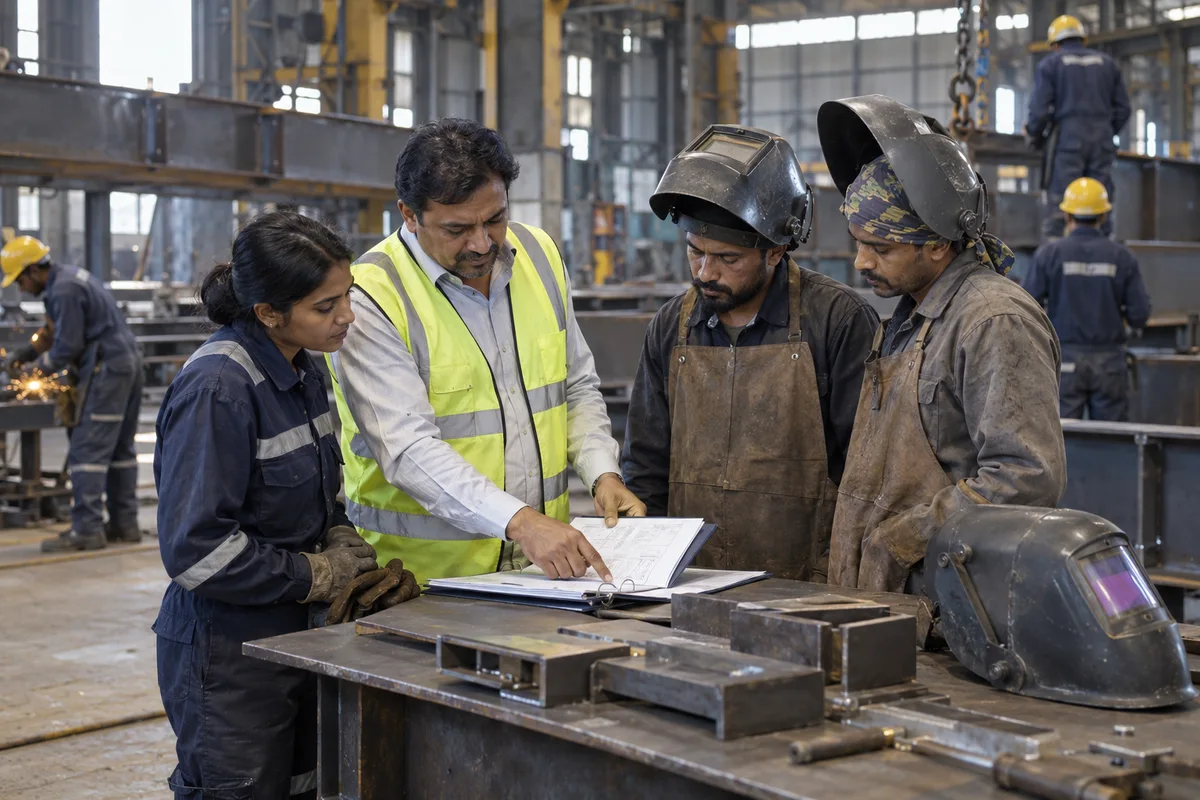
A steel fabrication workshop cuts, fits, welds and paints structurals, tanks, gates, platforms and machine frames from drawings, against dates set by a site or a plant. Fitters mark and tack, welders run MIG, TIG or stick, grinders dress the seams, painters coat, and crane operators and riggers move the loads. Welders are tested for a process, position and material, and some customers will accept only a tested hand. The shop mixes permanent staff with contract helpers, and the load follows the order book. Fumes, arc flash, hot slag, grinding discs and overhead lifts are daily hazards. Skilled welders are scarce and paid by the metre or the kilogram. For the wider sector picture, read HR for construction. A tested welder with a dated record can be put on a job and shown to the customer, while a shop that relies on reputation loses time proving it. Written lifting and ventilation rules work the same way.
Plan→
Hire→
Onboard→
Manage→
Develop→
Perform→
Engage→
Retain→
Exit→
Improve
When HR is weak in steel fabrication and welding workshops, you may see
Weld test results live in memory
Pay by the metre invites shortcuts
Contract helpers outnumber employees on busy days
Fumes, arc flash and overhead lifts are routine
Orders land in waves
Helpers learn welding by watching
Tested welders leave for a little more
These are the places the people side of this kind of business tends to give way. The rest of this page works through them.
Why GullyHR for steel fabrication and welding workshops
Tested welders on record, safe bays and pay that rewards clean work.
For fabrication shop owners who live on welder skill, order waves and customers who ask for tested hands. GullyHR writes down who can weld what, how helpers become welders and what safe looks like in each bay.
01
A welder test register with dates
We build a register of each welder's process, position, material and test expiry, so you can put the right hand on a job and show a customer the proof within the hour.
02
Metre rates with a rework charge
We write the piece-rate rule with a rework allowance and a quality check, so speed no longer pays more than a clean seam and shortcuts stop being rewarded.
03
Contract helpers listed and briefed
We set up a floor register for helpers and gas cutters, with a briefing on fumes, slings and arc flash, so busy days do not bring in people nobody has introduced to the bay.
04
A signed route from helper to welder
We write the stages a helper must be signed off on before welding alone, so learning by watching becomes a ladder and tested welders stop leaving for a little more.
Our services for steel fabrication and welding workshops
Start with any one of these. Scope and fee are agreed in writing after a free first conversation.
HR audit
We begin by listing each welder's tests and expiry dates, then ask whether any customer job could be proved from the file within the hour. We set one welder's piece-rate earnings beside their rework last month, and count the contract helpers on the floor against your own register. A walk through the bays looks at screens, extraction, slings and chains, and we talk to a helper about what must be signed off before welding alone. Our report separates what is recorded from what is only remembered by the supervisor.
What you receive
A welder test register gap list showing missing or expired tests
A piece-rate and rework comparison for a sample of welders
A bay walk report on screens, extraction, slings and helper briefing
An example, not a client storySuppose a customer's inspector asks which welder worked on a platform shipped last month and whether that person held a current test for the position. The supervisor recalls a name but cannot find a certificate. An audit would show which welders have no record and what the register must hold.
We start with the test register: process, position, material, test date, expiry and who holds the paper. Next the pay rule is written so a metre or kilogram rate carries a rework allowance and a quality check by the weld inspector before the job is counted. We then design the daily bay check for screens, extraction, slings and chains, signed by the shop supervisor. Last is the route for contract helpers, with named steps from grinding and fitting up to tack welding and, finally, a supervised weld test.
What you receive
A welder test register template with expiry and customer-acceptance columns
A piece-rate rule with a rework allowance and an inspector check
A daily bay safety check for screens, extraction, slings and chains
An example, not a client storyPicture a shop that pays by the metre and sees a welder rush a long seam on a tank, leaving porosity that the inspector finds at the end. Rework eats the margin and a day. A pay rule with a rework allowance and an inspection point would have made the clean seam the better earner.
Each week we update the welder test register and note any test falling due, so the right welder is booked for a retest before a customer asks. We reconcile the contract helper list with the people actually on the floor on busy days. Before an order wave, we sit with the works manager and plan which permanent welders, fitters and painters are on which job. We collect the signed bay checks, follow up gaps and keep the helper ladder moving, noting who is ready for the next sign-off and who needs more practice.
What you receive
A weekly test-register update showing welders due for retest
A floor head-count reconciled against the helper register on busy days
A monthly ladder report on helpers ready for the next sign-off
An example, not a client storySay several large orders land in the same fortnight and the shop swells its helper count overnight. Nobody checks who has been briefed on slings and extraction, and a helper is given a grinder with a loose guard. A weekly reconciliation would have put every new face on the register before the first shift.
The scarce people are the tested welder who is accepted by your customers, the fitter who reads drawings quickly and the inspector whose word the shop respects. We write each brief from your processes, positions and materials, then screen for the tests candidates say they hold. Interviews use scored questions on a bad fit-up, a customer rejecting a weld and a lift that looks unsafe. We pass on a shortlist with scores, notes and the tests and certificates claimed, for you and your adviser to confirm, while the trade test itself stays with your supervisors.
What you receive
A role brief for each welder, fitter, inspector and crane post
A scored interview form with fit-up, rejection and unsafe-lift scenarios
A shortlist pack listing claimed tests and certificates for confirmation
An example, not a client storyPicture a fabrication shop losing its only welder accepted by a key customer for pressure work. The owner takes the first applicant who claims a similar test and hopes for the best. A written brief naming the process and a scored interview would have shown who held proof and who only held a story.
Sessions are held on the floor, at the bay where the hazard lives, so welders and fitters practise setting screens, checking extraction and wearing the right protection for arc flash and hot slag. Crane operators and riggers go through sling inspection, signals and what to do when a load looks wrong. Supervisors learn how to brief a helper, give feedback on a weld and explain why the metre rate now carries a rework allowance. Helpers hear what each sign-off means and who gives it, and attendance is written into each person's file.
What you receive
A bay safety session on fumes, arc flash, hot slag and extraction
A rigger and crane operator session on slings, signals and unsafe loads
A supervisor workshop on briefing helpers and explaining the pay rule
An example, not a client storySuppose a new helper is asked to grind a seam beside a welder without a screen and takes a flash to the eyes. He learned the job by watching and was never told what to say. A short floor session on screens and stopping a job would have given him the words.
The handbook sets out how welders are tested, paid and promoted, in language a floor worker can read. The piece-rate policy states the rate, the rework allowance and the inspection point. A helper policy records who may be engaged, what they are briefed on and which stage they stand at on the route to welder, and bay rules for lifting, extraction and screens are written as one-page notices. In HR software we hold each welder's tests with expiry alerts and each helper's sign-offs, and your adviser confirms the contract labour, safety and wage rules that bind the shop.
What you receive
A welder handbook covering tests, piece-rate pay and promotion
A helper engagement policy with a briefing record and sign-off route
HR software test records with expiry alerts and helper sign-off history
An example, not a client storyTake a shop where one supervisor remembers who may weld what, and he leaves for a rival firm. His memory of tests and sign-offs goes with him, and a customer then asks for proof on a delivered job. A system record of each welder's tests would have stayed in the shop.
Questions owners of steel fabrication and welding workshops ask us
We build a register listing each welder's process, position, material, test date and expiry, and who holds the paper. In HR software it raises alerts to the works manager before a test lapses. Which tests your customers accept, and what a test must cover, is confirmed by your own adviser or the customer's inspector, and we set the register to match.
We write a piece-rate rule with a rework allowance and an inspection point before the metre counts, so a clean seam earns more than a fast one. We test it on a sample of recent jobs before it starts. How pay rules sit with wage duties is for your own adviser to confirm, and we draft with that in mind.
We set up a simple floor register for every helper and gas cutter, with a short briefing on fumes, slings and arc flash recorded at arrival. That puts the people on your floor on your paper. Which duties sit with you and with the contractor is something your adviser confirms. GullyHR does not supply helpers, only the routine around them.
Pay alone rarely holds a welder, so we write the route from helper to welder with named sign-offs, review how tests and rework feed earnings and set a clear conversation for a welder who is being tempted away. We recommend what to change, and your own adviser confirms any contract or notice terms involved before they are issued.
Who does the work in steel fabrication and welding workshops
MIG, TIG and arc welders
Fitters and layout markers
Grinders and fettlers
Painters and shot blasters
Crane operators and riggers
Shop supervisors and weld inspectors
Contract helpers and gas cutters
Roles we help you hire in steel fabrication and welding workshops
GullyHR runs talent acquisition for permanent roles in steel fabrication and welding workshops. For each role we agree the job description with you, find and screen candidates against it, and support the offer through to joining. Tell us the role and the number of people, and we start there.
We recruit permanent employees. We do not supply contract or temporary staff.
Where HR strains in steel fabrication and welding workshops
Weld test results live in memory
Who is tested for which process and position is known by reputation, so a customer asking for proof sets off a hunt through old paper.
Pay by the metre invites shortcuts
Weld rates reward speed, and fusion, finish and safe habits lose out when the target is tight.
Contract helpers outnumber employees on busy days
Gas cutters and fitters' helpers sent by a supplier work beside your staff with different briefings and no joint record.
Fumes, arc flash and overhead lifts are routine
Welding screens, extraction, slings and hand signals depend on habit more than on a rule anyone checks.
Orders land in waves
A tank or girder order calls for extra hands in a week, and the bay is half empty the next.
Helpers learn welding by watching
A helper picks up tack welding beside a senior, and no one signs off when the helper is fit to weld alone.
Tested welders leave for a little more
A small daily difference at the next yard is enough to lose a welder who holds your hardest test.
HR topics for steel fabrication and welding workshops
Start with the topics that matter most here: Employee Administration; Compensation, Payroll and Benefits; Health, Safety and Wellbeing. Then work through the rest. Each topic is written for construction and real estate, not in general.
The pieces a steel fabrication and welding workshops business puts in place, in an order that makes each easier. Open any card for the detail.
Keep a welder test register
Each welder's tests, process, position and expiry date, so a job goes to the right hand and a customer can be shown the page.
What this coversHide
Each welder's tests, process, position and expiry date, so a job goes to the right hand and a customer can be shown the page. The employee information management work holds it.
Add a rework charge to the metre rate
Count rejected seams in the rate and write down how a defect is charged.
What this coversHide
Count rejected seams in the rate and write down how a defect is charged. The payroll process holds the schedule.
List and brief contract helpers
Name, employer, trade and dates go in the shop's own register, and each helper gets the same fume, lifting and fire briefing as employees.
What this coversHide
Name, employer, trade and dates go in the shop's own register, and each helper gets the same fume, lifting and fire briefing as employees.
Make screens, extraction and slings a daily check
Issue, inspect and enforce, with a supervisor who can stop a lift or a weld.
What this coversHide
Issue, inspect and enforce, with a supervisor who can stop a lift or a weld. The health, safety and wellbeing work builds the routine.
Plan for order waves
A core crew, a registered pool of known welders for peaks and an overtime rule agreed before the rush.
What this coversHide
A core crew, a registered pool of known welders for peaks and an overtime rule agreed before the rush.
Give helpers a signed route to welder
A list of tasks, from tack to fillet to test piece, each signed off by a named senior.
What this coversHide
A list of tasks, from tack to fillet to test piece, each signed off by a named senior.
List each welder's tests and the date each expires.
Set one welder's metre-rate earnings beside their rework last month.
Count the contract helpers on the floor today and check they appear in your own register.
Walk the bays and look at screens, extraction, slings and chains.
Ask a helper what they must be signed off on to weld alone.
Confirm with a qualified professional the contract labour, safety and wage rules that bind your fabrication shop.
Pick one customer and see whether you could produce the weld tests for their last job within the hour.
Confirm with a qualified professional. What applies to you depends on your business, your state and your arrangements, and it changes. This page describes practice. It does not state a legal position.
Payroll says one joining date, the personal file says another and the manager remembers a third. How to establish a single trustworthy employee record and keep it that way.
Simple variable pay structures for product and engineering teams: four options, why individual metrics backfire, a build plan and a one page outline to adapt.
A shift, weekly and monthly safety routine for rubber plants that names who checks platen guards, mill trip bars, autoclave doors, burst-test cages and slings, and who acts on near misses.
Customers and inspectors ask who is tested for what, and a register answers faster than a search. It also lets you give each seam to the right welder.
Count rejected seams against the rate and write down how defects are charged. Pay for metres alone teaches speed over fusion.
Keep your own list, give them the same briefing on fumes and lifting and agree duties with their employer. Confirm the legal position with a qualified professional.
Pay fairly, recognise the harder tests, show a path to leading hand and keep conditions decent. A small gap at another yard moves people who feel unnoticed.
A core crew, a known pool and an overtime rule written beforehand, planned from the order book.
Fumes, arc flash, hot slag, grinding and overhead lifts, with equipment issued and checked. Confirm the obligations that apply with a qualified professional.
We would ask whether welder tests are on file, how metre rates shape the finish on the floor, and how contract helpers are listed and briefed. A practical first job is a weld test register with a pay rule that rewards sound seams. Nothing begins until you have agreed the scope in writing.
Yes, in your own list, with their tests and expiry dates. A customer will ask about the person who struck the arc, whoever employs them.
Tell us your industry, team size and the issue you want to address. Bring one example of where work gets delayed or ownership is unclear, and the deadline or decision you are working towards.