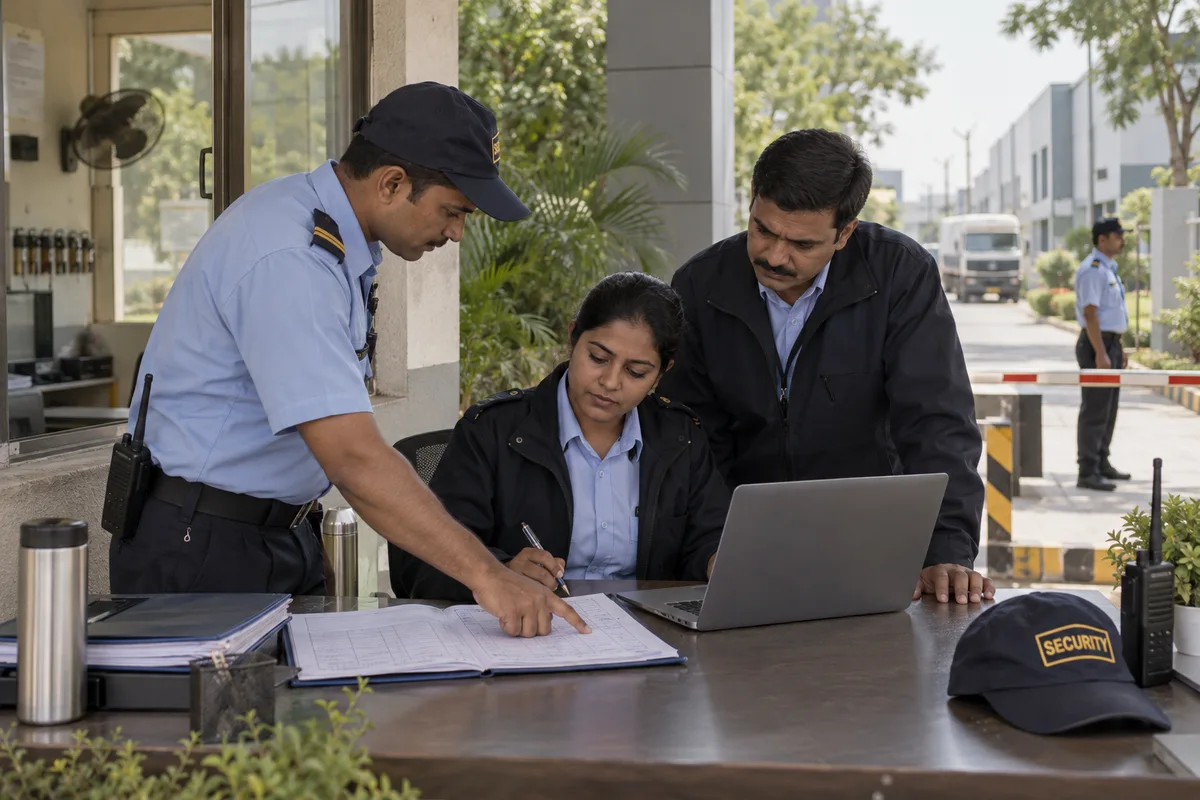
HR for Industrial Security Providers: Factory Gates, Night Rounds and Safety Awareness
An industrial security provider guards factories, warehouses, yards and industrial parks, where gates run all night and trucks, material and workers pass constantly. The guard needs steadiness, safety awareness and the nerve to say no to a supervisor.
Make this work for your business. Share your team size, priorities and what you need help with. We’ll use your brief to prepare for the first conversation.
An industrial security provider covers factory gates, stores, loading bays, yards, perimeter walls and warehouses in industrial areas. The work includes checking vehicles and materials in and out, logging movements, controlling worker entry and patrolling after dark. Plants run in shifts, so guard rosters follow production, with long hours and a lot of night work. Guards deal with truck drivers, plant managers, workers and sometimes union members, and they also have to follow the plant's own safety rules around machinery and moving vehicles. A weak gate leads to losses, a rude gate leads to arguments, and both come back to the agency. For the wider picture, see HR for security services.
Plan→
Hire→
Onboard→
Manage→
Develop→
Perform→
Engage→
Retain→
Exit→
Improve
When HR is weak in industrial security providers, you may see
The gate is where plant arguments begin
Twelve hour shifts are common and tiring
Safety rules inside the plant are unfamiliar
Night rounds carry real risk
Plants demand exactly the same guard
Supervisors split time between plants
Guards wait weeks for settled duty hours
These are the places the people side of this kind of business tends to give way. The rest of this page works through them.
Why GullyHR for industrial security providers
Gates that hold at midnight and guards who know the plant.
For agencies guarding factories, yards and warehouses round the clock. Guards arrive briefed on plant safety, rosters respect fatigue, and gate disputes have a written way to be settled.
01
A plant induction for every guard
GullyHR builds a short induction covering machinery zones, vehicle lanes, the fire assembly point and gate rules before a new guard takes a post. Unfamiliar safety rules stop being learnt on the job.
02
Rosters built around fatigue
We write roster rules that follow production shifts while limiting long runs of night duty and twelve hour days. Every guard gets a rest day that is recorded, not just promised.
03
A gate procedure for disputes
A one-page routine tells a guard what to say and whom to call when a driver, worker or plant manager argues at the barrier. The guard stops carrying the quarrel alone.
04
A bench of plant-ready relief guards
We train relief guards on the plants they may cover and keep that list current. When a guard falls sick, a briefed person arrives instead of a stranger.
Our services for industrial security providers
Start with any one of these. Scope and fee are agreed in writing after a free first conversation.
HR audit
An audit begins at the gate, at the hour when trucks queue longest, to watch what a guard has to decide on the spot. We then read the duty roster against production shifts, count the guards on twelve hour runs and check when each last had a full rest day. A night patrol guard is asked what the round feels like. We test whether guards know the fire assembly point, review gate registers for gaps and speak with a plant head about what they dislike. One written report follows.
What you receive
A gate observation note covering the busiest hour at one plant
A fatigue and rest-day table drawn from the duty rosters
A ranked list of fixes for gate, roster and night rounds
An example, not a client storySuppose a plant head complains that guards were rude to a supplier's driver, and the agency's only answer is to replace the guard. An audit would watch the gate at the same hour, find a driver arriving without papers and a guard with no script, and recommend a procedure rather than a dismissal.
Process design starts at the barrier, with a written route for what a guard does when a driver pushes, a worker disputes a bag check or a manager waves a vehicle through. Next comes the plant induction, a short sequence covering machinery zones, vehicle movement and the fire assembly point. Third is the supervisor visit routine, since supervisors split their time between plants and need a schedule showing who checked which post and when. Each is written so a guard can follow it under pressure, at night, with nobody to ask.
What you receive
A one-page gate dispute procedure with words to use and numbers to call
A plant induction sheet covering machinery zones and the fire assembly point
A supervisor visit schedule and log for each plant
An example, not a client storyTake a guard who is shouted at by a driver whose truck was refused entry, with the plant manager walking over to side with the driver. A written dispute procedure would tell the guard to hold the barrier, log the event and call the supervisor, and the manager would meet a process rather than an argument.
Week to week, we rebuild the roster against each plant's production shifts and check that no guard drifts into back-to-back night runs. Attendance and late arrivals are logged each morning. Supervisor visit sheets are collected and read, so a skipped post shows up in days, not months. We hold a regular call with each plant head, note complaints and praise, and feed them back to guards. Relief guard availability is kept as a live list, and any change in a plant's own safety rules goes straight into the induction.
What you receive
A weekly roster with fatigue flags marked by plant
A supervisor visit log showing each post checked and when
A short plant feedback note for each client site each month
An example, not a client storyPicture a plant that moves a production line to night running with two days' notice. Under management, the roster is rebuilt the same day, relief guards already briefed on that plant are called in, and the duty sheet shows who has had rest, so no guard slips into a fourth night without a break.
Hiring for industrial duty means finding people who stay calm when a driver shouts and still say no to a supervisor who wants a shortcut. We write a role profile for gate guards, patrol guards and control room operators, then set a short situational conversation: a truck without papers, a worker without a pass, a dark corner of the yard. Plant supervisors are chosen for how they run a post and speak to a plant head. Every candidate gets the same questions, and the interview notes are kept.
What you receive
A role profile for the gate guard and the night patrol guard
A situational question set with a simple scoring sheet
A supervisor selection note covering plant-head conversation skills
An example, not a client storyTake an agency that fills a vacant night patrol post by sending the first available man, and he walks off after one round in the yard. A profile that names calm, fitness for night work and comfort alone in the dark, tested in conversation, would have shown the mismatch before the posting.
Training is built around the plant, not a classroom. Guards practise vehicle and material checks with a real gate pass and a real delivery note, and rehearse how to refuse an entry politely and firmly. Night patrol guards walk the round with a supervisor and agree what to do on finding an open door. Control room operators practise logging movements and escalating an alarm. Supervisors learn to give feedback on a post visit. Everyone is shown where the fire assembly point is and what the plant expects when machinery stops.
What you receive
A gate practice session using real passes and delivery notes
A night round walk-through with a checklist for the patrol guard
A supervisor session on giving feedback after a post visit
An example, not a client storySay a guard is told by a plant manager to let a loaded truck leave without a gate pass because the buyer is waiting. A practice session on exactly this moment, with the words to use and the person to call, gives the guard something to say that protects both the plant and himself.
The handbook sets out duty hours, rest days, night allowances as the agency has agreed them, uniform and conduct at the gate. A roster rule limits long runs of night work and twelve hour days. An incident register captures gate disputes, near misses and losses, and a handover record passes information from one shift to the next. Guard files hold induction dates, post history and any warnings. Licensing, guard registration and employment points are flagged for your own adviser to confirm. All of it sits in software that supervisors can use from a phone.
What you receive
A guard handbook written in plain language for plant duty
An incident register and shift handover form for every post
A guard file template recording induction, posts and warnings
An example, not a client storyPicture a loss reported at a loading bay, and nobody can say which guard held the post or what was handed over at shift change. A written handover record and incident register would let the owner trace the sequence in minutes and answer the plant head calmly with facts rather than guesses.
Questions owners of industrial security providers ask us
GullyHR would write roster rules that follow each plant's production shifts but limit consecutive nights and long duty runs, and record every rest day. We would also keep a bench of relief guards briefed on each plant. Working-hour and rest rules differ from place to place, so your own adviser confirms exactly what applies to your agency and your guards.
We would write a one-page gate procedure naming what the guard says, who the guard calls and how the event is logged, then practise it in a short session on the gate itself. The guard gets words to use and backing from the agency, so the quarrel does not fall on one person standing alone at the barrier.
Yes. We would build a short plant induction for each client site, covering machinery zones, moving vehicles, the fire assembly point and the plant's own gate rules, and hold it before the guard's first shift. The plant head signs off the content, and a simple record shows who was briefed, by whom and on which date.
We would set up a visit routine with a schedule by plant and a simple log each supervisor fills in at the post, then read the logs weekly. A skipped post shows up quickly, and supervisors get a fair way to show their work. Any pay or allowance linked to visits is checked with your own adviser.
Who does the work in industrial security providers
Roles we help you hire in industrial security providers
GullyHR runs talent acquisition for permanent roles in industrial security providers. For each role we agree the job description with you, find and screen candidates against it, and support the offer through to joining. Tell us the role and the number of people, and we start there.
We recruit permanent employees. We do not supply contract or temporary staff.
Where HR strains in industrial security providers
The gate is where plant arguments begin
Disputes over a late truck, a missing pass or a manager in a hurry land on one guard, who needs to stay firm without picking a fight.
Twelve hour shifts are common and tiring
Plant clients want long coverage, and tired guards miss detail at exactly the points where losses occur.
Safety rules inside the plant are unfamiliar
A guard new to a factory may not know forklift paths, restricted areas or emergency drill roles, and nobody has told them.
Night rounds carry real risk
Guards walking dark yards alone face animals, uneven ground and trespassers, with little backup or training for such moments.
Plants demand exactly the same guard
A client who likes one guard resists replacements, so absences become awkward conversations with the plant head.
Supervisors split time between plants
A supervisor covering several plants spends hours on the road, and records of what was checked are thin.
Guards wait weeks for settled duty hours
Changes in plant shifts, shutdowns and overtime requests arrive late, so guards cannot plan home life.
HR topics for industrial security providers
Start with the topics that matter most here: Health, Safety and Wellbeing; Learning and Development; HR Analytics and Management Reporting. Then work through the rest. Each topic is written for security services, not in general.
The pieces a industrial security providers business puts in place, in an order that makes each easier. Open any card for the detail.
Hold a plant induction for every new guard
Safety rules, restricted zones, vehicle movement, emergency roles and contacts shown on the ground, with a sign-off.
What this coversHide
Safety rules, restricted zones, vehicle movement, emergency roles and contacts shown on the ground, with a sign-off. See workplace health, safety and wellbeing.
Design the roster around fatigue
Limits on stretches of long hours, rest between shifts and a fair pattern for nights, agreed with the plant head in advance.
What this coversHide
Limits on stretches of long hours, rest between shifts and a fair pattern for nights, agreed with the plant head in advance.
Write a gate procedure for disputes
A script for what the guard says, who to call and how to record a refusal, so a manager in a hurry meets a calm routine.
What this coversHide
A script for what the guard says, who to call and how to record a refusal, so a manager in a hurry meets a calm routine.
Train a bench of plant-ready relief guards
A small group who know two or three plants well and can step in without a client complaint.
What this coversHide
A small group who know two or three plants well and can step in without a client complaint.
Set supervisor visit routines by plant
A calendar with night visits, a checklist of points seen and a note filed within the day.
What this coversHide
A calendar with night visits, a checklist of points seen and a note filed within the day.
Walk one plant gate at the busiest hour and note where a guard has to make a hard call.
Count the guards on twelve hour duty and the weeks since they had a full rest day.
Ask a night patrol guard what scares them most about the round.
Check whether every guard can say where the plant fire assembly point is.
Ask a plant head what they most dislike about the current guards.
Confirm with a qualified professional the licensing, guard registration and employment rules that apply to a private security agency working in factories and warehouses.
Confirm with a qualified professional. What applies to you depends on your business, your state and your arrangements, and it changes. This page describes practice. It does not state a legal position.
Why guards and supervisors leave security agencies, and how to ask about duty hours, relievers, pay timing and site conditions in an exit conversation.
A shift, weekly and monthly safety routine for rubber plants that names who checks platen guards, mill trip bars, autoclave doors, burst-test cages and slings, and who acts on near misses.
A founder's guide to hiring freshers and running a first-year programme: campus or open drives, a screening round, a training plan by quarter, mentors and checkpoints.
Give a simple script, a named contact and a rule that disputes are recorded, not argued. Role play it once. Tell the plant head your procedure so the gate has support from both sides.
Yes, if you show the plant head figures on tiredness, missed checks or absences and propose a roster that keeps coverage. Clients respond to a clear plan more than to general complaints.
Vehicle movement, restricted zones, forklift routes, fire points and how to handle material checks. Each plant differs, so an on-site induction is worth more than a general course.
Pair high-risk rounds, give proper torches and radios, set regular check-in times and have supervisors visit at night. Ask guards where they feel exposed and fix those spots first.
Respect the reason, but build a trained relief who has shadowed that guard. A single person should never be the only way a post can run.
We would walk a plant gate at its busiest hour, count guards on long duty with no rest day and ask supervisors how they spend their week. A plant induction plus a roster limit on long hours is a sensible first job, with scope in writing.
Tell us your industry, team size and the issue you want to address. Bring one example of where work gets delayed or ownership is unclear, and the deadline or decision you are working towards.