



















GullyHR

Restaurants & Cafes · Food courts

HR for Food Courts: Many Counters, One Floor and Mall Hours

A food court puts many counters, and sometimes many employers, under one roof. Staff work to mall timings, share seating, cleaning and queues, and a single complaint can land on the wrong counter.

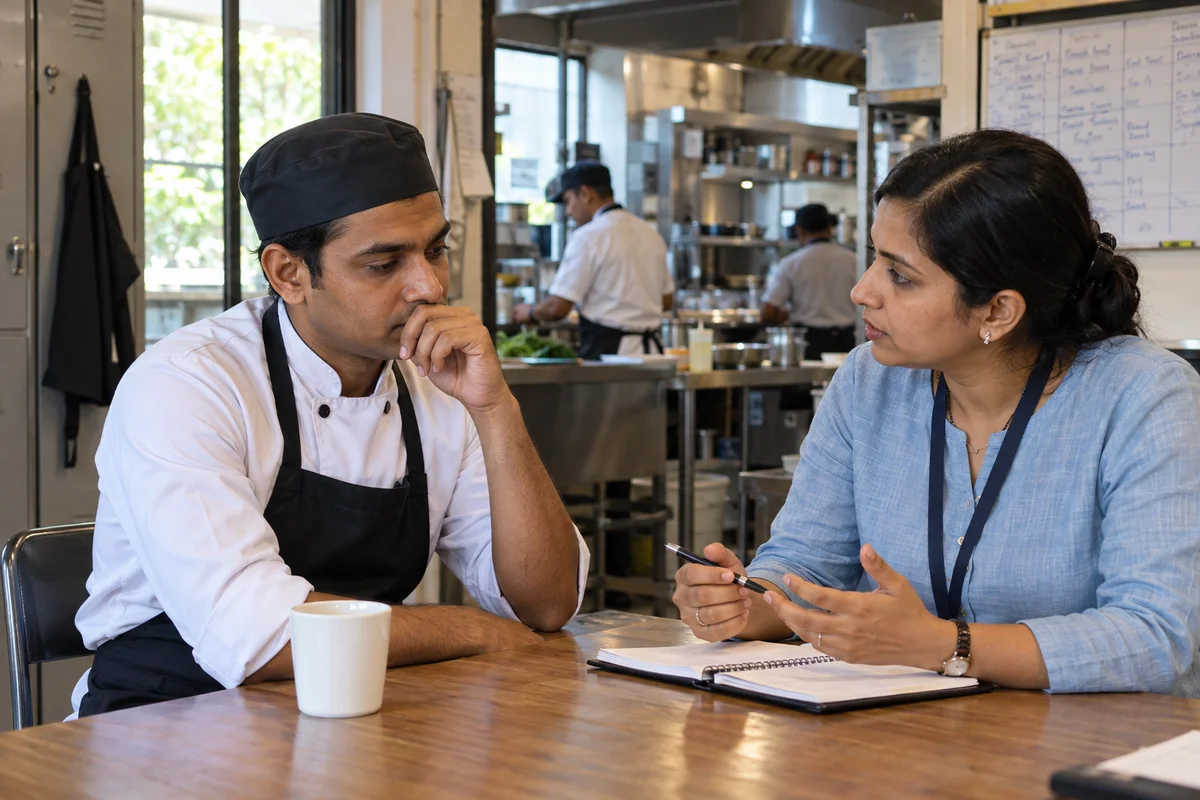
A restaurant manager, chef and service supervisor planning staffing before opening

Not sure what you need? Tell us about your business in six short steps and we will come to the first meeting prepared.

Share your requirements

A food court is a row of counters facing a shared seating area, usually inside a mall, a transit hub or an office park. Some courts are run by one operator with many brands. Others are a landlord's space with independent counters, each with its own staff. Everyone works to mall opening hours, and the busy periods are lunch, evening and weekends. Cooks, counter staff, runners and cleaners share a floor, so their behaviour is seen by the same guests. The wider food and beverage hub covers what the sector shares.

  1. Plan
  2. Hire
  3. Onboard
  4. Manage
  5. Develop
  6. Perform
  7. Engage
  8. Retain
  9. Exit
  10. Improve

When HR is weak in food courts, you may see

  • Mall timings fix the day, not the owner
  • Counters under different employers share one floor
  • The lunch rush is short and intense
  • Cleaning of the common area is nobody's job
  • Staff compare pay across counters
  • Mall security rules apply to staff
  • Weekends and holidays are the busiest days

These are the places the people side of this kind of business tends to give way. The rest of this page works through them.

Who does the work in food courts

HR here has to work for each of these groups, not only the office. The set-up below is written with all of them in mind.

  • Counter cooks and fry station staff
  • Billing and order counter staff
  • Food court managers and supervisors
  • Table cleaning and tray return staff
  • Seating area attendants
  • Dishwashing and kitchen helpers
  • Stock and store keepers
  • Mall coordination staff

Where HR strains in food courts

  • Mall timings fix the day, not the owner

    Opening and closing times follow the mall, so staff stay late on busy nights and arrive early on days with deliveries.

  • Counters under different employers share one floor

    Guests see one food court, but staff answer to different owners, and shared problems such as cleaning are left to nobody.

  • The lunch rush is short and intense

    Peak lunch and weekend evening queues need full strength for two hours, while the rest of the day needs far fewer.

  • Cleaning of the common area is nobody's job

    Tables stay dirty at peak because each counter thinks the court operator is responsible, and guests blame everyone.

  • Staff compare pay across counters

    People who stand ten metres apart learn what the next counter pays, and move at the first better offer.

  • Mall security rules apply to staff

    Passes, entry points, bag checks and uniform rules set by the mall add steps to every morning and every exit.

  • Weekends and holidays are the busiest days

    Leave is hard to give, so staff go without festivals and family events, and absence rises just before long weekends.

HR topics for food courts

Start with the topics that matter most here: Policies, Compliance and Governance; Employee Relations; Employee Administration. Then work through the rest. Each topic is written for food and beverage, not in general.

Policies, Compliance and Governance

Policies a manager can apply, and obligations with owners and dates.

Employee Relations

Two routes — one for complaints, one for conduct — kept separate.

Employee Administration

Records, attendance, leave and the day-to-day HR that must simply work.

HR Strategy and Workforce Planning

How many people, in which roles, by when — and what they will cost.

Organisation Design

Structure, reporting lines and who is allowed to decide what.

Recruitment and Talent Acquisition

Requisition to joining, the same way every time.

Onboarding and Probation

A first day that is the same for the fifth joiner as the first.

Compensation, Payroll and Benefits

Salary structure, payroll inputs and a month that closes on time.

Performance Management

Goals, reviews and ratings that hold up in a conversation.

Learning and Development

Training planned from need rather than from the calendar.

Career and Succession Management

Named backups for the roles that cannot be vacant.

Employee Engagement and Experience

Communication, recognition and the conditions people actually work in.

Health, Safety and Wellbeing

Induction, records, incident reporting and follow-through.

Retention and Attrition Management

Who leaves, when, why — and which of them mattered.

Exit and Alumni Management

Resignation to relieving letter, in a defined order.

HR Technology and Automation

Records that survive people, and approvals that do not queue.

HR Analytics and Management Reporting

A short monthly pack management actually reads.

HR Operations and Governance

An HR function that runs the same way every month.

What a working HR set-up looks like

The pieces a food courts business puts in place, in an order that makes each easier. Open any card for the detail.

Define who owns the shared floor

A written arrangement on who cleans seating, who returns trays and who handles complaints, with named supervisors for each shift.

What this covers

A written arrangement on who cleans seating, who returns trays and who handles complaints, with named supervisors for each shift.

Roster to the footfall, not the clock

Plan strength by lunch, evening and weekend peaks, with part-time cover for the rush.

What this covers

Plan strength by lunch, evening and weekend peaks, with part-time cover for the rush. The attendance, shift and leave process can carry the pattern.

Create one induction for every counter

A common half-day on mall rules, hygiene routine, guest behaviour and complaints, followed by a counter-specific hour.

What this covers

A common half-day on mall rules, hygiene routine, guest behaviour and complaints, followed by a counter-specific hour.

Write clear reporting lines

For each counter, who the cook reports to, who the supervisor is and who speaks to the mall.

What this covers

For each counter, who the cook reports to, who the supervisor is and who speaks to the mall. Role design helps fix them.

Set a short rule for disputes at the counter

A simple route for staff to raise an issue with a colleague or a guest, and for the supervisor to settle it before it grows.

What this covers

A simple route for staff to raise an issue with a colleague or a guest, and for the supervisor to settle it before it grows.

Start by checking where you stand

Before changing anything, find out what is true today. These checks take an afternoon and tell you which of the topics above to start with.

Share your requirements
  • Walk the court at the peak hour and count who is cleaning tables.
  • Ask three counter staff what they earn compared with the counter next door.
  • List mall rules that staff must follow at entry and exit.
  • Count absences in the three days before the last long weekend.
  • Ask the supervisor how many complaints last week reached the manager.
  • Confirm with a qualified professional the shop, food, working hour and contractor rules that apply to a food court operator in your state.

Confirm with a qualified professional. What applies to you depends on your business, your state and your arrangements, and it changes. This page describes practice. It does not state a legal position.

How GullyHR helps

The services below fit this kind of business best. Each starts by recording where you stand, and every later report compares against that. We do not promise outcomes.

Start with a free conversation, or see the paid HR Diagnostic.

Our HR transformation approach

  1. 1

    Assess

    Understand the business, its workforce, current processes and HR challenges.

  2. 2

    Identify gaps

    Find the missing, weak, inconsistent or person-dependent processes.

  3. 3

    Design

    Create the structure, processes, policies, SOPs, dashboards and systems needed.

  4. 4

    Implement

    Help HR and department managers actually adopt the new system.

  5. 5

    Automate

    Digitise repetitive and approval-based workflows where it is worth doing.

  6. 6

    Measure

    Track hiring, attendance, employee cost, performance, training and attrition.

  7. 7

    Improve

    Strengthen the people-management system continuously, not once.

Blogs worth reading first

From the GullyHR blog: one on HR in food and beverage, and one on each of the topics this page points to.

HR Process

What should an employee handbook include?

A practical contents list for an employee handbook in a growing Indian business: what to cover, what to leave to policies, and how to keep it usable and current.

5 min readRead article

More on the GullyHR blog.

Questions owners ask

Each employer owns its own staff, but the court operator can set common rules on conduct, hygiene, uniform and shared duties. Write them down, agree them with every counter and appoint one person to apply them.

Your next chapter

Let’s make HR work better.

Tell us what is slowing your team down. We’ll help you find a practical way forward, starting with a conversation.

  • A free first conversation with an HR practitioner
  • A clear scope and fee before any paid work
  • A practical next step for your business

Let’s start with your business

Share your contact details and the HR challenge on your mind. We’ll help you find the right starting point.

10-digit Indian mobile, without +91.

Your details stay private. Privacy policy


