



















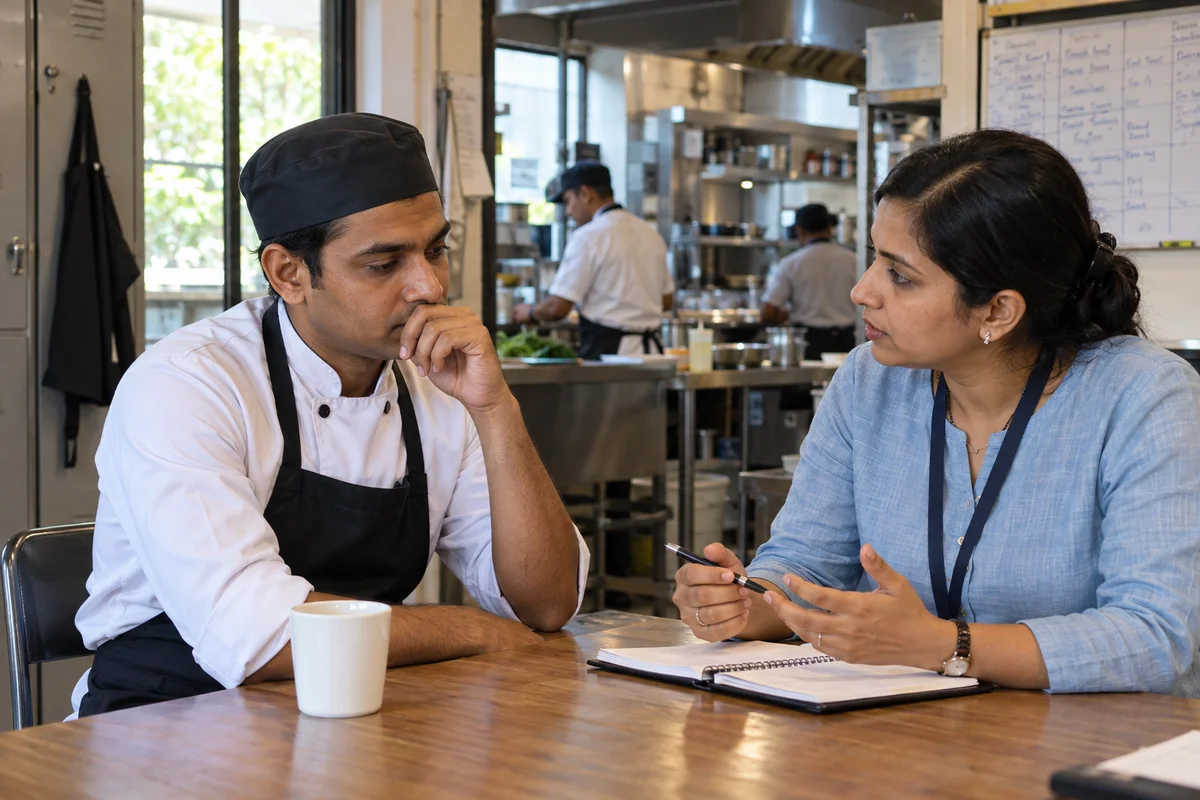
Why food and beverage staff leave and how to understand why
Kitchen, service and outlet staff leave quickly in food and beverage. How to ask what lies behind the first answer, compare outlets and act on what you learn.
7 min readRead articleA bakery works while the town sleeps. Bakers start past midnight, ovens set the pace and counter staff sell what was made hours before. Skill, early hours and heat shape every people decision.

Not sure what you need? Tell us about your business in six short steps and we will come to the first meeting prepared.
Share your requirementsA bakery has two teams under one roof. The production team mixes, shapes, proves and bakes from the small hours, and the counter team sells from morning to night. Dough, ovens and timing decide the day, so a late baker means empty shelves, not a slow service. Skill is held by a few senior bakers, often learnt on the job over years. Festivals, weddings and cake orders bring sharp peaks, followed by quiet days. Owners with several shops also run a central kitchen that supplies them. The wider food and beverage hub covers what the sector shares.
These are the places the people side of this kind of business tends to give way. The rest of this page works through them.
HR here has to work for each of these groups, not only the office. The set-up below is written with all of them in mind.
Quality depends on the senior baker, and if he or she leaves or falls ill, taste and texture change overnight.
Night and early starts are hard to staff, travel at that hour is uncertain and people are tired by the end of the week.
Orders double before a festival, extra hands are found at short notice and the regular team is stretched for days.
Burns, back strain and flour in the air affect the production team, and minor injuries are often left unreported.
A helper may wait years to touch the dough, so ambitious ones leave and set up their own small bakery.
Counter staff do not know what was baked or what is running short, and the kitchen does not hear what guests ask for.
Wastage is blamed on whoever is nearest, and the counter team feels watched about things they cannot control.
Start with the topics that matter most here: Learning and Development; Organisation Design; Health, Safety and Wellbeing. Then work through the rest. Each topic is written for food and beverage, not in general.
Training planned from need rather than from the calendar.
Structure, reporting lines and who is allowed to decide what.
Induction, records, incident reporting and follow-through.
How many people, in which roles, by when — and what they will cost.
Requisition to joining, the same way every time.
A first day that is the same for the fifth joiner as the first.
Records, attendance, leave and the day-to-day HR that must simply work.
Salary structure, payroll inputs and a month that closes on time.
Goals, reviews and ratings that hold up in a conversation.
Named backups for the roles that cannot be vacant.
Communication, recognition and the conditions people actually work in.
Two routes — one for complaints, one for conduct — kept separate.
Policies a manager can apply, and obligations with owners and dates.
Who leaves, when, why — and which of them mattered.
Resignation to relieving letter, in a defined order.
Records that survive people, and approvals that do not queue.
A short monthly pack management actually reads.
An HR function that runs the same way every month.
The pieces a bakeries business puts in place, in an order that makes each easier. Open any card for the detail.
One card per product with quantities, timings and a photo of the finished item, so quality does not rest with one baker.
What this coversHideOne card per product with quantities, timings and a photo of the finished item, so quality does not rest with one baker. See role design for who owns which product.
Helper, assistant baker, baker, senior baker and head baker, each with a list of products and tasks to prove, tied to pay.
What this coversHideHelper, assistant baker, baker, senior baker and head baker, each with a list of products and tasks to prove, tied to pay. The learning and development process supports it.
List festivals, local events and wedding season for the year, and decide extra hands, leave limits and overtime in advance, not a week before.
What this coversHideList festivals, local events and wedding season for the year, and decide extra hands, leave limits and overtime in advance, not a week before.
Five minutes on what was baked, what is short and what guests asked for, led by the shop manager.
What this coversHideFive minutes on what was baked, what is short and what guests asked for, led by the shop manager.
A practical session on ovens, trays, racks and wet floors, with an injury log kept in the kitchen.
What this coversHideA practical session on ovens, trays, racks and wet floors, with an injury log kept in the kitchen. The health, safety and wellbeing work can shape it.
Before changing anything, find out what is true today. These checks take an afternoon and tell you which of the topics above to start with.
Share your requirementsConfirm with a qualified professional. What applies to you depends on your business, your state and your arrangements, and it changes. This page describes practice. It does not state a legal position.
The services below fit this kind of business best. Each starts by recording where you stand, and every later report compares against that. We do not promise outcomes.
A route from helper to baker, with products proved at each step.
Clear roles for production, decoration, packing and the counter, so each person knows their own task.
Routines for heat, lifting, slips and tiredness on night and early shifts.
A hiring route and a practical trial for bakers, plus extra hands ready for peak season.
Start with a free conversation, or see the paid HR Diagnostic.
Understand the business, its workforce, current processes and HR challenges.
Find the missing, weak, inconsistent or person-dependent processes.
Create the structure, processes, policies, SOPs, dashboards and systems needed.
Help HR and department managers actually adopt the new system.
Digitise repetitive and approval-based workflows where it is worth doing.
Track hiring, attendance, employee cost, performance, training and attrition.
Strengthen the people-management system continuously, not once.
From the GullyHR blog: one on HR in food and beverage, and one on each of the topics this page points to.

Kitchen, service and outlet staff leave quickly in food and beverage. How to ask what lies behind the first answer, compare outlets and act on what you learn.
7 min readRead article

Plastics training dies when it waits for a free Saturday. Tie it to mould changes, purges and cold starts, use one-point lessons and a visible skill ladder, and protect it in peak months.
7 min readRead article
A flat structure works until the founder becomes the only route to a decision. How to tell when you have passed that point, and how to redesign without a reorganisation.
8 min readRead article
A shift, weekly and monthly safety routine for rubber plants that names who checks platen guards, mill trip bars, autoclave doors, burst-test cages and slings, and who acts on near misses.
7 min readRead articleMore on the GullyHR blog.
Write method cards, have the senior baker teach two others each product and check the result by tasting. Reward the senior baker for training, so sharing the skill feels like a gain.
Be clear about hours at hiring, offer a fair night allowance, help with travel where you can and give a proper rest day. Many bakers accept night work for pay and respect but leave over uncertain rosters.
Plan early, bring back trusted former staff, train a few extra hands in simple tasks and spread leave across the year. Imagine a festival week: the team that was briefed a month ahead copes better than the one told on Monday.
Yes, at a basic level. A few visits to the kitchen and a tasting teach them what is in each item, how long it keeps and how to describe it to guests, which improves both sales and trust.
Show them a path to baker in months, not years, give them real products to own and share credit. Some will still leave, but fewer will go in frustration.
We would ask which recipes only one person can make, how many bakers left last year and what the next peak looks like. A baker grade ladder with method cards is a sensible first job, and scope is written down for you to accept or change.
All 8 business types in restaurants & cafes · Find another business type
See all HR topics for food and beverage, or another industry.
Tell us what is slowing your team down. We’ll help you find a practical way forward, starting with a conversation.
