















Industries
Why retail employees leave and how to understand why
Why store staff and managers leave retail jobs, and how to ask about rosters, weekends, targets and incentives in an exit conversation that leads to action.
7 min readRead articleA supermarket runs billing counters, fresh sections, shelves and a stockroom across long trading days. Footfall peaks on evenings and weekends, so rostering, cashier breaks and department cover decide customer experience.

Not sure what you need? Tell us about your business in six short steps and we will come to the first meeting prepared.
Share your requirementsA supermarket is a floor of departments under one roof: billing counters, fruit and vegetables, dairy and frozen, packaged goods, bakery or deli, a stockroom and a receiving dock. A mid-sized store may employ cashiers, shelf stackers, department staff, security, a store accountant and a store manager, working in two overlapping shifts. Footfall climbs every evening, on weekends and before festivals, and the counters must be fully staffed exactly then. Pay is modest, hours are long and people leave for the store down the road. See HR for grocery and supermarkets and retail.
These are the places the people side of this kind of business tends to give way. The rest of this page works through them.
HR here has to work for each of these groups, not only the office. The set-up below is written with all of them in mind.
GullyHR runs talent acquisition for permanent roles in supermarkets. For each role we agree the job description with you, find and screen candidates against it, and support the offer through to joining. Tell us the role and the number of people, and we start there.
We recruit permanent employees. We do not supply contract or temporary staff.
Every business interviews, but few have a written process that works the same way for every role and every interviewer. GullyHR designs yours, from the role brief to the offer, trains your managers to run it, and can run it for you on the roles you hand us.
We agree what the role must deliver, the must-have and nice-to-have skills, and how each will be scored.
Screening call, assessment, interview rounds and decision points, sized to the role and the number of people you hire.
Structured questions for each role family and a rating guide, so two interviewers judge the same answer the same way.
A short briefing for your managers on what to ask, what to avoid and how to give a clear yes or no.
Who approves, how the offer is made, and how candidates are kept informed from first call to joining.
Evening rush brings twenty customers per counter and half the cashiers are on break or off. The queue is the store's loudest complaint.
Standing at a counter for hours, handling cash and cards, leads to billing slips and short tills that are argued over later.
Fresh staff are pulled to billing, shelf stackers to the dock. Each department head complains and nobody records the moves.
Restocking, till reconciliation and cleaning push people past scheduled hours, and extra time is agreed with a nod.
Everyone wants a weekday off and nobody a Saturday. Offs get swapped informally and the roster no longer matches who is in.
Staff learn at the last minute that the store trades through a holiday. Absenteeism rises around it.
Staff buy at store price, ask colleagues to bill and use discount cards for family. Rules vary by department.
Start with the topics that matter most here: HR Operations and Governance; Employee Administration; Performance Management. Then work through the rest. Each topic is written for retail, not in general.
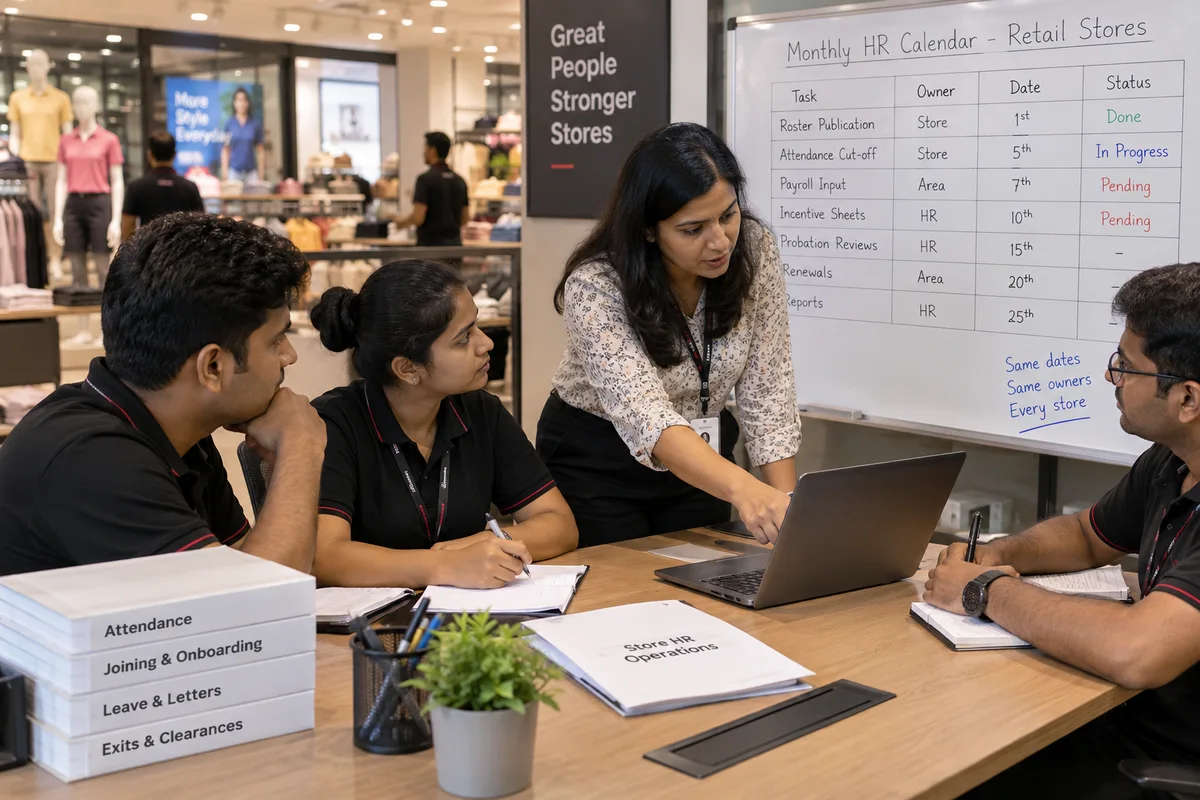
An HR function that runs the same way every month.
Records, attendance, leave and the day-to-day HR that must simply work.
Goals, reviews and ratings that hold up in a conversation.
How many people, in which roles, by when, and what they will cost.
Structure, reporting lines and who is allowed to decide what.
Requisition to joining, the same way every time.
A first day that is the same for the fifth joiner as the first.
Salary structure, payroll inputs and a month that closes on time.
Training planned from need rather than from the calendar.
Named backups for the roles that cannot be vacant.
Communication, recognition and the conditions people actually work in.
Two routes, one for complaints, one for conduct, kept separate.
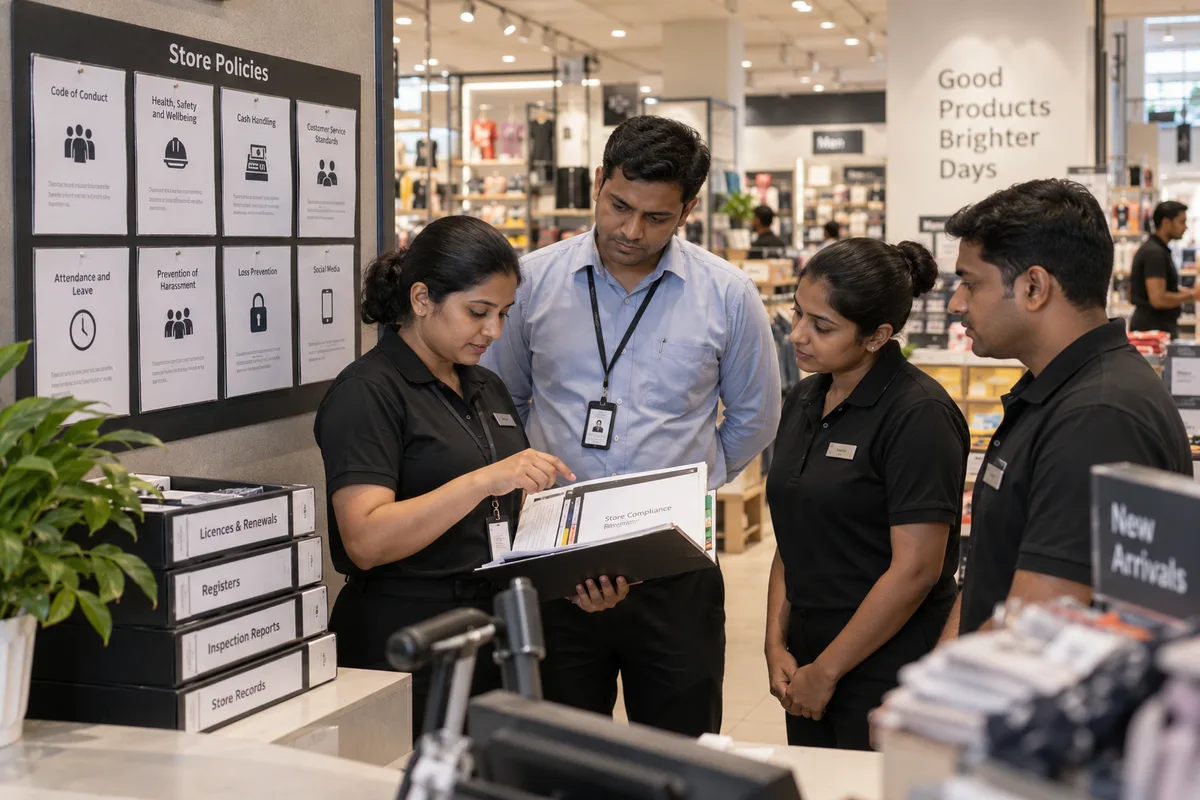
Policies a manager can apply, and obligations with owners and dates.
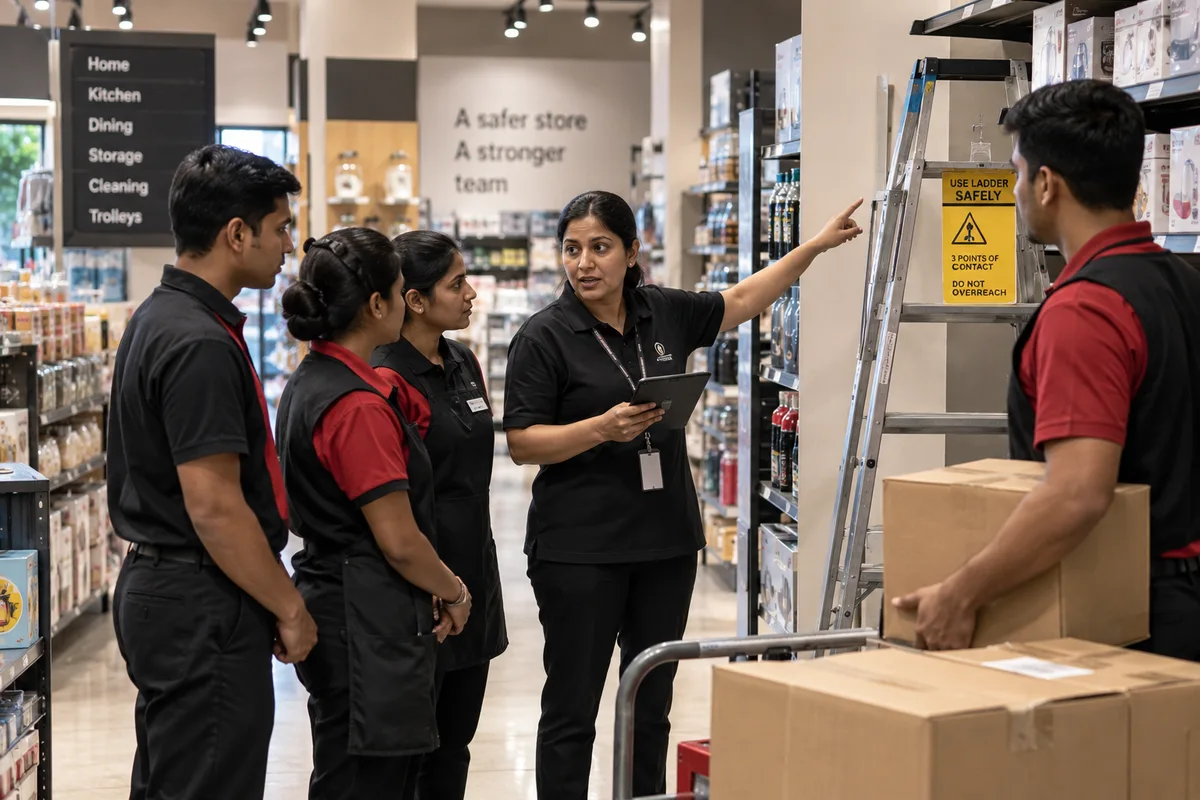
Induction, records, incident reporting and follow-through.
Who leaves, when, why, and which of them mattered.
Resignation to relieving letter, in a defined order.
Records that survive people, and approvals that do not queue.
A short monthly pack management actually reads.
The pieces a supermarkets business puts in place, in an order that makes each easier. Open any card for the detail.
Build counter shifts around the busiest hours, with staggered breaks.
Build counter shifts around the busiest hours, with staggered breaks. The recruitment process supplies part-time evening cashiers.
Rotate between billing, packing and customer desk to reduce fatigue, and set a till count routine with a second person present.
Rotate between billing, packing and customer desk to reduce fatigue, and set a till count routine with a second person present.
A trained backup per department, so borrowing is planned and recorded rather than ad hoc.
A trained backup per department, so borrowing is planned and recorded rather than ad hoc.
A closing-duty log signed by the department head, reviewed weekly.
A closing-duty log signed by the department head, reviewed weekly. The policies and governance work states when extra time needs approval.
With offs, swaps and the festival calendar visible.
With offs, swaps and the festival calendar visible. Swaps need a manager's initials.
Who is eligible, which items, what limit, who may bill and how it is checked.
Who is eligible, which items, what limit, who may bill and how it is checked.
Before changing anything, find out what is true today. Work through the checks using a recent operating period. The time needed depends on the records you hold; note missing evidence and use the findings to choose a priority.
Share your requirementsConfirm with a qualified professional. What applies to you depends on your business, your state and your arrangements, and it changes. This page describes practice. It does not state a legal position.
The services below fit this kind of business best. Each starts by recording where you stand, and every later report compares against that. We do not promise outcomes.
Practical training for cashiers and floor staff on queues, complaints and difficult moments at the counter.
Written rules on overtime, swaps, discounts and till shortages that managers apply the same way.
Fair measures for cashiers and department staff, including speed, accuracy and customer comments.
A pipeline of cashiers and part-time evening staff before the busy season.
Start with a free conversation, or see the paid HR Diagnostic.
Understand the business, its workforce, current processes and HR challenges.
Find the missing, weak, inconsistent or person-dependent processes.
Create the structure, processes, policies, SOPs, dashboards and systems needed.
Help HR and department managers actually adopt the new system.
Digitise repetitive and approval-based workflows where it is worth doing.
Track hiring, attendance, employee cost, performance, training and attrition.
Strengthen the people-management system continuously, not once.
From the GullyHR blog: one on HR in retail, and one on each of the topics this page points to.

Why store staff and managers leave retail jobs, and how to ask about rosters, weekends, targets and incentives in an exit conversation that leads to action.
7 min readRead article
Every growing company reaches a point where the founder approving everything stops being speed and starts being the bottleneck. Twelve signs it has happened, and what to fix first.
8 min readRead article
Payroll says one joining date, the personal file says another and the manager remembers a third. How to establish a single trustworthy employee record and keep it that way.
7 min readRead article
A practical design for an IT services appraisal cycle: when to run it, how to rate fairly across projects, and how to explain hikes so they hold.
7 min readRead articleMore on the GullyHR blog.
Count customers per hour at your busiest times, check how long each bill takes and set counters to keep queues acceptable. Review monthly. Do this by looking at your own tills, not general figures.
Count with a second person, record every difference and look for patterns by shift and cashier before drawing conclusions. A written procedure protects honest staff and shows where training or process is the cause.
Yes, if they are trained and rostered predictably. Students and homemakers may suit evening blocks. Confirm with a qualified professional the rules that apply to part-time engagement.
Record each move, agree a rule on duration and frequency, and give each department a trained backup. When borrowing is visible, managers can ask for more people with evidence.
Several stores do. Set it in writing, with limits and a check on use. A clear rule is kinder to staff than an informal habit that is challenged later.
We would ask how many counters are open at peak against rostered cashiers, how extra hours are recorded and how departments borrow staff. A footfall-based roster with a cashier rotation is a good first project. Scope is written down for you to accept or change.
All 7 business types in grocery & supermarkets · Find another business type
See all HR topics for retail, or another industry.
Tell us your industry, team size and the issue you want to address. Bring one example of where work gets delayed or ownership is unclear, and the deadline or decision you are working towards.