
HR for Electrical Equipment Manufacturing: winding and wiring skill, test sign-off, key hands, order peaks
Panels, transformers, motors, cables, lights and chargers all depend on a few skilled hands for winding, wiring and testing. The hard part is keeping that skill, training the next layer and handling uneven order books.
Not sure what you need? Tell us about your business in six short steps and we will come to the first meeting prepared.
Share your requirementsElectrical equipment makers build products that switch, carry, convert or use power. The group runs from cables drawn on long lines to panels wired one at a time against a drawing. Work arrives as a tender, a customer drawing or a repeat order from a utility, contractor or equipment builder, and the shop has to quote, plan material, build, test and dispatch against a promised date. Copper, steel and insulation are major cost items, so stores and planning matter as much as the shop floor.
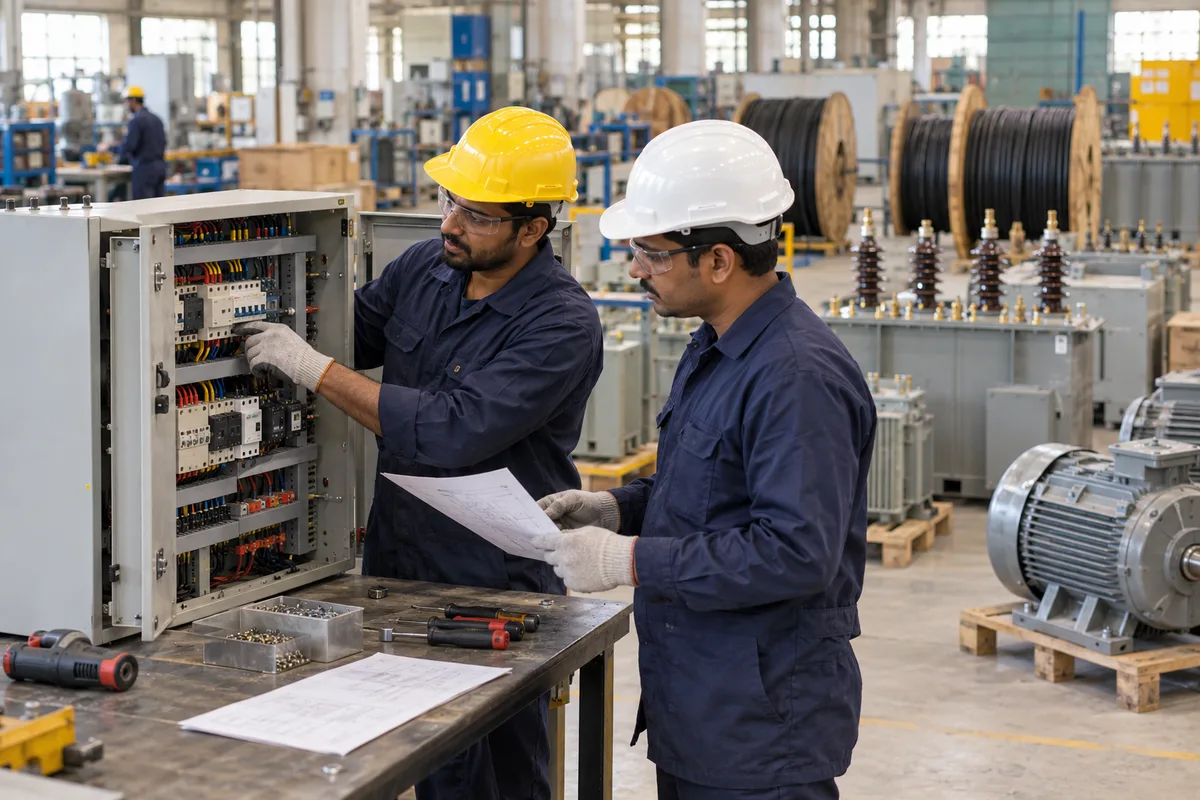
The people side is shaped by hand skill and by testing. A good winder, wirer or fitter takes years to become fast and clean, and most firms train them on the job beside a senior. Test and inspection staff carry the final word on whether a unit leaves, so their role needs clear authority. Shifts run continuous in cable and extrusion lines and single shift in assembly shops. Owners depend on two or three people who know every customer and every drawing, which is where succession planning and role design start.
What electrical equipment manufacturing have in common
Skill sits in a few pairs of hands
The fastest winder, the wirer who never needs rework and the tester who spots a fault by sound are known to everyone. When one leaves, output and quality both dip. Writing down how they work and pairing them with juniors protects the plant.
Order peaks arrive in bursts
Tenders close, a project releases drawings and suddenly every bay is full. Overtime, casual help and rushed hiring follow. Planning headcount against the order book, not against last month, calms these swings.
Testing and production pull in different directions
Production wants units out; test wants them right. Without a clear sign-off rule and a testing role that reports outside the line, disputes arrive at month end. Performance goals should reward right first time.
Apprentices learn by watching, not by plan
Most new hands are handed to whoever is free. A short skill ladder with named tasks and a sign-off at each step makes training faster and makes pay conversations fairer.
Design, production and site teams speak different languages
Engineers draw, shop staff build and site teams commission. Handover gaps cause rework and blame. Clear hand-off rules and joint reviews cost little and save calls from customers.
Business types in electrical equipment manufacturing
Choose the one closest to yours. Each page covers how that kind of unit is run, where its people processes strain, and the HR processes worth putting in place first.
- Control Panel MakersWiring skill plus drawing reading; each job is a one-off, so juniors learn on live work and rework is the main people cost.Explore HR guidance
- Transformer ManufacturersLong cycle jobs with winding, core stacking and oil work; a few master craftsmen hold quality and the drying and test stages need patient, senior staff.Explore HR guidance
- Electric Motor ManufacturersRepeat production with winding and assembly lines; skills are trainable in batches, so attrition shows as line disruption more than lost knowledge.Explore HR guidance
- Switchgear ManufacturersSheet shop, busbar work and wiring in one flow; hiring must cover fabrication and electrical trades and keep both groups aligned.Explore HR guidance
- Cable and Wire ManufacturersContinuous lines and long shifts; operators of drawing and extrusion machines are the scarce group and shift discipline matters most.Explore HR guidance
- Industrial Lighting ManufacturersFast, high-volume assembly with LED boards; lighter skills, higher turnover, and a growing need for product testing and design staff.Explore HR guidance
- Power Distribution Equipment MakersMix of fabrication, powder coating and assembly for standard boards; steady volumes, with site fitters and service staff as a second people group.Explore HR guidance
- EV Charger ManufacturersPart electronics, part metalwork, with firmware and cloud staff beside shop hands; hiring competes with technology firms and pay bands stretch widely.Explore HR guidance
Roles we help you hire in electrical equipment manufacturing
GullyHR runs talent acquisition for permanent roles in electrical equipment manufacturing. For each role we agree the job description with you, find and screen candidates against it, and support the offer through to joining. Tell us the role and the number of people, and we start there.
- Panel wiremen
- Mounting and fitting helpers
- Schematic and design engineers
- Continuity and functional test staff
- Commissioning engineers
- Sheet cutting and fabrication staff
- Stores and bought-out part buyers
- Project coordinators
- Coil winders
- Core cutting and stacking staff
- Assembly and lifting crew
- Drying oven and oil filling operators
- Test engineers and technicians
- Insulation and pressboard handling staff
- Crane operators
- Design and costing engineers
- Stator winders
- Coil insertion and slot lacing staff
- Rotor and shaft press-fit staff
- Varnish dip and baking oven operators
- Dynamic balancing machine operators
- Test bench technicians
- Shaft turning and machine shop operators
- Failure analysis and returns staff
Job descriptions for this sector
We recruit permanent employees. We do not supply contract or temporary staff.
We set up the interview and hiring process for electrical equipment manufacturing
Every business interviews, but few have a written process that works the same way for every role and every interviewer. GullyHR designs yours, from the role brief to the offer, trains your managers to run it, and can run it for you on the roles you hand us.
1. Role brief and scorecard
We agree what the role must deliver, the must-have and nice-to-have skills, and how each will be scored.
2. Stages and sequence
Screening call, assessment, interview rounds and decision points, sized to the role and the number of people you hire.
3. Question bank and scoring
Structured questions for each role family and a rating guide, so two interviewers judge the same answer the same way.
4. Interviewer readiness
A short briefing for your managers on what to ask, what to avoid and how to give a clear yes or no.
5. Offer and follow-up
Who approves, how the offer is made, and how candidates are kept informed from first call to joining.
HR processes that matter most for electrical equipment manufacturing
Each business-type page above goes into the processes that fit it best. These are the ones that come up most across the whole group.
- Learning and development process
Winding, wiring and testing are learnt on the job. A skill ladder with sign-offs turns that into a plan.
- Succession planning
A few master craftsmen and testers hold the plant. Name their successors before they leave or retire.
- Recruitment process consulting
Hiring wirers, winders, testers and design engineers needs different channels. A clear process saves repeated searches.
- Performance management process
Right-first-time output and test pass rates make fair goals for floor teams and supervisors.
- Role design and job descriptions
Separates production, testing and site roles so sign-off authority and handoffs are clear.
- Employee retention and attrition management
Skilled hands are poached by competitors and nearby plants. Retention needs pay, growth and respect for craft.
Questions owners ask
Start by listing the three or four tasks only they do well. Pair each with a junior for a fixed period, record the steps in simple photos and checklists, and tie part of their recognition to how well the junior learns. This works better than a one-off documentation drive.
Look at the order book and tender pipeline together, then agree which skills are scarce and which can be added quickly. Keep a small trained bench for the scarce skills and plan overtime and extra hands for the rest, with clear limits.
Ideally a role that does not report to the production head, with written pass rules and the right to hold a unit. Where the firm is small, an owner or quality lead can hold this, but the authority and the record must be clear to everyone.
Treat it as a separate hiring track with its own pay band, role description and reporting line. Do not force it into shop grades. Be clear about the product roadmap, since good engineers ask about it before they accept.
We would look at how people join, learn and move through your shop, who the key hands are, how test sign-off works, and where attrition or rework hurts most. We then suggest a few priorities and agree scope in writing afterwards.