



















Why food and beverage staff leave and how to understand why
Kitchen, service and outlet staff leave quickly in food and beverage. How to ask what lies behind the first answer, compare outlets and act on what you learn.
7 min readRead articleA bakery or sweet shop depends on makers who start before sunrise and on counters that must be full when the festival crowd arrives. Here is how to keep skills, shifts and seasons under control.

Not sure what you need? Tell us about your business in six short steps and we will come to the first meeting prepared.
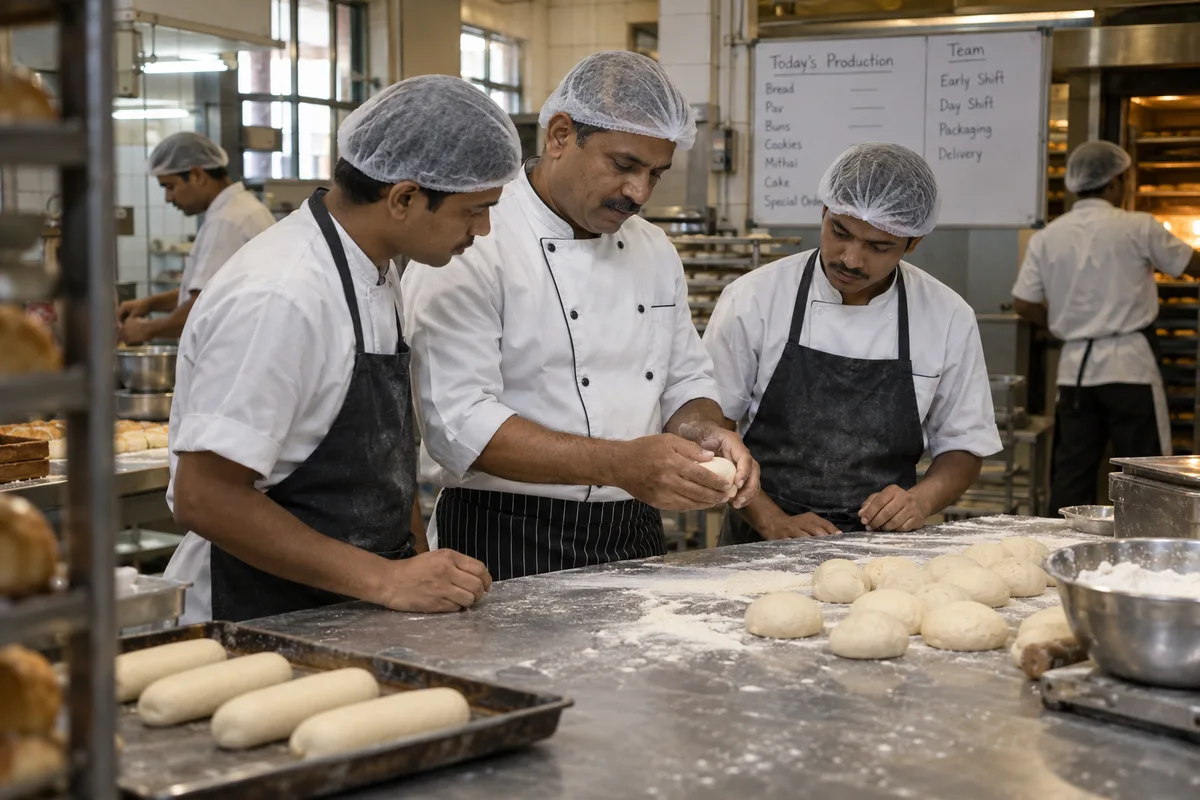
Share your requirementsA bakery or sweet shop makes fresh goods in a back room and sells them over a counter, or through a few outlets that share one production unit. Bakers, sweet makers and decorators start work in the small hours so that bread, cakes, snacks and mithai are ready when the shop opens. Counter staff, billing staff and packers take over from there, and delivery riders carry orders to homes, offices and events. The best makers carry recipes, texture and flavour in their hands, often learnt from a senior over many years, and a shop's name can rest on two or three of them. Festivals change everything: orders for gift boxes and bulk trays arrive together and the kitchen runs for far longer than usual. See also HR for food and beverage. What makes HR different here is the combination of a skilled, hard-to-replace maker and a very uneven calendar. Rotas must work for early starts, seasonal helpers must be found and taught quickly, and the maker's knowledge must be shared in a way that does not leave the business exposed when one person moves on.
These are the places the people side of this kind of business tends to give way. The rest of this page works through them.
HR here has to work for each of these groups, not only the office. The set-up below is written with all of them in mind.
Makers begin well before dawn, and travel to work, sleep and family time suffer when shifts are not planned.
Recipes, proportions and finishing touches are carried in memory, and a rival offer can threaten the shop's best-selling items.
Bulk orders and gift boxes arrive together, and long hours, extra helpers and rushed training follow.
Temporary hands are shown the work on the busiest days, so quality and cleanliness vary.
Ovens, frying stations and sugar work are hot, tiring and risky, and injuries are treated as part of the job.
Knowledge of products, allergens, packing and billing is learnt on the job, and mistakes reach customers.
Helpers watch for years with no stated route to a maker's role, and the ambitious ones leave to start their own shop.
Start with the topics that matter most here: Learning and Development; Compensation, Payroll and Benefits; Retention and Attrition Management. Then work through the rest. Each topic is written for food and beverage, not in general.
Training planned from need rather than from the calendar.
Salary structure, payroll inputs and a month that closes on time.
Who leaves, when, why — and which of them mattered.
How many people, in which roles, by when — and what they will cost.
Structure, reporting lines and who is allowed to decide what.
Requisition to joining, the same way every time.
A first day that is the same for the fifth joiner as the first.
Records, attendance, leave and the day-to-day HR that must simply work.
Goals, reviews and ratings that hold up in a conversation.
Named backups for the roles that cannot be vacant.
Communication, recognition and the conditions people actually work in.
Two routes — one for complaints, one for conduct — kept separate.
Policies a manager can apply, and obligations with owners and dates.
Induction, records, incident reporting and follow-through.
Resignation to relieving letter, in a defined order.
Records that survive people, and approvals that do not queue.
A short monthly pack management actually reads.
An HR function that runs the same way every month.
The pieces a bakeries and sweet shops business puts in place, in an order that makes each easier. Open any card for the detail.
Start times, breaks, transport or a late-night allowance where it applies and a weekly rest day, planned in advance.
What this coversHideStart times, breaks, transport or a late-night allowance where it applies and a weekly rest day, planned in advance. The attendance and shift process holds the rules.
Record recipes and methods, pair every master with an assistant and recognise the people who teach.
What this coversHideRecord recipes and methods, pair every master with an assistant and recognise the people who teach. The learning and development process holds the plan.
Orders from past seasons, the number of extra hands needed by week and a list of returning helpers.
What this coversHideOrders from past seasons, the number of extra hands needed by week and a list of returning helpers. The workforce plan holds it.
A short induction on hygiene, allergens, packing and safety, with a named senior and a record of attendance.
What this coversHideA short induction on hygiene, allergens, packing and safety, with a named senior and a record of attendance.
Safe lifting, hot trays, floor surfaces and breaks near ovens, with an injury record.
What this coversHideSafe lifting, hot trays, floor surfaces and breaks near ovens, with an injury record. The health, safety and wellbeing work covers it.
Defined steps from helper to assistant to maker to lead, with the skills for each step written and shown.
What this coversHideDefined steps from helper to assistant to maker to lead, with the skills for each step written and shown.
Before changing anything, find out what is true today. These checks take an afternoon and tell you which of the topics above to start with.
Share your requirementsConfirm with a qualified professional. What applies to you depends on your business, your state and your arrangements, and it changes. This page describes practice. It does not state a legal position.
The services below fit this kind of business best. Each starts by recording where you stand, and every later report compares against that. We do not promise outcomes.
A fair early-shift rota with rest days and clear rules for festival-week overtime.
A way to pass a maker's skill to assistants and to bring helpers up in steps.
A look at why skilled makers and helpers leave and what would keep them.
Pay and recognition that reward skill and reliability through the festival peak.
Start with a free conversation, or see the paid HR Diagnostic.
Understand the business, its workforce, current processes and HR challenges.
Find the missing, weak, inconsistent or person-dependent processes.
Create the structure, processes, policies, SOPs, dashboards and systems needed.
Help HR and department managers actually adopt the new system.
Digitise repetitive and approval-based workflows where it is worth doing.
Track hiring, attendance, employee cost, performance, training and attrition.
Strengthen the people-management system continuously, not once.
From the GullyHR blog: one on HR in food and beverage, and one on each of the topics this page points to.

Kitchen, service and outlet staff leave quickly in food and beverage. How to ask what lies behind the first answer, compare outlets and act on what you learn.
7 min readRead article

A calendar of courses, a budget spent by March and no record of what any of it changed. What a learning and development process contains when it starts from need rather than from the catalogue.
7 min readRead article
Most salary structures grew one negotiation at a time. How to build grades and bands from what you already pay, without repricing everybody at once.
8 min readRead article
How to spot an unmanageable workload before it becomes an exit or an error, what to look at, how to talk about it and what to change, without guessing.
5 min readRead articleMore on the GullyHR blog.
Pay fairly, recognise the skill and give the person a real role in teaching and developing the range. Sharing the knowledge also reduces the risk. Confirm any restrictive terms with a qualified professional.
Look at orders from past festivals, decide how many extra hands you need in each week, line up returning helpers early and brief them before the rush. Starting after orders arrive is too late.
With written start times, breaks and weekly rest days, a rotation that spreads the earliest starts and a plan for travel at odd hours. Confirm the working-time rules that apply to you with a qualified professional.
With a short fixed briefing on hygiene, allergens, packing and safety, a named senior and one or two tasks at first. Teaching the whole job on the busiest day leads to mistakes.
The products and ingredients, how to answer questions on allergens, how to pack and bill and how to handle a complaint. A short guide and a check by the manager helps.
Write the steps from helper to assistant to maker, list the skills for each step and review progress twice a year. People stay when they can see where they are going.
With a brief on safe handling, suitable footwear and hand protection, breaks and a record of every injury. Reviewing the record shows where the real risks are.
We would ask who could cover each master maker's work for a week, what start times and rest days the production team really has, and how festival peaks compare with the staff you had. Briefing for seasonal helpers and counter staff would be reviewed. A sensible first piece of work is an early-shift rota plus a festival plan. Scope is agreed in writing after that.
All 7 business types in food and beverage · Find another business type
See all HR topics for food and beverage, or another industry.
Identify payroll leaks, record gaps and hiring bottlenecks in a free first conversation, and leave knowing what to fix first.
Know what you need? Share your requirements in four short steps.
Want the full picture? See the paid HR Diagnostic.
Prefer a quick message? Chat on WhatsApp