
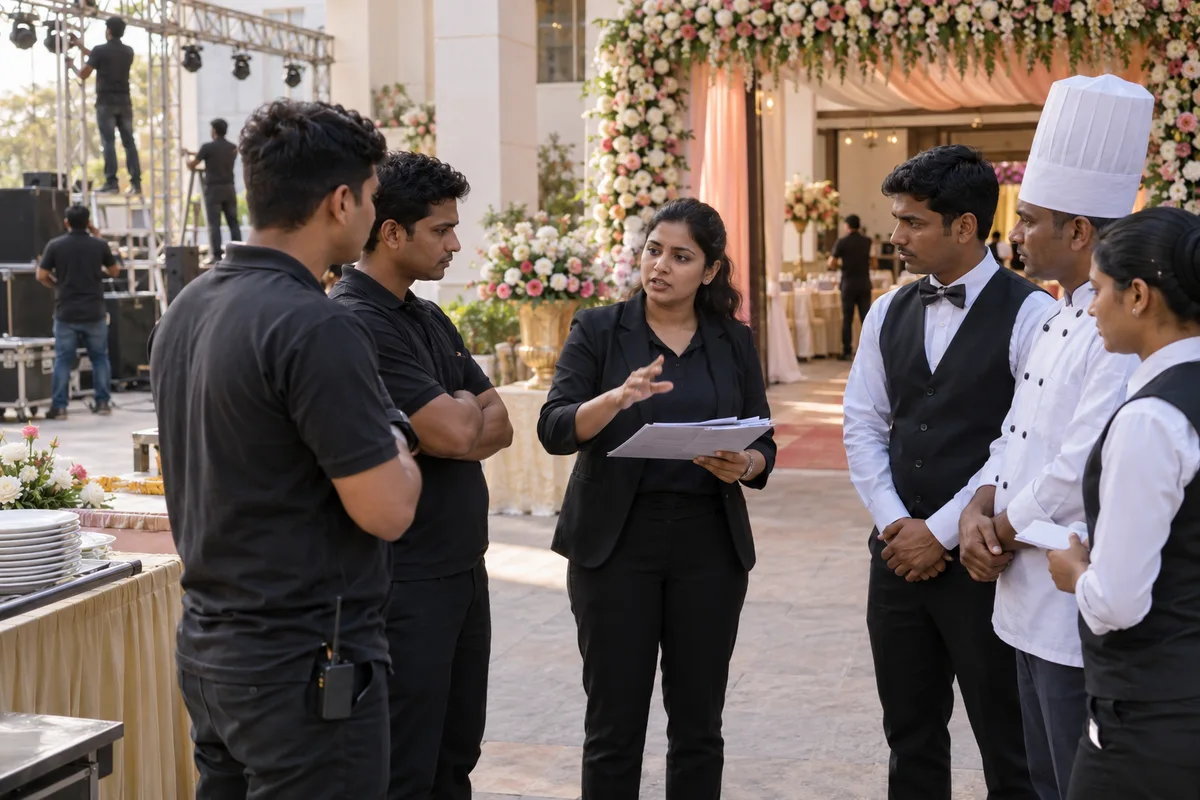
Picture a wedding planner at one in the morning after a reception. A décor helper says two extra shifts were promised, a hostess left at nine, the supervisor's list is a photo of a notebook page, and the planner has a site visit at eight.
Where should an event or wedding business start with HR?
Start with the points where money, safety and client trust meet: who is employed by you and on what basis, what each crew member is promised, how attendance is signed, when payment happens, who briefs the site and how the permanent team rests. Policies, appraisal forms and software follow once an event can run from paper.
You run two workforces
The first is small and stays: lead planners, coordinators, producers, production managers, designers, vendor executives and accounts staff. They hold client relationships and the calendar. The second arrives for an event: stage hands, riggers, lighting and video technicians, drivers, hosts, marshals, registration desk staff and runners. Some come from you directly, some through labour contacts and some belong to caterers, décor firms or sound companies.
Draw this on a single page for your last large event. Against each group write who engaged them, who pays them, who supervises them on site and who answers if one is hurt. Gaps on that page are your first HR work. Do not assume that calling someone a freelancer settles what they are in law. Pay particular attention to crew who come through a labour contact: ask what the contact deducts, when the worker is paid and what happens if the contact does not pass the money on, because the dispute will reach your planner at the venue.
Six foundations, in order
- 1
Settle the basis of engagement
Sort permanent staff, fixed-period hires, day-paid crew, independent specialists and vendor personnel. Have an adviser check any arrangement you are unsure of.
- 2
Issue written terms
State role, date, reporting place and time, expected finish, rate, what extra hours earn, meals, travel, dress, cancellation and payment date. A message the worker acknowledges is better than a call.
- 3
Create the crew register
Hold name, contact and emergency number, skills, identity record, certificates, payment details and who recommended them. Limit who can open it.
- 4
Run sign-in and sign-out
Each supervisor records arrival, role, breaks, release time and exceptions, and the worker initials the entry before leaving.
- 5
Fix the payment cycle
Choose a date after the event, name who approves the sheet and give crew one person to raise a dispute with.
- 6
Protect the core team
Block recovery days after heavy runs, record leave and extra time, and name a second person for each live client.
The attendance, shift and leave process is where the third group of problems lives for event firms: setup that starts before dawn, a show that overruns and a breakdown that finishes after the venue wants you gone.
ASSIGNMENT SHEET
Event: ______________________
Date: _________ Venue: ______
Site lead: __________________
Lead's phone: _______________

Crew name: __________________
Role today: _________________
Report at: _______ Gate: ____
Expected release: ___________
Rate agreed: ________________
Extra hours rule: ___________
Meals / travel: _____________
Dress: ______________________
Briefing by: ________________

In: ____ Out: ____ Sign: ____
Payment due on: _____________
Brief the site, including people who are not yours
A client sees a rude parking attendant or an unsafe cable and blames your firm. Agree in vendor bookings that their people attend or receive the site briefing, follow conduct and dress rules, and report to a named contact. The briefing covers exits, the incident contact, restricted areas, photography and phones around guests, alcohol, gifts and tips, and how anyone reports harassment. Crew working near families, performers or intoxicated guests need to know that a supervisor will back them.
Give supervisors authority with limits
A function-day supervisor makes people decisions all night: sending a worker home, approving an extra shift, finding a replacement, allowing an early release, handling a quarrel between your crew and a caterer's. If none of this is written, each supervisor invents a rule and accounts inherits the result. State what a site lead may approve alone, what needs the event lead's agreement and how the approval is recorded. A short note on the sign-in sheet with a time and a name is enough.
Set conduct limits for supervisors too. No withholding pay as punishment, no taking a share from the crew's payment, no borrowing identity documents and no abuse in front of guests or anywhere else. Tell crew how to reach someone senior if the supervisor is the problem.
Plan the welfare basics into the budget
Meals, drinking water, a place to sit, toilets, changing space for hosts and transport after a late breakdown are easy to leave out of a quotation. Crew remember which firm fed them and which left them waiting by a venue gate after midnight. Add these lines to every event estimate and name who delivers them on the day, so that a tight client budget does not silently remove them.
Check the plan against split sites. A welcome lunch in one place and a reception setup across town need separate leads, separate sheets and a stated travel arrangement for anyone moving between them.
What can wait
- An organisation chart with layers. Know who leads each event and who approves spend.
- Annual ratings for day crew. A short supervisor note after each event is more useful.
- A thick staff handbook. Start with conduct, safety, payment, complaints and client confidentiality.
- An HR system, until the assignment and sign-in habit works on paper or in a shared sheet.
- Branded team perks, while payment dates and rest are still unreliable.
Test it on one event
Pick a mid-sized function and run the whole routine. Afterwards, ask the supervisor what was ignored on site, ask accounts which sheet entries they had to chase and ask two crew members whether they knew their finish time and pay date. Repair those points before the peak. If you cannot see where the gaps are, an HR audit looks at records, terms and daily practice together.
Review the setup again when you add a city, begin hiring technicians permanently or take on larger public events. Each change brings new roles, risks and people who need to approve things.
Where to go next
Use the assignment sheet at your next booking and keep the completed copies. More on this trade is on our event management and wedding services page. To discuss where your gaps are, send us a few details.