
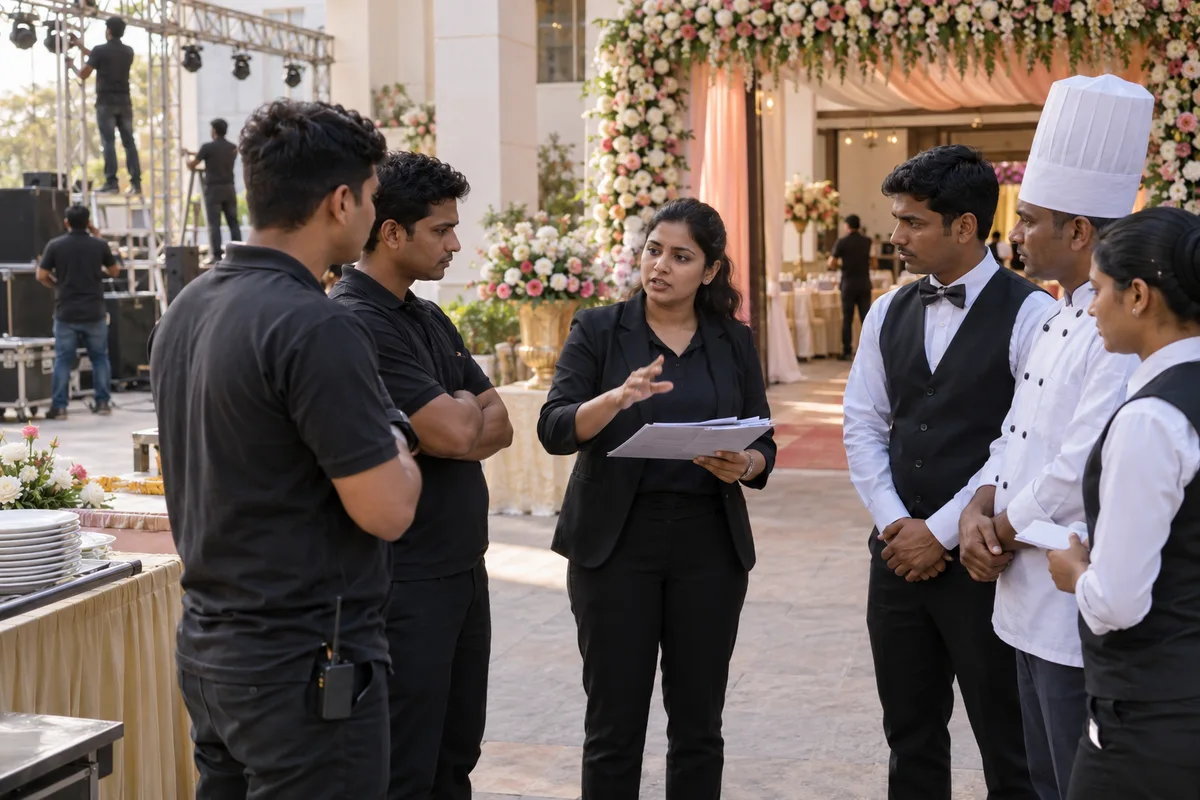
Two days before a destination wedding, the lead planner at a hypothetical firm falls ill. Only that planner knows that the bride's family changed the dinner order, that the florist expects a deposit and where the latest seating plan is saved.
How can an event firm build skills and rely less on a few people?
List the abilities each function depends on, score people by what they have actually led, and mark any held by one person. Give each booking a second who attends key meetings and shares the file. Use quieter months to pass on skills through teaching, rehearsal and supervised ownership, then update the matrix after events.
Find the dependence before you train
In event work, knowledge sits in people more than in equipment. Go through the next season's bookings and ask these for each.
- Who does the client call, and who else have they met?
- Which vendors give their rate or priority only to one executive?
- Who can read the lighting file, run the video wall or sign off a stage build?
- Who knows the venue's loading times, power limits and permit contact?
- Who holds the budget sheet, payment promises and changes agreed by phone?
Where one name answers, write it down. The fix may be a shared folder or a second introduction, which is quicker than a course. Training is the answer only when the second person lacks the ability.
Define levels by live responsibility
Four letters keep the sheet readable. Use N for no exposure. Use A for assists under direction. Use L for leads that part of an event with someone available. Use T for leads under pressure, including a failed vendor or overrun, and can teach it. A level rises after a named senior has watched the work or reviewed the output, not because someone has attended several weddings.
SKILL MATRIX  Season: _______
N none      A assists
L leads     T leads and teaches

Skill: Client change meetings
  T: ________  L: __________
Skill: Budget and change log
  T: ________  L: __________
Skill: Vendor booking, backup
  T: ________  L: __________
Skill: Show calling and cues
  T: ________  L: __________
Skill: Stage and rig checks
  T: ________  L: __________
Skill: Guest travel and rooms
  T: ________  L: __________

Single-name skills: ________
Next learner: ______________
Event for practice: ________
Skills worth rows of their own
Separate work that fails in different ways. For planners and coordinators: discovery meetings, scope and change control, run sheet writing, difficult family or sponsor conversations and closing accounts. For production: floor plans, power planning, show calling, console operation and safe breakdown. For guest teams: registration systems, arrivals and rooming, accessibility requests and complaint handling. Exhibition organisers add stall allocation and exhibitor manuals; concert promoters add artist riders, crowd flow and entry control.
Temporary crew need a lighter version. Record the roles each trusted person is cleared for and who can lead others. That tells a coordinator whom to book as a shift anchor when the regular chief is away. Ask supervisors to note each season who has started directing others without being asked, and offer that person a trial lead on a small setup.
Teach through real events
- 1
Choose the weak rows
Start with skills needed on several confirmed dates and held by one person.
- 2
Hand over a defined part
The learner owns the rooming list, the sound check or one vendor group from first call to settlement, with the expert watching.
- 3
Rehearse failure
In a quiet week, run a table exercise: rain on the lawn, a delayed artist, a caterer short of staff, a power cut. The learner decides; the expert questions.
- 4
Debrief within days
Ask what was planned, what happened, what the learner decided and what they would change. Add useful points to the checklist. Keep blame out of it, or learners will hide the near miss that teaches the most.
- 5
Let them lead
Give a suitable booking with the expert reachable but off site, then confirm the new level.
Make the second person real. They should attend the design sign-off and the final vendor meeting, hold current versions of the plan and be introduced to the client early. A name typed on a form on the eve of the function is no backup at all.
An illustration from an exhibition team
Suppose an organiser finds that three coordinators can sell and allocate stalls, but only the operations manager can read the hall's power and rigging submission and answer the venue's engineer. The next show gives one coordinator that thread. They draft the submission from the exhibitor orders, the manager reviews it and explains each correction, and the coordinator attends the engineer's walk-through. At the following show they lead it, with the manager checking before it is sent. The rating changes on evidence, and the venue contact now knows two people.
Put the knowledge where a second person can reach it
Agree one folder structure for each booking: client brief, signed scope, change log, budget and payments, vendor contacts and terms, floor plan, run sheet, permits and the contact list for the day. Name files so that the current version is obvious. At each weekly meeting, the lead says what changed and confirms it is in the folder. Check this by asking the second planner to answer a question about the booking without phoning anyone.
Handle client and guest information with care. Wedding files hold family details, room lists, identity documents and sometimes dietary or medical notes. Give access to those working on the booking, remove it when they leave and delete what you no longer have a reason or duty to keep.
Keep experts willing to share
A senior producer may fear that teaching makes them replaceable or adds hours to an already heavy season. Reduce other work while they coach, make the ability to develop others part of progression and credit them when the learner succeeds. Plan the heaviest teaching for the quiet period, with refreshers shortly before peak dates.
Avoid sending everyone to the same course, scoring creativity out of ten or copying a corporate competency dictionary. A learning and development process should say who maintains the matrix, which gaps get money and how learning is checked on site.
Where to go next
Take your next three confirmed bookings and name the second person for each. See the event management and wedding services overview for wider context, or explain your skill gaps to us if you would like help building the plan.