
Skill matrix and multi-skilling for manufacturing plants
A skill matrix shows who can run which machine and at what level. We build it with your supervisors, find the people who are the only ones who can, and turn each gap into a training plan.
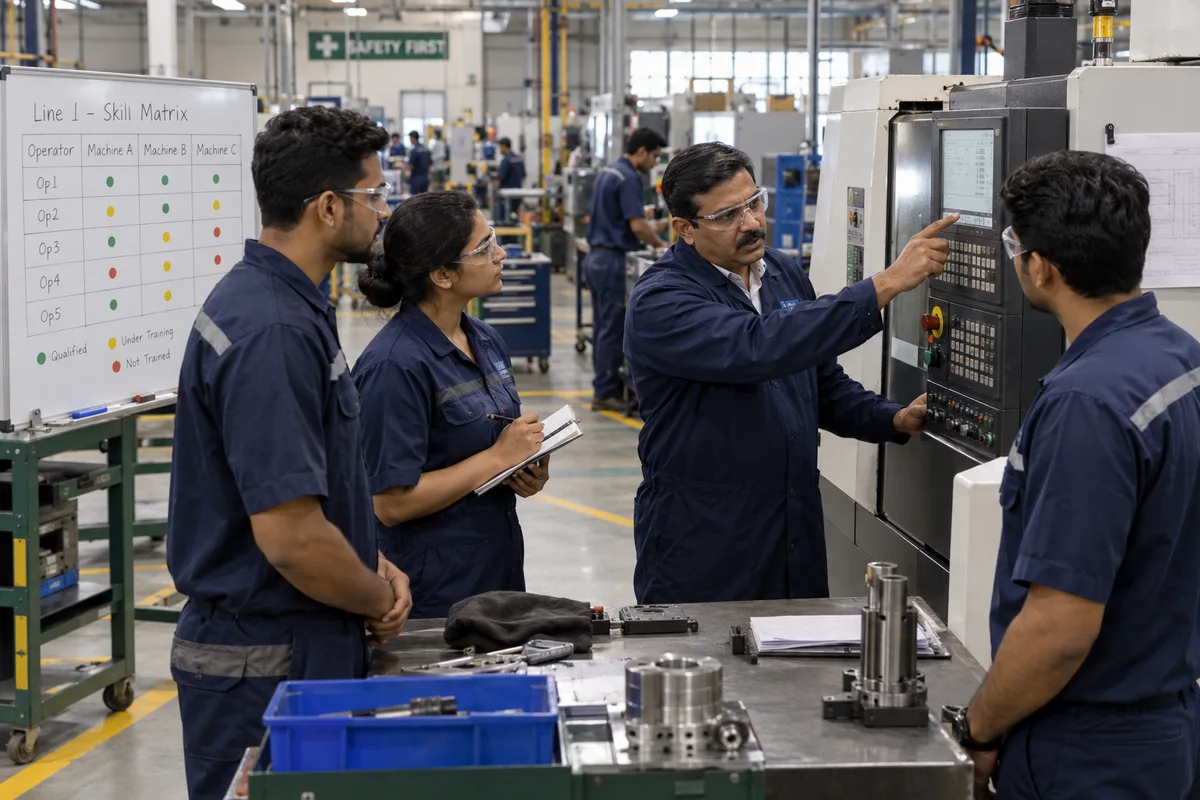
What this covers
A skill matrix is the cheapest risk register a plant can keep. It shows single points of failure before they become a stopped line.
- Machine-wise skill mapping
- Operator skill levels
- Certified vs under training
- Multi-skilling plan
- Critical-skill coverage per shift
- Training needs from the matrix
- Re-certification cycle
- Skill-based deployment
- Role
- Machine
- Required level
- Current level
- Gap
- Training plan
Where this goes wrong on the shop floor
- Only one operator can set up the press, and when that operator is absent the line is idle for the shift.
- A new supervisor moves operators between machines without knowing who is trained on what.
- Skills live in the supervisor's head, and they leave with that supervisor when they resign.
- Training is chosen by availability and not by gaps, so the same easy courses are repeated.
- Operators are paid the same whether they run one machine or four, so nobody volunteers to learn another.
- A certification lapses unnoticed, and an untrained person is asked to run the machine during a rush.
How we set it up with your plant
List machines and roles
We list the machines, stations and tasks per line with the production head, and mark the ones where an untrained operator could cause a stoppage or injury.
Define skill levels
We write a four or five step scale with observable criteria for each level, so supervisors rate the same way on every shift.
Rate people on the floor
We help supervisors and trainers rate each operator against each machine, then review the ratings in a group to remove personal bias.
Find the gaps and risks
We mark machines where one person holds the skill, shifts with no cover and people ready for the next level. The output is a one page risk view for the plant head.
Build the multi-skilling plan
We set who trains on which machine, with whom, and by when. The plan is linked to the training calendar and the manning sheet.
Set review and re-certification
We define when ratings are reviewed and how re-certification is done, with the matrix displayed at the line and updated on a fixed cycle.
Records and registers this produces
- Machine-wise skill matrix
- Skill level definition sheet
- Critical skill coverage chart by shift
- Single point of failure list
- Multi-skilling plan with dates
- Training need list drawn from the matrix
- Re-certification calendar
- Skill-based deployment note
What good looks like
- Every critical machine has at least one trained person on every shift, and gaps are visible.
- The supervisor deploys operators from the matrix instead of from memory.
- Training plans come from the matrix gaps, with names and dates attached.
- Operators know what level they are at and what it takes to reach the next.
- The matrix is displayed at the line and updated when someone completes training.
Questions plant teams ask
Detailed enough to name the machine or station, light enough that supervisors will keep it updated. We begin with the critical machines and extend to the rest after a review cycle.
They accept it when the criteria are clear and linked to training and progression, not only to control. We involve supervisors in writing the levels so the scale feels fair.
It can inform pay structures and progression, which we design separately. We agree with management how skill levels will be used before ratings begin, so people know the purpose.
Senior operators or department trainers. We design the training content and the sign-off method, and help identify who is ready to train others.
A sheet works for a single plant starting out. Where several plants or a large number of operators are involved, we can set up HR software to hold the matrix and report coverage by shift.
We set up the interview and hiring process for manufacturing
Every business interviews, but few have a written process that works the same way for every role and every interviewer. GullyHR designs yours, from the role brief to the offer, trains your managers to run it, and can run it for you on the roles you hand us.