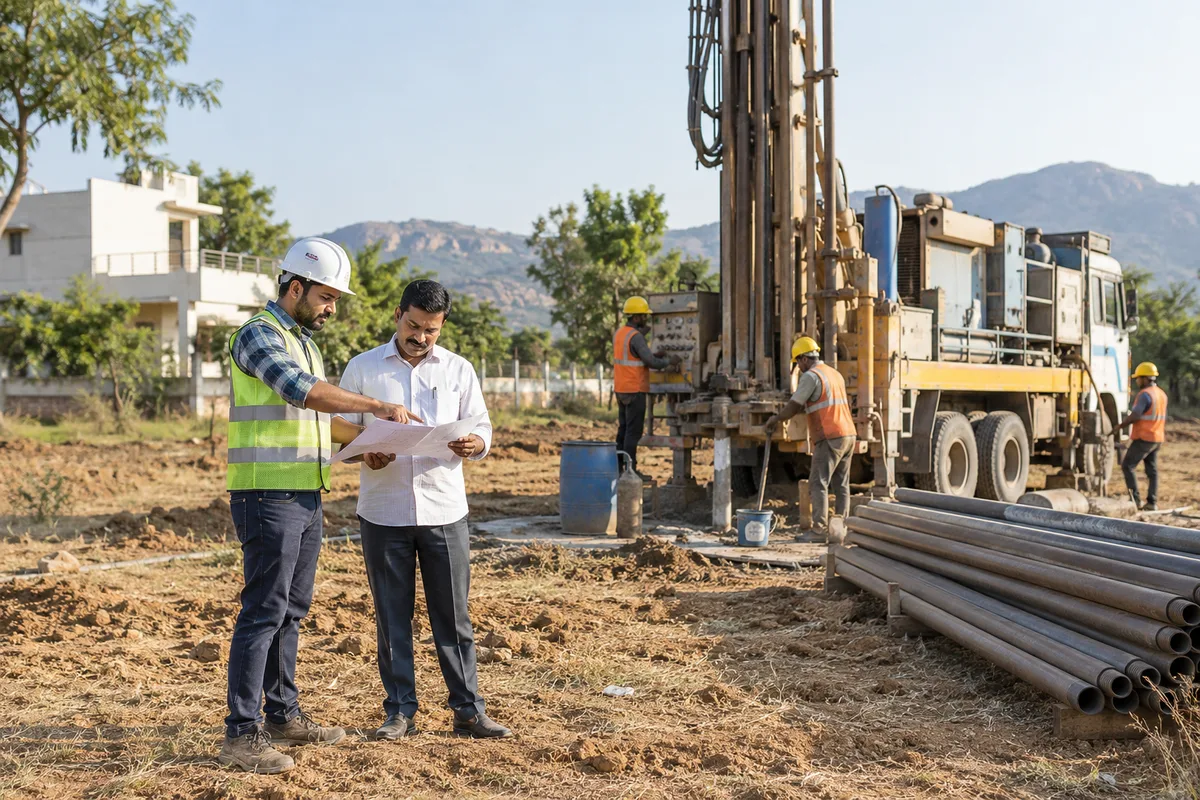
In the thick of the summer order book, your rig operator rings from a village two districts away to say a family matter means going home tonight, return date unknown. The helpers can couple rods and start the compressor, but none of them will take the lever in broken ground. The next farmer is already waiting.
How do you train a second borewell rig operator?
Choose a steady crew member, list the skills the operator uses on a job, and have the learner build them in stages on real sites: set-up, routine drilling, changing ground, stuck rods, casing and shutdown. The operator coaches and signs off each stage. Protect time for it, and recognise both people.
Choose the learner, and make the offer clear
Look for someone who notices things: a change in the cuttings, a different note from the hammer, air pressure drifting. Safety habits and honesty with job records matter as much as mechanical confidence, because an operator works far from the office. Tell the person what training involves, how long you expect to review it, what changes in pay or duties at each stage and what licence or certificate the final role needs.
Speak to the current operator first. A person who fears being replaced will teach badly or not at all. Explain that a second operator means leave that can actually be taken, relief on long deep holes and a senior title with pay that reflects teaching. Then honour it.
Get the judgement out of the operator's head
Asked to explain the job, an experienced operator will say it comes with time. Ask about particular days instead. What did the ground do before the rods stuck? When did you slow the feed? What told you the hammer bit was finished? When would you stop and ring the customer? Record answers by voice on site and have the office type them into short notes by ground type. Add photographs of cuttings.
Stages of learning on the rig
- 1
Set up and secure
Site walk, overhead lines, buried services, levelling the truck, exclusion area, pre-start checks and covering the hole at every pause and at the end.
- 2
Drill routine ground
The learner handles feed, rotation and flushing in familiar formations with the operator beside them, calling out what they see and what they will adjust.
- 3
Read changing ground
Loose overburden, boulders, fractures and water strikes. The learner decides aloud before acting, and the operator corrects the reasoning as well as the hand.
- 4
Recover from trouble
Walk through stuck rods, collapse, falling air pressure and hose failure while parked, then under close supervision as occasions arise. Include when to stop.
- 5
Complete the job
Casing, flushing, yield measurement, pump hand-over, customer explanation, job sheet and making the borehole safe.
- 6
Lead with backup
The learner runs a suitable job as operator, with the senior present at first and then reachable by phone, where licences allow.
Learner:
Coach:
Rig number:
STAGE     SEEN  ASSISTED  ALONE
Pre-start checks:
Truck set-up and levelling:
Rod handling and coupling:
Compressor and air pressure:
Soft ground drilling:
Hard rock and hammer care:
Collapse or stuck rod response:
Casing and flushing:
Yield test and pump support:
Secure open borehole:
Daily job sheet accuracy:
Ground types met:
Coach comment and date:
Next practice goal:
Review the sheet at a monthly meeting between owner, operator and learner. Blank rows show what the season has not yet offered, such as hard rock or a collapse. Plan which coming job can fill the gap rather than waiting for luck.
A teaching day that fits a real job
Before leaving the yard, the coach names one goal, such as holding steady feed through weathered rock or judging when flushing has cleared the hole. On site the learner explains the plan aloud, including the sign that would make them stop. During the work the coach asks what the cuttings, sound and pressure are saying before offering a view. Afterwards both take ten quiet minutes beside the rig to record what happened and what to try next.
The coach keeps the right to take over at any moment, and says so in advance, so that stepping in is not read as failure. The learner keeps the right to say they are not ready. Helpers need to know who holds the controls and who gives the stop signal at every point in the job. Two voices giving instructions beside a rotating drill string is a hazard in itself.
Why the training stalls
- Pay per foot makes every learner minute feel like lost earnings for the whole crew
- The summer rush ends supervised practice just as the best variety of ground arrives
- The operator takes the lever back at the first hesitation
- The learner sees no change in standing and leaves for another rig
Deal with the pay problem openly. Decide how earnings are protected on training jobs, whether through a coaching allowance, a fixed element or agreed teaching days. Schedule early practice before the dry-season peak and pick sites where a slower pace is acceptable. Tell the customer nothing that is untrue about who is operating.
Next: a rate card the crew can calculate
Write how earnings change with depth, rock, a dry hole, boulders, a broken hammer, waiting and travel. Give a copy to each crew member and work through a recent job together. A learner weighing the operator's role wants to see that a hard day will not become an argument.
And one job sheet from the field
Capture date, location, start and stop, depth by formation, casing used, diesel, breakdowns, rest taken, borehole secured by name and customer signature, with photographs sent the same day. It feeds billing, pay and training at once. Add rules for rest and night driving, since a tired crew learns little and the road home is a hazard.
Formal appraisals and software can wait until a second name stands against each rig. The stages above form the start of a learning and development process, and founder dependency and succession planning applies the same thinking to the owner's own role.
Where to go next
Write each rig number with the names of those who can run it today. More on this trade is in HR for well drilling and borewell contractors. If you want a training plan built around your crews, tell us your requirements.