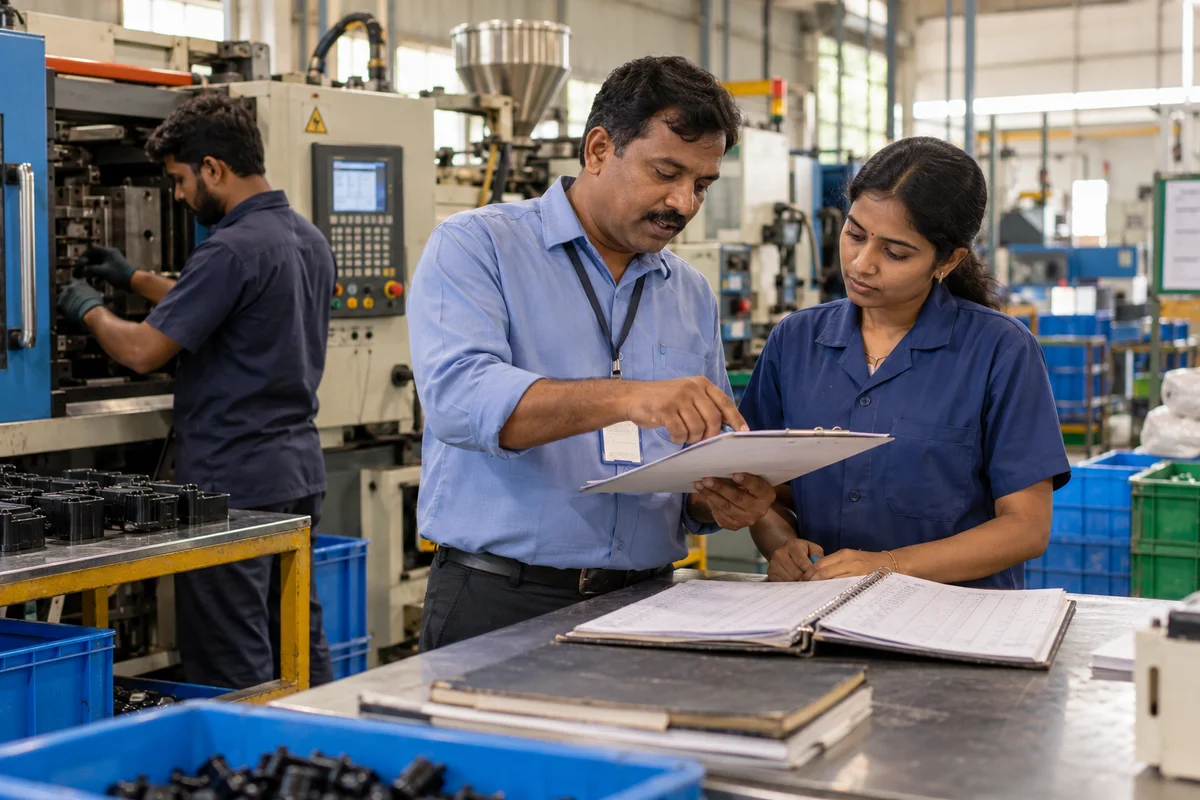
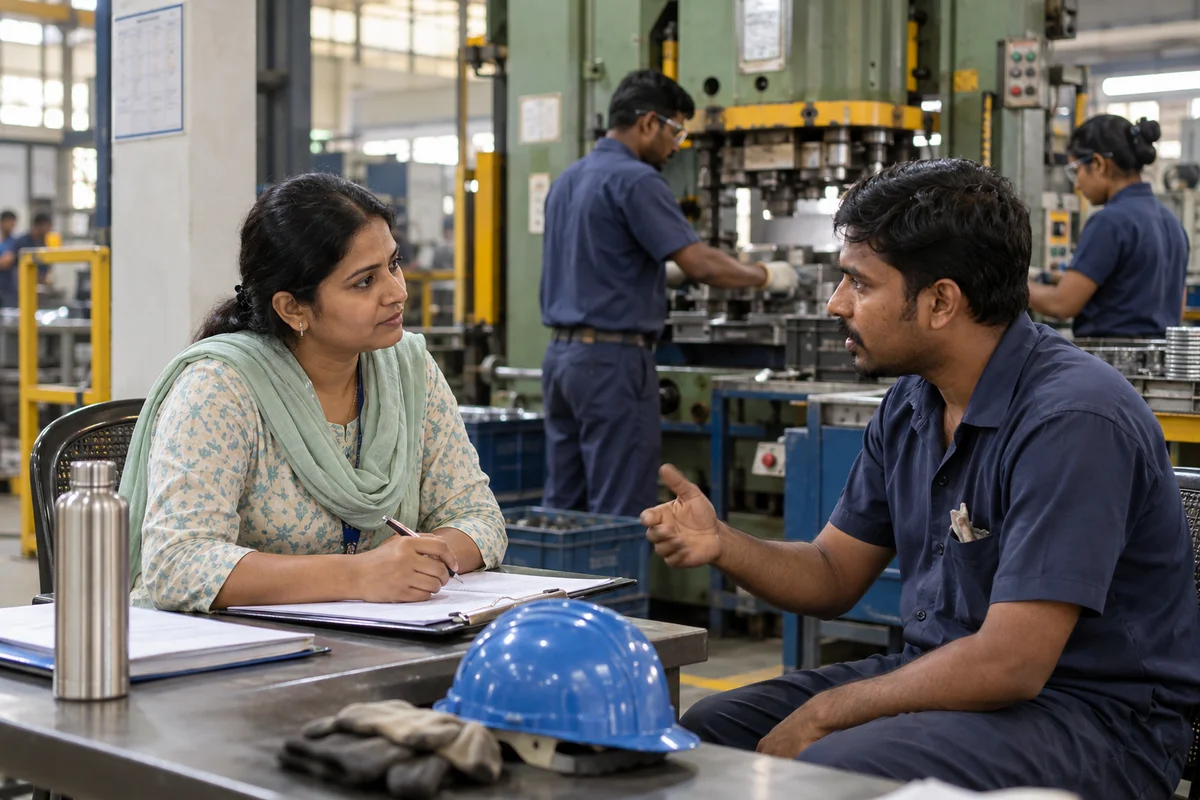
It is the second day for a new operator on a power press line. The trainer has been pulled away to clear a jam elsewhere, the shift supervisor assumes the induction covered guarding, and the newcomer is feeding blanks by copying the person at the next station. Nobody has said what to do when a part sticks in the die.
What should happen in a new joiner's first week?
Give the joiner a named trainer, teach hazards and stopping the machine before production, then build one task at a time from watching, to doing under observation, to doing alone. Keep setting, clearing faults and maintenance work off limits. Finish with a demonstration that the supervisor watches and records.
Settle these before the first shift
A poor first week is decided before the gate opens. If the safety shoes are the wrong size, the trainer is on leave or the badge does not work at the turnstile, the first morning disappears and the joiner learns that preparation here is optional.
- A trainer on the same shift, plus a backup for absence
- The one station or cell where learning will start
- Protective equipment in the right size, issued and recorded
- The current work instruction, drawing or setting sheet, in a language the joiner reads
- Gate access, attendance enrolment, locker and canteen arrangements
- A short list of tasks the joiner must not attempt this week
The week, day by day
- 1
Day one: stay safe and find your way
The safety lead or supervisor walks the actual floor: exits, assembly point, forklift routes, hot, sharp and moving hazards, emergency stops and who gives first aid. The joiner presses nothing yet, but shows where each stop is and says when to use it.
- 2
Day two: watch the whole job
The trainer runs the station and talks through loading, cycle, checks, unloading and housekeeping. The joiner explains it back, including what a good part and a rejected part look like, using real samples from the line.
- 3
Day three: do it under the trainer's eye
The joiner runs the normal cycle slowly with the trainer within reach. Speed is ignored. The trainer corrects hand position, check sequence and recording, one point at a time.
- 4
Day four: add what goes wrong
Walk through a stuck part, a failed gauge check, a low coolant or material alarm and a tool nearing wear limit. For each, agree whether the joiner acts, calls the setter or stops and waits.
- 5
Day five: demonstrate and decide
The supervisor watches a stretch of production, asks what the joiner would do for two faults and marks each task on the card. Anything unsure stays supervised, with a date to look again.
Adjust the plan to the area
The same five days carry different weight around the plant. In a plating or coating shop, spend longer on chemical labels, splash protection, rinsing and what to do after contact, and keep bath additions supervised well past the first week. In a foundry or forging bay, teach heat stress signs, drinking breaks and where never to stand during a pour or lift. On assembly and wiring benches the hazards are quieter, so the effort goes into torque settings, static handling, reading the build sheet and stopping when a part looks wrong. Stores and dispatch joiners need vehicle routes, stacking limits and who may drive handling equipment.
Night and weekend starts deserve extra care. If the safety lead and the plant head are absent, either start the person on a day shift for the first days or name who covers each teaching point at night.
Alone, supervised or not yet
The single most useful decision in the week is the boundary. New people get hurt and scrap parts in the space between what they were shown and what they believe they are allowed to do. Draw that space explicitly, station by station, and let it differ between a CNC cell, a plating line, a foundry bay and a packing table.
- Alone, once demonstrated: emergency stop, workstation cleaning, material identification, normal loading and unloading, in-process checks with a fixed gauge, defect segregation
- Supervised: first-piece approval, offset entry within a stated range, material changeover, lifting aids, chemical top-ups
- Not yet: setting or die change, defeating or adjusting a guard, clearing a jam inside the danger zone, electrical panels, lockout, crane or forklift operation
Skipping a stage because the joiner has done similar work elsewhere is the common trap. An experienced turner still does not know your fixtures, your offsets convention or the quirk on the third lathe. Shorten the watching if you like, but keep the demonstration.
Name:
Station:
Trainer / backup:
Shift supervisor:

Mark: A alone, S supervised,
N not yet

Emergency stop      [ ]
Guards and exits    [ ]
Load and unload     [ ]
In-process check    [ ]
Reject and tag      [ ]
Record entries      [ ]
Material change     [ ]
Fault: who to call  [ ]

Not allowed this week:

Next review date:
Joiner initials:
Supervisor initials:
Keep the learning alive across shift change
If the joiner moves to another shift, or the trainer does, the card travels with the joiner. The incoming supervisor reads it before allocating work. Put it at the station or in the supervisor's file, not in an office drawer. A two-minute question at the end of each shift helps more than a long talk on Friday: what did you do alone today, and what stopped you?
Output pressure is where the plan breaks. When a station is empty and an order is late, a supervisor will be tempted to leave the newcomer to run it. Decide now, as owner or plant head, that a joiner is never counted as manpower for a task marked supervised or not yet. Say it to supervisors in those words, and back them when it costs some output.
Use the quality inspector too. Ten minutes at the inspection bench, handling parts the joiner's station sent back last month, explains why a check matters better than a poster. Ask the inspector to look at the newcomer's first output at set points during the week and to speak to the trainer about any pattern before it becomes a habit.
Where to go next
Pick the station that takes new people most frequently and write its card this week with the best operator and the supervisor. Our manufacturing HR page shows where joining fits among shift and skill issues, and onboarding and probation covers what follows week one. For records of safety training, see safety induction and incident reporting. If you want help, tell us what you need.