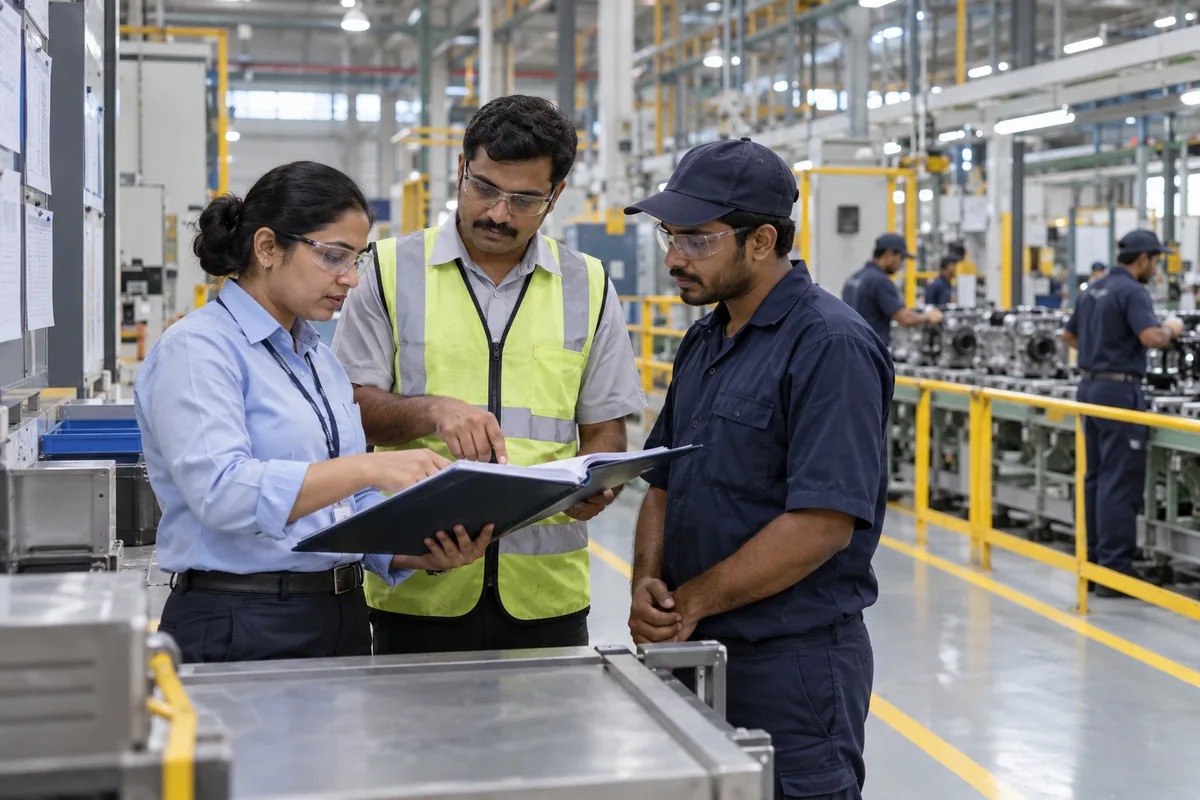
When an operator, technician or supervisor leaves a plant, the line feels it quickly. A machine goes without its trained person, a shift runs short and someone is moved across. Understanding why people leave is the first step to keeping the next trained operator.
The purpose of an exit conversation is to learn from the person's experience, respect their decision and see what could be better for those who remain.
CIPD's guidance on employee turnover highlights the value of understanding why staff leave and addressing areas such as fair treatment, flexibility and employee wellbeing. Source: CIPD
Look beyond the first answer
"Better salary." "Nearer to home." "Family reasons." These may be accurate. They may also be a polite way of avoiding a harder answer, such as an unfair supervisor, overtime that was assumed rather than asked for, or a long wait to move up a level.
Start with a simple question: "What made you start thinking about a change?" Then ask what made them decide. A job nearer home or at a larger company may be the reason someone moved, but not the reason they began looking.
Not every exit signals a fault. Marriage, relocation, family needs, further study and a move to a different trade are all real reasons.
Explore the areas that shape a plant job
Use these as prompts rather than assuming any one of them caused the resignation.
- Shift pattern and rotation: Was the shift schedule published in time? Was rotation fair, or did some people stay on nights longer than others?
- Overtime and weekly offs: Was overtime requested or assumed? Were hours recorded and paid as agreed?
- Supervisor treatment: Were instructions clear and respectful? Did the same rules apply to everyone, and across every shift?
- Skills and progression: Could the person learn more machines and see how that would change their level and pay? Was the route to line lead clear?
- Pay and incentives: Were production-linked incentives and increments explained and applied consistently? Did people at the same level on different shifts feel treated alike?
- Safety and working conditions: Did the person feel safe? Were protective equipment, heat, noise, breaks and canteen facilities adequate? Were concerns acted on?
- Status and contract: Did the person feel they were treated differently from permanent staff, or unsure how their own engagement would continue?
- Personal circumstances: Did travel distance, housing, family or health play a part?
Several of these usually combine. Let the person explain how, in their own words.
Who should hold the conversation
Invite the person to a voluntary conversation during the notice period. Explain that the purpose is to understand and improve, and that nothing said will change their final settlement.
The shift supervisor or production manager is rarely the right interviewer, because the concern may involve them. An HR representative, a welfare or training officer, or a manager from another department is better. If the concern is about a supervisor, offer someone else. Written feedback, or a short form read out in the person's own language, should always be an option.
In a plant with two hundred people, details can easily identify a speaker. Do not promise complete anonymity. Explain who will see the answers and how they will be used. Listen without defending, and do not ask the person to justify leaving. For how to run the process around the conversation, see exit interviews that produce action.
Questions that lead to useful feedback in manufacturing
- 1
What first made you think about a change?
This finds the starting point, which is often different from the final reason.
- 2
What were the main reasons you decided to leave?
Let them order or connect the reasons in their own words.
- 3
What did you value about working here?
It shows what is worth protecting for those who stay.
- 4
Was the job what you were told when you joined?
Gaps point to promises about pay, shift or role that did not hold.
- 5
How were your shifts, rotation and overtime?
Listen for late roster changes, unpaid time and uneven rotation.
- 6
How did your supervisor treat you and your team?
Offer a different interviewer if the person is uneasy answering this.
- 7
Did you have the chance to learn other machines or processes? What stopped it?
Ask about the link between skills, level and pay.
- 8
Were incentives and increments clear and fairly applied?
Listen for differences between shifts and lines.
- 9
Did you ever feel unsafe, or did you raise a safety or welfare concern? What happened?
Take any safety concern seriously, whatever the person decided to do.
- 10
What should we change for the next person on your line?
A forward-looking close that stays practical.
Allow the person to skip any question, and keep the conversation short and plain.
Turn individual feedback into a pattern review
Record the main reason, any contributing factors and a short factual summary, separating what was said from your interpretation. Add plant, shift, line, supervisor, skill level and length of service.
Review exits over time by plant, shift, line and supervisor. Compare people leaving in their first weeks with those leaving after several years. Look for clusters around increment time, festival periods, a change of shift pattern or a new supervisor. A small number of exits should prompt further questions, not an immediate verdict on a supervisor. The attrition number that hides the problem explains why a single plant-wide figure is not enough.
Compare exit feedback with attendance, overtime, incident and complaint records. Keep identifiable responses to those who need them.
Give each improvement an owner
Feedback that is filed away helps nobody. For each issue chosen for action, agree on:
- The specific change needed.
- The person responsible.
- A completion date.
- How progress will be reviewed.
For example, uneven rotation could be owned by the production manager, with a visible rotation record. Unclear incentive rules could be owned by the plant head with HR, written down and explained to every shift. A supervisor concern should be taken up by someone senior to the supervisor. Where appropriate, tell current staff what has changed without revealing any person's private feedback.
Start listening before people resign
Do not wait for the resignation. Hold short, regular conversations at the line or in small groups, led by someone other than the supervisor. Ask: "What would make you think about leaving, and what could we fix now?"
Good moments are after the first month, after a change of shift, after the increment cycle and after any safety event. Act on what you hear and say what was done, or people stop telling you.
Every departure deserves a respectful response. The same approach, for all roles, is set out in why employees leave and how to understand their reasons.