
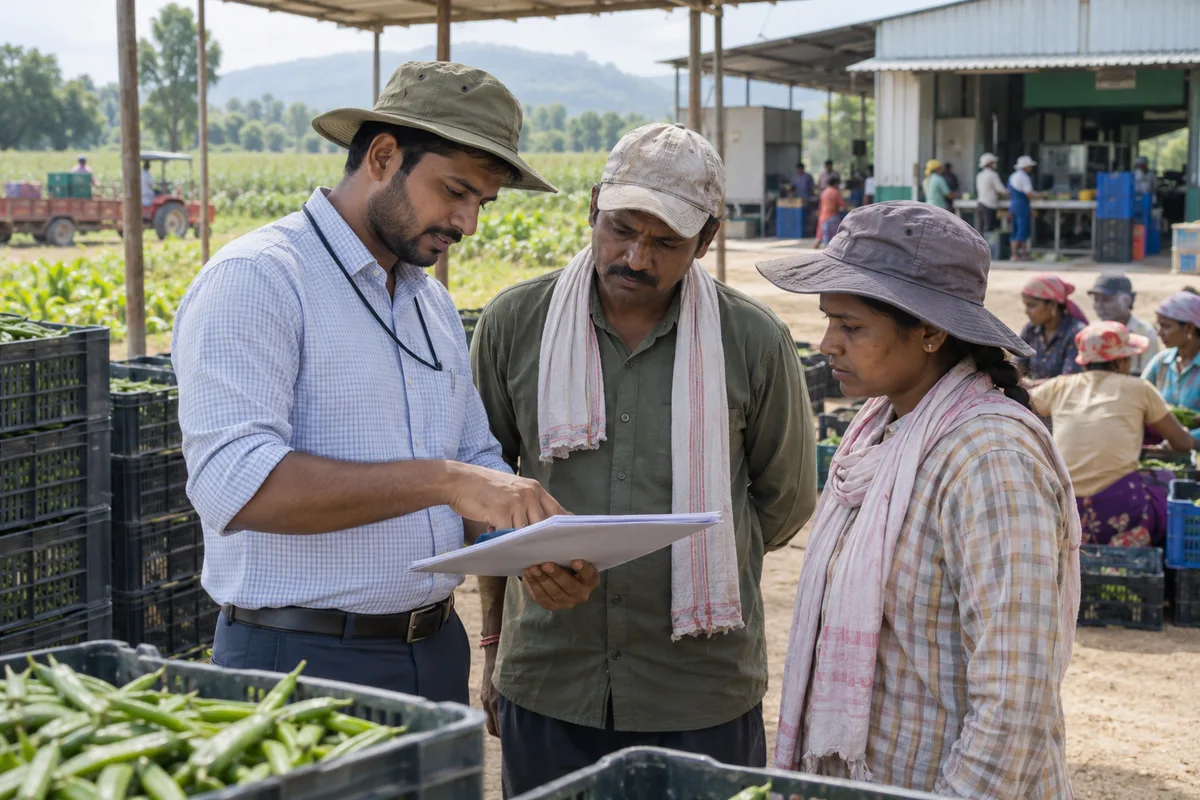
The one operator everyone calls when the fertigation unit throws a fault is away at a family wedding. The dosing schedule lives only in that person's memory, the filter was last cleaned on a date nobody knows, and the head grower is looking at yellowing leaves in the far house. Four other people are standing nearby.
How do you build farm skills so one absence does not hurt the crop?
Write down the tasks your farm cannot afford to get wrong, mark who can do each one and to what level, then train backups during the weeks when the task actually occurs. Start where only one person is capable. A wall chart, a named teacher and a field check are enough to begin.
Choose the skills worth tracking
Do not list everything. A matrix with every chore on it dies within a month. Pick tasks that are hard to learn, tied to timing, dangerous or visible to the buyer. Walk the crop calendar from land preparation to dispatch and ask at each stage who would be missed.
- Water: pump starting and fault finding, valve rotation, filter cleaning, reading soil moisture.
- Crop protection: scouting for pests and disease, mixing, sprayer calibration, waiting periods before harvest, safe storage.
- Plant work: nursery raising, grafting, pruning, training and thinning.
- Protected growing: climate controls, fertigation settings, backup power.
- Harvest and packhouse: maturity judgement, grading to the buyer's specification, bunching, pre-cooling, cold room operation.
- Machines and records: tractor and implement use, spray and input logs, traceability sheets, daily crew counts.
Four levels anyone can judge
Level one means the person has seen the task and assists with it. Level two means they can do it while somebody checks. Level three means they can do it alone, including noticing when something is wrong. Level four means they can teach it and decide what to do when the usual method fails. Avoid marks such as good or average, which describe a supervisor's mood.
Score by observation. Ask a worker to calibrate the sprayer with water, prune three trees while explaining each cut, or sort a crate against the grade standard. Years on the farm are not proof. Equally, a quiet seasonal worker who returns every year could be your best grafter without anyone having written it down.
Block or unit:
Season:
Levels: 1 helps  2 checked
        3 alone  4 teaches

Task            | A | B | C | D
Pump faults     |   |   |   |
Valve rotation  |   |   |   |
Pest scouting   |   |   |   |
Spray mixing    |   |   |   |
Grafting        |   |   |   |
Grading         |   |   |   |
Cold room       |   |   |   |

A:        B:
C:        D:
Tasks with one level 3 or 4:
Backup being trained:
Teacher:
Practise during week of:
Checked by and date:
Spot the dependence
Read the chart row by row. Any task with only one person at level three or above is exposed. Then read column by column. A manager or old hand who is the sole name in several rows is a bigger risk than any single row suggests, especially if the same person also holds the shed keys, the buyer's phone number and the only copy of the spray record.
- Work waits for one person to return from market before it starts.
- Instructions are given only by phone and never written.
- A supervisor says teaching takes longer than doing it themselves.
- A gang leader is the only one who knows which returning workers can prune.
- Nobody else has handled a pump trip or a cold room alarm.
Decide who teaches whom
- 1
Rank the exposed rows
Put first the tasks where a gap would cost the standing crop or hurt someone: water, chemicals, cooling and harvest maturity.
- 2
Pair teacher and learner
Choose a teacher at level three or four who explains patiently, and a learner who is likely to stay. Include women workers, seasonal returners and young staff on merit, subject to local rules on age and hazardous work.
- 3
Capture the method
Film the teacher on a phone or write a one-page sheet with pictures in the local language. Note the signs that something is wrong, which experts forget to mention.
- 4
Practise in season
Pruning is learned in pruning weeks. Book the learner onto the task then, with slack in the plan so teaching is not dropped when the work gets heavy.
- 5
Check and hand over
A manager or specialist watches the learner work alone before raising the level. After that, give the learner the task on set days so the skill stays fresh.
An illustration from a flower unit
Suppose the chart for a rose house shows one person who can set the climate controller, two who can mix sprays and nearly everyone able to bunch. Training more bunchers would feel productive and change little. The owner's first move is to have the controller operator walk a chosen backup through alarms, vent settings and manual override, then write the readings that should trigger a phone call. The backup takes the quieter shift first, with the operator reachable, and moves to a hot afternoon only after being watched. Meanwhile the head grower decides which settings the backup must never change alone.
The same logic applies in an orchard with one grafter, or on a vegetable farm where one person knows the order of valves across sloping ground. Protect the narrow row before improving the wide one.
Give teachers a reason to share
Some skilled people guard knowledge because it protects their place. Say openly that teaching is part of the higher grade, reward it and make clear that training a backup frees them for leave and better work. A grafter who gains an allowance for each learner brought to level three has a stake in the result. Link this to your grade rules through a simple learning and development process, and keep role expectations in writing with role design and job descriptions.
Use the chart to plan hiring and leave
Before approving leave in a critical week, look at the column for that person and name the cover for each row. When you recruit, ask for the skill your chart lacks and test it on the plant or at the pump. When a skilled worker gives notice, spend the remaining days on the rows only they hold, with the learner beside them.
Keep it alive
Review the chart before each major crop stage and after anyone leaves. Hang it where supervisors plan the morning, but keep personal notes private. When you offer a new block, crop or buyer standard, add the new rows before you promise the work.
Where to go next
Fill in the chart for one block this week and circle every lonely name. For more on people issues in this sector, see HR for farms and agribusinesses. If you would like help building the process, send us your requirements.