
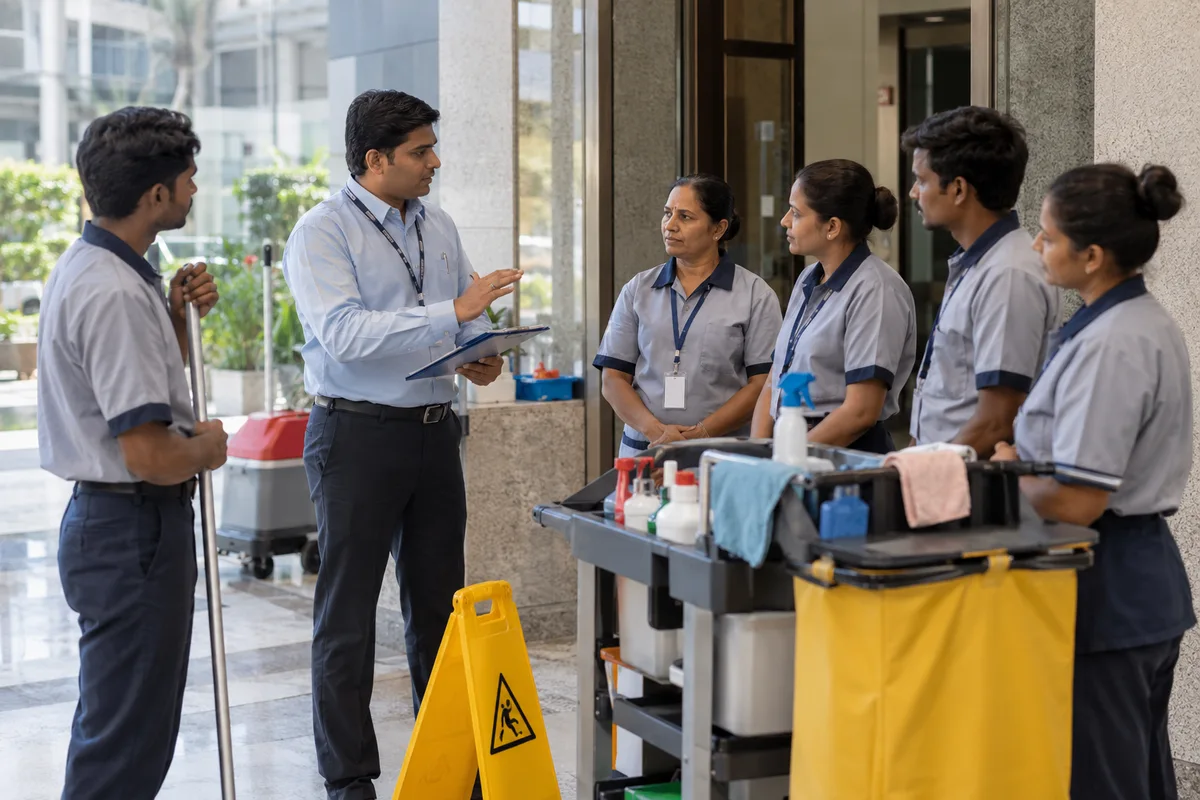
Consider a hospital site where one attendant, with long service, is the only person the ward sister trusts to clean the isolation room. On the day that attendant takes leave, a reliever is sent in, nobody can say what sequence to follow, and the room stays closed while the site manager is called from home.
How do you build skills and stop depending on a few people?
Write the tasks each site needs, score every worker against them on four levels, and circle any critical task with fewer than two capable people per shift. Assign a trainer and a learner to each gap, practise on site, observe the work and update the sheet.
List the tasks your sites really need
Job titles hide the differences. Two people called housekeeping attendant may be able to do very different things. Walk a shift with the supervisor and note each task that would cause a complaint or an injury if done badly.
- Floor care by surface: hard floors, carpet, stone and raised office flooring.
- Washroom cleaning and restocking, with colour-coded cloths and mops kept apart.
- Chemical handling: reading labels, measuring concentrate and what must never be mixed.
- Machines: scrubber-dryer, polisher, wet vacuum, including battery, pad and cleaning care.
- Hospital work: isolation and critical areas, spill response, waste segregation and linen handling.
- Public-facing work: lobby, pantry, helpdesk calls and speaking with occupants.
- Technical work: pumps, lifts, electrical and plumbing tasks, restricted to people with the required permission.
- Supervisor work: roster, attendance close, material control, inspection and client handover.
Mark which tasks are critical
Put a star beside tasks where a mistake can hurt someone, damage a client surface, spread infection or break a contract term. Stone floor care with the wrong chemical, a wet lobby without a sign, sharps in an ordinary waste bag and an untrained person at a polisher all belong here. Set the minimum cover for each starred task by shift, and do the training for these before anything optional.
Client standards differ too. A corporate lobby, a mall food court, an outpatient corridor and an apartment stairwell each call for their own order of work and timing. Add a column or a note for site-specific sign-off, so a level two washroom cleaner is not assumed to know a hospital sequence.
Use levels a supervisor can judge
Four levels are enough. Level zero means not trained. Level one means works with someone beside them. Level two means works alone to the site standard and knows when to stop and ask. Level three means can teach it and check another person's work. Attendance at a talk earns no level on its own. Someone must watch the task being done.
Site:          Shift:
Key: 0 none  1 with help
     2 alone  3 can teach
Task      A    B    C    D
Floors    _    _    _    _
Washroom  _    _    _    _
Chemicals _    _    _    _
Machine   _    _    _    _
Spills    _    _    _    _
Waste     _    _    _    _
Client    _    _    _    _
Gap task:
Learner:
Trainer:
Recheck date:
Find the single points of dependence
Read the matrix across each row. Where only one person scores two or higher, you have a post that fails on their rest day. Then look for knowledge that has no row: the client manager who dislikes noise before ten, the store key, the sequence for opening the pantry, the contractor who services the pump. Put that into the site note so it does not live in one head.
Test the sheet with a simple question for each shift: if the strongest person were absent tomorrow, who would do their critical task? Name the cover. If the answer is a worker at another building, check travel, site access and training before relying on them.
Teach on site in small pieces
- 1
Pick the riskiest gap
Start with tasks affecting health, safety or contract standards, then work down to convenience.
- 2
Choose the trainer carefully
A fast worker is not always a patient teacher. Confirm that the trainer follows the approved method before they pass habits on.
- 3
Show, do together, watch
The trainer demonstrates, the pair work side by side, then the learner works alone while the trainer observes.
- 4
Use pictures and the local language
Place a short visual card at the chemical store and machine bay. Ask the learner to explain the step back to you.
- 5
Recheck later
Observe again after some weeks of real use. Lower the level if the method has slipped, and say why without blame.
Protect the time. Agree with the coordinator when a pair can practise, such as the quieter part of the afternoon at an office or the overnight lull at a mall. If training is expected on top of a full cleaning round, it will not happen.
Fit training around real shifts
A new mobilisation, a deep-clean weekend and a machine delivery are natural teaching moments. Pair a learner with the trainer during that work and record the observation afterwards. Where a supplier shows how to use a new machine or product, have your trainer attend and then repeat the lesson for the night crew, who are easily missed by daytime demonstrations. Check that damaged pads, flat batteries and missing dosing cups are replaced, because people cannot practise a method without the kit it depends on.
Make learning worth the effort
Tell people what each level opens up: new sites, machine work, a team leader opening. Thank trainers and count teaching when you consider them for advancement. A senior attendant who fears being replaced may guard knowledge, so explain that teaching is part of becoming more valuable. If a skill carries extra pay, state the condition in writing.
Use the matrix to deploy
Check the sheet before moving a reliever, approving leave or promising a client an added service. If the only trained machine operator wants the same week off as a scheduled deep clean, you will see it early enough to train a second person or agree another date.
Keep the matrix alive
Update it when someone joins, moves or leaves, and before mobilising a new site. Let the team see their own row and challenge it. A structured learning and development process adds owners, review points and records once several sites are running their own sheets.
Where to go next
Read more about people management in facility management and housekeeping, and consider how role design and job descriptions support clearer task lists. For help building matrices across your sites, tell us your requirements.