Consider a night at a rice mill when loaded trailers are queuing and the dryer attendant sends a message to a colleague, not the shift lead, saying they will not come. The day attendant stays on, nobody records it, and by morning the person running hot equipment has been awake far too long.
How should shifts, attendance and absence cover work in an agribusiness?
Set the minimum people and skills needed for each shift, route or block, publish who works when, and give absences one reporting line with a cut-off. A named lead fills gaps from a prepared backup list, records the change and the overtime approval, and hands over in person. Review the pattern weekly during peaks.
Three kinds of work need three attendance methods
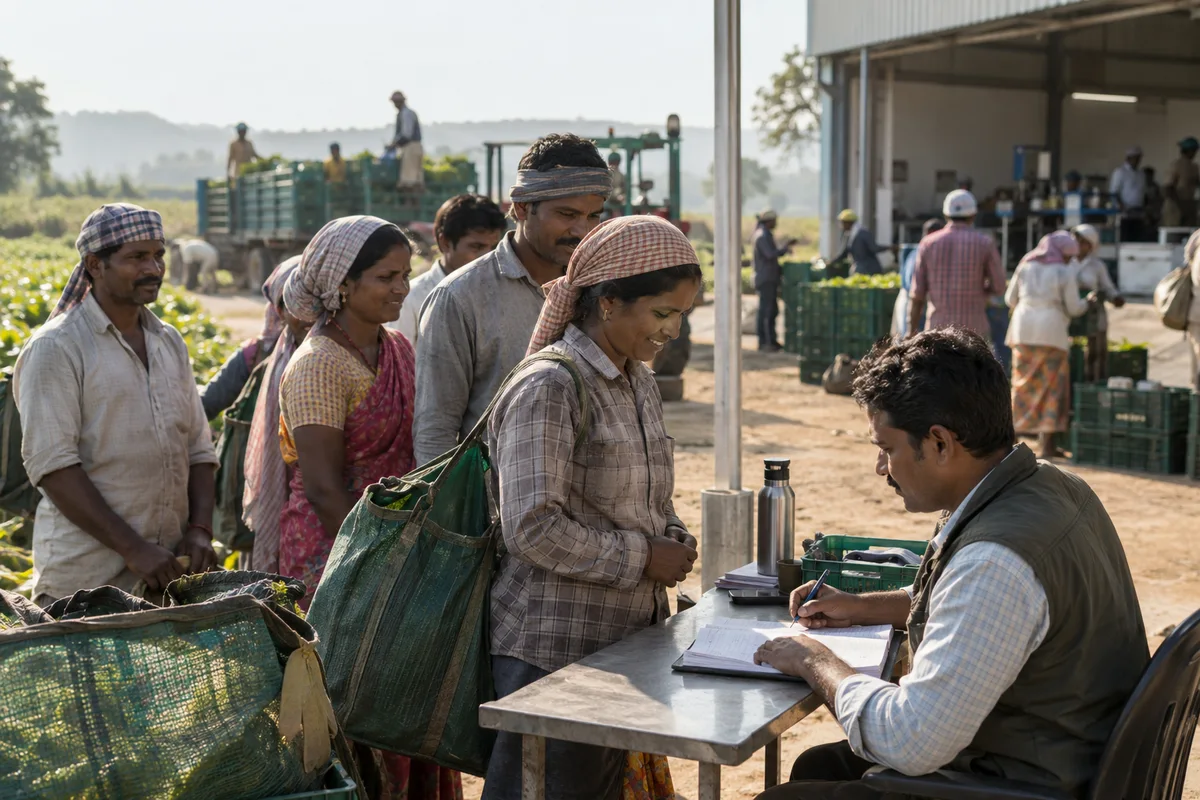
- Processing, packing and cold storage: shift-based, marked at the gate or shed, with a handover signature for posts that cannot be left empty.
- Farm, nursery, poultry and dairy crews: task-based starts that follow daylight, milking, feeding or irrigation, marked by the block supervisor at the work spot.
- Field officers, procurement staff and delivery riders: a planned route, a start check-in, visit notes and an end-of-day close. Location data alone does not show that useful work happened.
All three should flow into one record using the same codes for present, leave, weather stop, absence and overtime. Set the daily time by which supervisors send entries, so that corrections happen while memories are fresh and not in the week pay is prepared.
Write the minimum cover before the roster
List each post whose absence stops work or creates danger: boiler or dryer attendant, weighbridge operator, quality sampler, cold-room technician, pump operator, milking-parlour lead, hatchery attendant. For each, note the number needed per shift, which backups are trained, and any licence required. A roster with enough heads but no cleared dryer operator is short. Mark single points of failure in red and treat them as a training task before the next window.
When someone cannot come
- 1
Take the call on one line
The worker rings or messages the duty number before the agreed cut-off. A note passed through a friend is followed up by the lead, who records the reason given and expected return.
- 2
Check what is exposed
Compare the gap with the minimum cover sheet. A missing bag stacker and a missing quality sampler during intake need different responses.
- 3
Move people already on site
Shift a trained person from lower-priority work such as cleaning, repairs or repacking, and write down what that work is now delayed until.
- 4
Call the backup list in order
Use a rotating order so extra hours are offered fairly. Confirm the person has had enough rest and holds any needed clearance before accepting.
- 5
Reduce the operation if needed
Slow intake, close a lane, postpone a spray round or reassign grower visits. The lead tells procurement and transport early so vehicles are not sent to wait.
- 6
Close the entry
Record who covered, approved hours and any follow-up, then speak with the absent worker on return.
Swaps, handovers and rest
Allow swaps, with limits people can see: both workers ask the lead before the shift, both are cleared for each other's post, neither breaks rest rules, and the roster is changed in writing. At handover the outgoing person reports equipment faults, lots under drying or fumigation, temperatures outside range, queued vehicles and anyone still inside a restricted area. If the relief has not arrived, the outgoing worker informs the lead, who decides what happens. Nobody should silently roll into a second shift.
Animals, water and cold rooms need cover every day
Milking, feeding, hatchery checks, pond aeration, nursery watering and cold storage carry on through weekends and festivals. Plan these as duty rotas with a named primary and backup for every day, including nights where an alarm or pump needs a response. Say whether the duty person must stay on site or be reachable, how quickly they need to answer, and how that time and any call-out are paid. Check alarms and phone numbers when the rota is issued.
Agree festival and local holiday cover early, while people can still choose. Offer the unpopular turns in a published rotation, so the newest worker or the person who lives nearest does not carry them all. Where one family traditionally covers a shed or pump house, name a trained person outside that household as well, because they may all need to be away together.
Rain, breakdowns and sudden gluts
Weather and machines change the plan faster than any roster. Decide in advance who calls a stop, how crews are told before they travel, which indoor tasks are available, and how waiting time is recorded and paid. For gluts, name the point at which an extra shift is opened, such as the queue at the gate reaching a level the unit in-charge has set, and confirm the supervisor, transport and meals that go with it.
Agree overtime before it is worked
Name who can approve extra hours at each site and how approval is captured, even by message when the manager is away. State the reason, the people and the expected finish. Compare approved hours with gate records every week. Repeated overtime for the same post points to a staffing or training gap, and the owner should decide whether to hire, cross-train or change the intake schedule.
The cover sheet for the shed wall
Site:            Week:
Duty phone:
Report absence by:

CRITICAL POST:
Needed per shift:
Day / Night names:
Backup 1:
Backup 2:
Licence needed: Y / N
If uncovered, we will:

Overtime approver:
Stop-work call by:
Weather message sent via:
Wet-day tasks:
Open gaps:
Reviewed by / date:
Field staff cover without surveillance fights
For field officers, agree territories in pairs so each knows the other's priority growers, pickup commitments and pending payments queries. Keep a shared visit note that a colleague can act on. Explain what location data is collected, why, and during which hours, and check local privacy rules. Judge cover by whether promised visits and collections happened.
A written attendance, shift and leave process ties these rules to pay inputs. If supervisors already follow a routine on paper, attendance and shift software can reduce retyping, provided it copes with poor signal and shared devices.
Where to go next
Fill in the cover sheet for your riskiest site and walk through an imagined absence with the shift lead. Browse our agriculture and agribusiness guidance, or send us your requirements with your shift pattern and season dates.