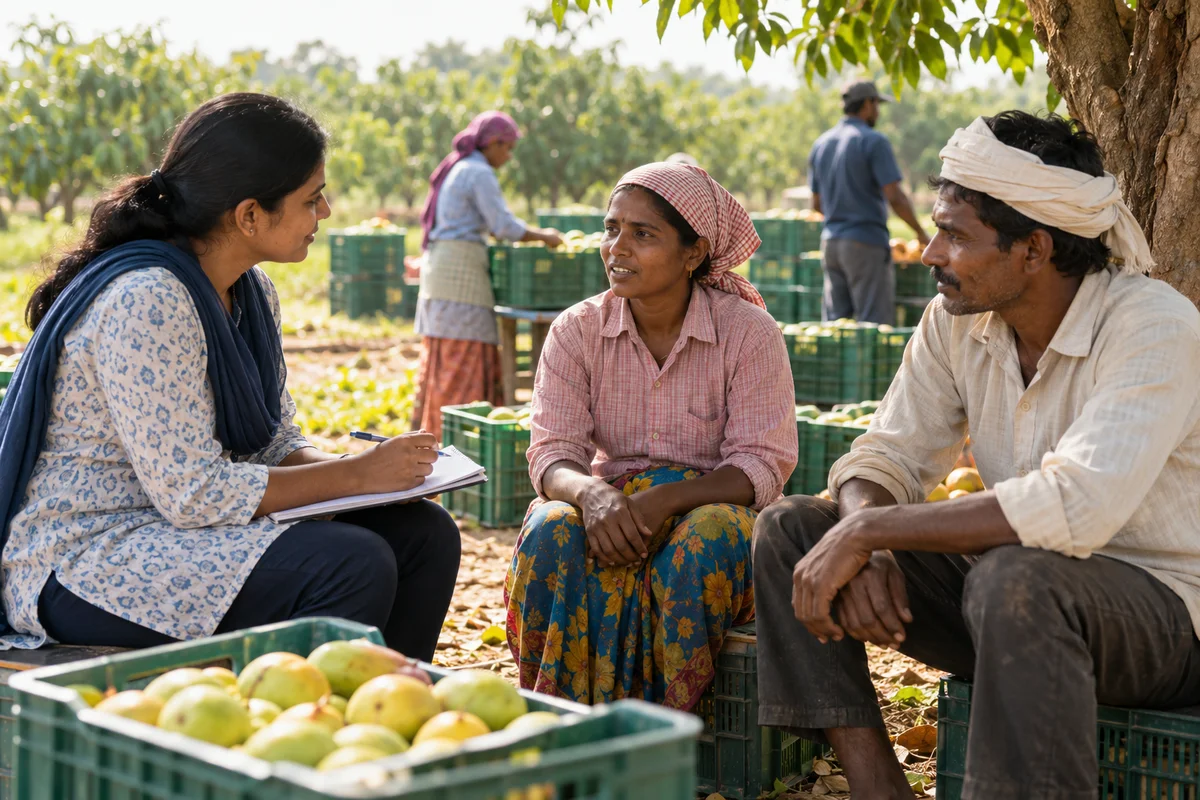
Picture a collection centre where procurement officers earn extra for every tonne brought in. Arrivals look excellent until the processing manager opens the stacks and finds damp lots accepted late in the day, while the officer who turned bad produce away earned less than anyone.
How can an agribusiness set pay, grades and incentives fairly?
Group similar work, define a few grades by what a person can do unaided, and set a pay range for each from local evidence and what you can sustain through a weak season. Keep incentives small enough to protect judgement, link volume to quality, and place existing people without cutting anyone.
Find out what you pay for now
Pull one peak pay run and one lean one. Beside each person write the basic rate, overtime, piece earnings, travel and phone allowances, food or lodging, advances, season bonus and anything handed over in cash by a manager. Then ask what earned each item. You may find two dryer attendants doing the same job on different rates because one joined during a shortage, or a long-serving helper paid above a trained operator. Check whether people doing equal work differ by gender, origin or engagement type, and take advice where a gap cannot be explained by the work.
Grades people can see in the work
Keep families separate: field and procurement, processing and storage, farm and livestock, workshop and maintenance, office and sales. Three or four steps in a family are plenty. For processing, the steps could read like this.
- Helper: loads, stacks, cleans and tags to the standard, follows stop and hygiene rules.
- Process hand: runs one station unaided, records readings and reports faults early.
- Operator: runs and adjusts a dryer, grader, packer or cold-room system, handles routine faults and holds any required licence.
- Shift lead: allocates people, takes over in exceptions, teaches others and signs the handover.
A grade changes when a supervisor and one other assessor have watched the tasks done under working conditions. Publish the tasks so a helper knows what to learn next. Do not create a grade for every machine or every loyal individual; recognise rare skills with a clearly described allowance that stops if the duty stops.
Set ranges from what nearby employers advertise, what applicants and leavers tell you, and your own margins across good and poor harvests. Review them before recruitment for the season, since rates agreed in the rush of arrivals are hard to defend afterwards.
Incentives that do not spoil the crop or the relationship
Any single measure will be chased at the expense of the unmeasured. For procurement, count accepted quantity only after quality results, and hold back credit where weights are disputed, grading is overturned or growers are promised terms the business never approved. For input and equipment sales, reward collected payments and suitable recommendations, not stock pushed to a farmer who cannot use it. For piece work in picking, sorting or packing, pay on accepted units, show each worker the count daily, and set breaks and safety rules that no rate can override. For maintenance, avoid paying per repair, which rewards breakdowns; credit completed preventive checks and verified fixes.
A season completion payment gives a crew a reason to stay to the end. State the qualifying days, how illness and weather stops are treated, and when it is paid, before the season begins. Team bonuses suit shared work such as unit throughput with low rejection, provided newcomers know how their share is worked out.
A grade card to copy
Work family:
Grade name:
Can do alone:
 1.
 2.
 3.
Licence or clearance:
Assessed by:
Pay range: from ___ to ___
Allowances and their reason:

Incentive counts:
Quality condition:
Safety / conduct condition:
Worker can check count where:
Paid on:
Query goes to:
Next grade needs:
Review date:
Move across without taking money away
- 1
Place each person
Supervisors assess current tasks against the grade cards. A second manager reviews borderline cases and any pattern that favours particular crews.
- 2
Compare with the range
Mark who falls below, inside or above. Cost the lift for those below and decide how and when it will be made.
- 3
Protect those above
Leave their pay in place. Record the reason, discuss duties that match a higher grade, and take advice before altering how future increases apply.
- 4
Test the incentive on paper
Recalculate a past peak week under the new rules. Look for someone who gains from poor quality or loses because of rain, breakdowns or a thin route.
- 5
Explain individually
Tell each person their grade, pay, what counts, and how to raise a query, in their language and with a written copy.
- 6
Review after the window
Compare earnings, rejects, complaints and who left. Adjust through a stated change date, not mid-week.
Make the count something a worker can check
Trust in an incentive depends on the record behind it. Give pickers and packers a token, tally card or message showing accepted units on the day, with the reason for any rejection. Calibrate scales and moisture meters on a stated routine and let the worker or officer see the reading. For field officers, share the list of lots, collections and sales counted towards their earnings, including any later reversal. Set a short window for raising a query and have someone other than the recorder decide it.
Handle the lean stretch openly too. If incentive earnings fall sharply outside harvest, say so at hiring and again when the scheme is explained, so that staff are not surprised into leaving just before maintenance and training work begins.
Mistakes to avoid
Do not change counts after the work is done, hide the formula, or let one supervisor both record quantities and approve their own share. Treat advances as a recorded balance the worker has acknowledged. Skip complex scoring schemes with a dozen weighted measures; a crew that cannot work out its earnings will assume it is being short-paid.
If rates have grown by negotiation for years, compensation benchmarking and salary structure work gives an outside method for comparing roles and setting ranges. Questions about how bonuses fit your wider approach belong in a rewards strategy.
Where to go next
Complete grade cards for one family and test them on the people already doing that work. See more under agriculture and agribusiness, or outline your requirements including pay bases, sites and the season you are preparing for.