
Strengthen the Records Behind Safe Work on Live Assets
Energy sites combine high voltage, work at height, confined spaces, hot work, rotating machinery and, at some plants, process hazards. Safety rests on a chain: a permit, an isolation, a competent person, the right equipment and a briefing. Our service builds the people-side records and routines that hold that chain together, from induction to incident follow-through. Engineering controls and technical safety decisions stay with your qualified safety team. We organise the induction, competence, equipment and follow-up records around them.
Not sure what you need? Tell us about your business in six short steps and we will come to the first meeting prepared.
Share your requirementsThe starting point
Is Every Link in Your Safety Chain Recorded?
Incidents tend to begin at the weakest link: an isolation not verified, a permit issued for the wrong task, a contractor not briefed. Each of those links involves a person, a competence and a record that either exists or does not.
We help you build the people-side records and routines that keep each link visible.
You may be experiencing:
- Induction given after a person has already started work, or shortened for contractor crews.
- No quick way to confirm that a person named on a permit holds the authorisation for the task.
- Protective equipment issued without a record of what, when and in what condition.
- Near misses discussed on shift and never written down, because reporting feels like blame.
- Investigations that stop at the person closest to the event and never reach the cause.
- Corrective actions agreed at a meeting and not tracked to closure.
- Shutdown weeks with long shifts, unfamiliar crews and little attention to fatigue.
- Emergency drills held irregularly with no record of who took part.
What we can help with
Our Health, Safety and Wellbeing Services for Energy and Utilities Businesses
Site Safety Induction System
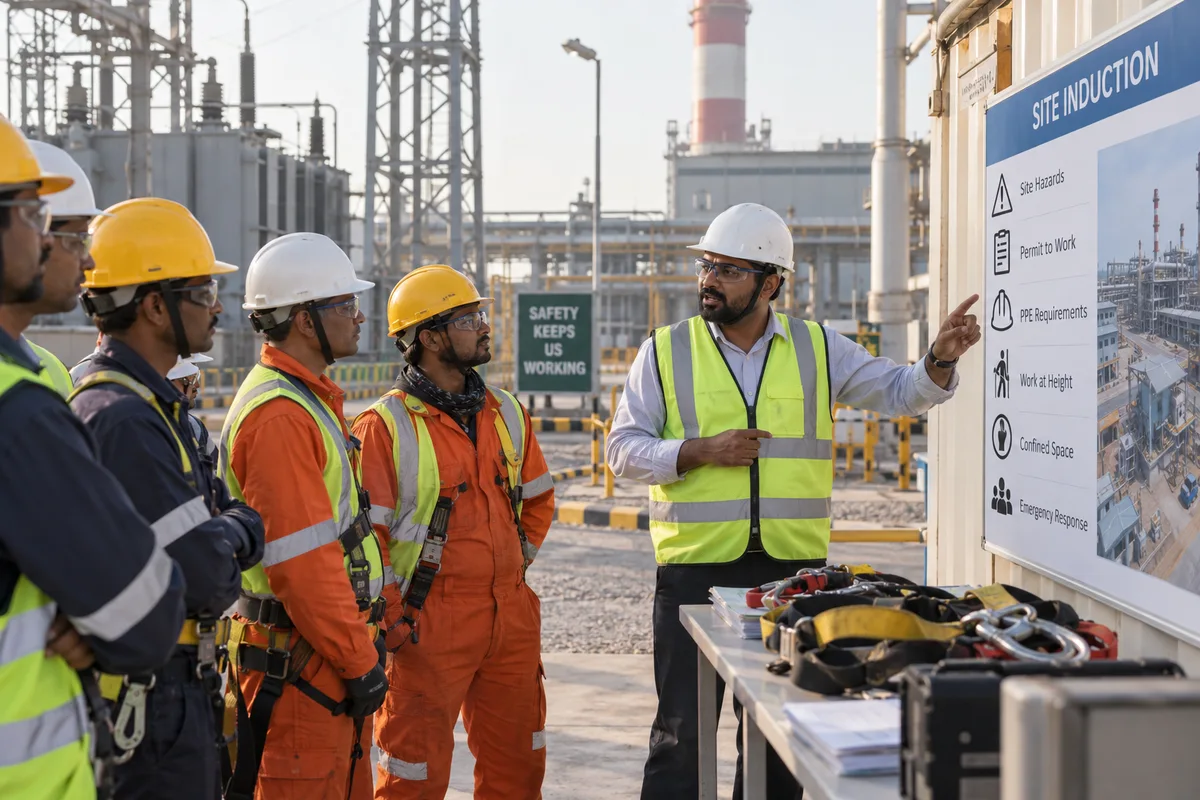
Structure induction for every person who enters a site, whether employee, contractor or visitor, with content by area, a signed record and a rule that no one starts a task without it.
Competence Before Permit
Link the register of authorised persons to the people named on permits and isolation records, so competence is checked before work is assigned and not after an event.
Safety Training Matrix by Role
Define the safety training each role needs, such as work at height, confined space, electrical safety and first aid, with validity dates, reminders and a record by person.
Protective Equipment Issue and Records
Set up how equipment is selected, issued, inspected and replaced, with a record per person and a check at shutdown mobilisation.
Incident and Near-Miss Reporting
Create a simple reporting route that works on a plant floor or a remote site, with a no-blame stance on near misses, a reference number and a feedback note to the reporter.
Investigation and Corrective Action Tracking
Prepare a structure for investigating incidents to cause, and a tracker that holds every action with an owner, a date and a closure check.
Contractor Safety Briefing and Records
Set the briefing, document checks and sign-off for contractor crews, including rolling mobilisation during shutdowns, and keep the records by contractor and site.
Emergency Preparedness and Wellbeing
Plan drills and keep attendance records. Cover fatigue, rest between shifts, first-aid coverage by shift and support for people after a serious event.
The deliverables
What You Receive
Typical working documents delivered to your safety and HR teams:
- An induction outline with a record format for each site type.
- A competence-before-permit check procedure.
- A safety training matrix with validity tracking.
- A protective equipment issue and inspection record.
- An incident and near-miss reporting route with forms.
- An investigation guide and corrective action tracker.
- A contractor briefing and document checklist.
- An emergency drill calendar and a fatigue and rest note for shutdowns.
Step by step
How We Work
Trace the Chain on Site
We follow a task from planning to permit to completion on a plant or project site, and note where the people records are held and where they are missing.
Work With Your Safety Team
We take the technical content and decisions from your own safety officers and engineers, and design the records and routines around them.
Build the Records
We draft induction records, matrices, issue records and reporting forms, and test them with shift supervisors and contractor representatives.
Set Owners, Reminders and Reviews
Each record gets an owner and a review date. Where helpful, we configure reminders and tracking on the GullyHR platform or your own system.
Measure and Improve
Before work starts we record your current position, covering induction completed before first task, near misses reported and corrective actions closed on time. We report against it after the first quarter.
The difference
Keep Competence and Follow-Through on Record
Stronger people-side records help you:
We do not promise outcomes. We record a baseline before work starts, covering induction completed before first task, near misses reported and corrective actions closed on time, and report against it, so you can see what changed and what did not.
- Show that each person was inducted before starting work.
- Check competence against the permit before the task begins.
- Know which safety training is current and which is close to expiry.
- Hear about near misses without anyone being blamed.
- Track corrective actions until they are closed.
- Brief and record contractor crews consistently, including at shutdown.
Find your fit
Who This Service Is For
Operating Plants and Substations
Keep induction, competence and equipment records tied to the permit chain.
EPC and Construction Firms
Mobilise large crews at a project site with a consistent induction and record.
Companies Running Planned Shutdowns
Brief, record and monitor hundreds of unfamiliar people in a short window.
Water and Utility Field Teams
Bring structure to work on roads, pipelines, pumping stations and in confined spaces.
Contractor-Heavy Sites
Hold contractor safety records to the same standard as your own.
How it usually shows up in energy and utilities
Energy sites combine hazards that are rarely found together: high voltage, work at height, confined spaces, hot work, rotating machinery and, in some plants, process or chemical risks. Safety rests on a chain of controls: a permit to work, an isolation, a competent person, the right equipment and a briefing. A weakness in any link, such as an isolation that was not verified, a permit issued for the wrong task or a contractor who was not briefed, is where incidents start. Shutdowns put the most people on the site in the least time, with the greatest number of unfamiliar crews, and long shifts add fatigue to everything else.
Common challenges
Where it goes wrong in energy and utilities
The permit chain has weak links
Isolations are not verified, permits are issued for the wrong scope, and a signature is treated as a control.
Shutdowns concentrate risk
Many crews, short timelines and long shifts coincide.
Contractors are less familiar
Crews arrive with their own practice and a short briefing for hazards they do not know.
Fatigue is built into the roster
Long outage shifts and rotating patterns erode concentration, and are accepted as normal.
A better process
What a working version looks like
- 01
Verify the controls, not just the paper
Isolations tested and confirmed on the day by a competent person, with the permit matched to the real scope. The health, safety and wellbeing work builds the routine.
- 02
Plan the shutdown for safety
Crew numbers, access, simultaneous operations and shift length planned in advance with safety review.
- 03
Brief every contractor crew on the site
A practical session on the specific hazards of the area before work starts.
- 04
Manage fatigue
Limits on shift length and consecutive days, with approvals for exceptions.
What to check this week
- Watch a permit being issued and ask how the isolation was verified.
- Look at the shutdown plan for simultaneous operations and crew density.
- Ask a contractor supervisor what he was told about this site's hazards.
- Check the longest shifts worked in the last outage.
- Confirm with a qualified professional the safety, permit and working-hours obligations that apply to your sites.
Confirm with a qualified professional. What applies depends on your establishment, your state and your sector, and it changes. This page describes a practice; it does not state a legal position.
What this looks like in energy and utilities
The parts of health, safety and wellbeing that are specific to this sector, rather than general.
Site Safety and Permits
Documented safety in a high-risk environment.
What this coversHide
Site Safety and Permits
Documented safety in a high-risk environment.
What this coversHide- Safety induction for site entry
- Work authorisation procedures
- Pre-work safety briefings
- Protective equipment issue and records
- Incident and near-miss reporting
- Accident investigation
- Corrective action tracking
- Emergency response drills
- Safety audit records
Questions on this, in energy and utilities
No. Technical safety design, permit systems and isolation procedures belong with your qualified safety and engineering staff. We organise the records around people: induction, competence, equipment, reporting and follow-up, so those technical controls can be shown to have worked.
No. GullyHR does not give legal advice. The safety, health and environmental obligations that apply to your sites and activities should be confirmed with a qualified professional, and we build the record keeping around the list you confirm.
By making reporting easy, giving feedback to each reporter and keeping blame out of near-miss records. Reviews should reward people who report. Where the culture is not yet ready, we suggest starting with supervisors who will model it.
Yes. We design the site entry and briefing standard for everyone on site, including contracted crews, and keep the records by contractor. Contractors remain responsible for their own employees, and your arrangements with them are agreed separately.
We help you set out who monitors hours, how rest between shifts is recorded and what happens when a person is close to your limits. The limits themselves are yours to set with your safety advisers.
Verification that the work is isolated and the permit matches the actual task. A signed permit is not a control unless someone has checked the physical state.
Plan crew numbers and simultaneous work in advance, limit shift length, brief every crew and have supervision on the ground. Most shutdown incidents involve unfamiliar crews and fatigue.
On the site's specific hazards, in the area, with a practical element, before work begins. A general induction is not enough.
Yes. Long shifts and short rest reduce attention and judgement, and they are created by the roster, so the roster is where to control them.
The site head, with named safety owners for permits, contractors and equipment. Everyone has a part, and each control needs a named person.
Make Competence and Follow-Through Visible on Every Site
If you cannot quickly show who was inducted, who was authorised and what happened to the last corrective action, start with the records. Tell us how your sites work and we will discuss where to begin.
Prefer to talk first? Call +91 80958 58589 or write to hello@gullyhr.com.
Book a Health and Safety Consultation
Describe your sites, your hazards in general terms and the records you keep now.
The general method — what health, safety and wellbeing covers, the questions it answers and what an engagement produces — is the same whatever the sector, and is set out on the workplace health, safety and wellbeing page. What is above is the part that differs for energy and utilities.
Other HR topics for energy and utilities
Where to start
Most engagements begin with a review of how this runs in your business today, then a written process and the sequence to implement it.
See all HR topics for energy and utilities, or another industry.