
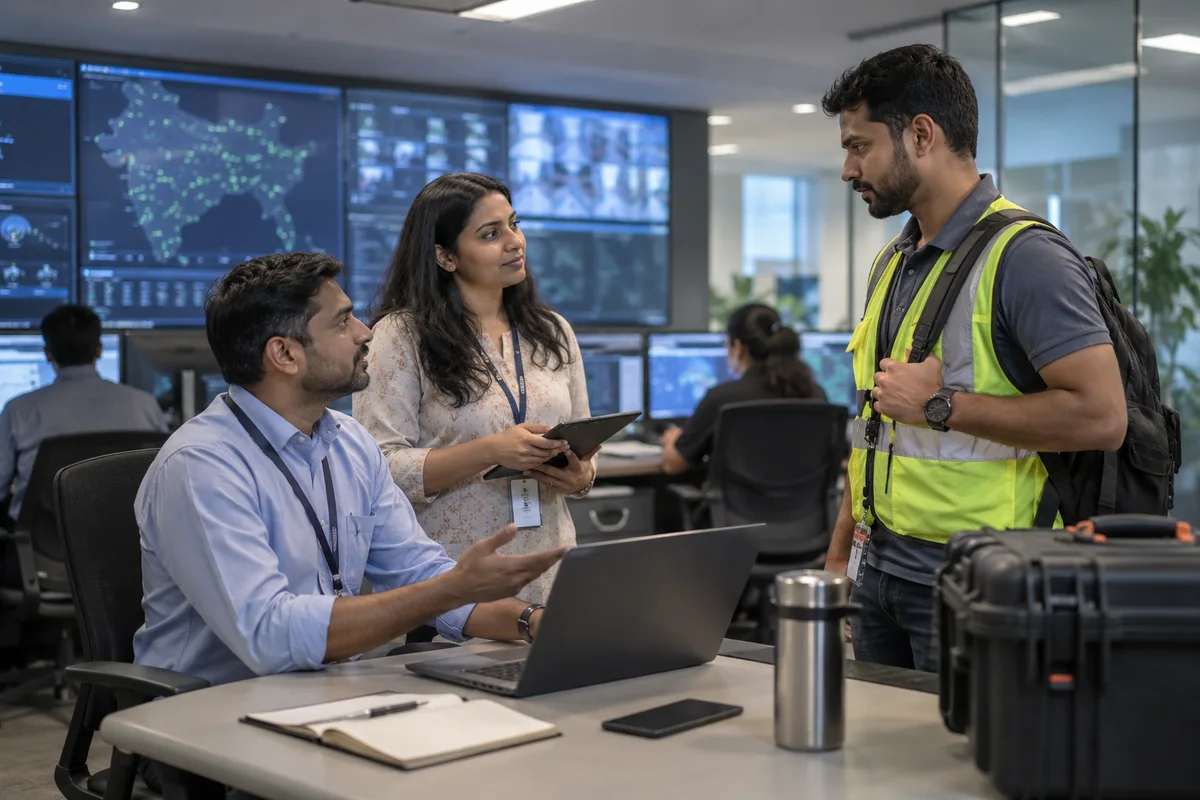
A ring fault takes out several sites and the only person who understands the old distribution frames is on leave. Their phone rings anyway, and the crew waits beside an open cabinet while someone searches for a photograph of the labels.
How do you stop relying on the one technician who knows?
Draw a matrix of real field tasks against names, rate each person from observed work, and count who can act alone in every area and duty shift. Where only one can, name a learner and a coach, move knowledge out of heads into shared records, and recheck monthly.
Choose rows a dispatcher would recognise
Skills such as networking or fibre are too broad to assign work from. Write tasks narrow enough that a team lead can watch one and say yes or no. Start with those that stop service, carry safety risk or are asked for by a client contract. Expand later.
- Fibre: fusion splicing a joint closure, dressing a distribution frame, testing a section and reading the trace, restoring a cut cable.
- Access and customer premises: installing a drop and terminal, configuring a router, proving speed and explaining the handover.
- Network desk: triaging alarms, deciding whether a field visit is needed, escalating to a vendor and keeping the ticket accurate.
- Radio and tower: link alignment, antenna replacement, tower rescue and ground crew duties.
- Power: rectifier and battery checks, generator changeover, earthing inspection within the person's authorisation.
- CCTV and security: camera mounting and aiming, recorder storage setup, remote access configuration and password handover.
- Site records: route survey, as-built drawing updates, material reconciliation and client acceptance.
Define levels by what happens on site
Use the same scale on every row. Level zero means not yet trained. Level one assists and can name the hazards. Level two performs the task while a qualified person watches. Level three performs it alone, tests the result and records it. Level four can teach it, diagnose unusual cases and assess others. A person who attended a course but has not done the task starts no higher than their observed work supports. Keep permit validity in a separate column, because a skilled climber with a lapsed certificate is not available to climb.
Levels
0 not trained   1 assists
2 supervised    3 alone
4 teaches and assesses

Area:        Checked on:
Skill      | A | B | C | 3+
Splicing   |   |   |   |
Trace read |   |   |   |
Frame work |   |   |   |
Link align |   |   |   |
Power check|   |   |   |
Desk triage|   |   |   |
Recorder   |   |   |   |

Only one at 3+:
Learner / coach:
Next observed job:
Read the matrix for hidden dependence
Replace the letters with names and complete the last column with the count of people at level three or above. Then repeat the count for each area and for nights and weekends, since a skill held by several people in head office may be held by nobody within reach of a remote exchange after dark. Look for other kinds of dependence too: the single holder of a client site pass, the person whose phone receives vendor codes, the engineer who keeps router configurations on a personal laptop, and the supervisor who alone knows which splitter feeds which street.
- 1
Rank the gaps
Put first any task where failure cuts off a large group of customers or risks injury, and where one person is the only independent cover. Rare, low-consequence tasks can stay on a vendor or planned appointment for now.
- 2
Pair for a purpose
Name the learner, coach, task and target level. Send them together to suitable planned jobs, where the learner holds the tools and the coach explains choices and intervenes for safety or service.
- 3
Capture what the expert knows
After each job, update the cabinet photographs, port map, configuration backup and fault note. Keep credentials in a controlled shared vault with named access, never in a chat group.
- 4
Sign off on evidence
Ask an assessor to watch the whole task, check the test result and records, and note any limits. A coach should not be the sole judge of a high-risk sign-off.
- 5
Keep the skill alive
Rotate the new holder onto that work and onto backup call-out. A skill learned once and never used will fail on the night it is needed.
Let the matrix change tomorrow's dispatch
A matrix filed away protects nobody. Give the dispatcher a short view showing who is at level two and who is at level three for the tasks on today's tickets. When a planned splice, cabinet upgrade or link alignment comes in and the coach is nearby, send the learner too, even though another assignment would be quicker. Agree with the operations head when that trade is acceptable, so the learner is not dropped every time the queue grows.
Check client commitments as well. A contract that promises restoration at night needs independent holders of the relevant tasks on the night rota, with permits and site passes to match. Where cover is missing, tell the account manager, arrange a vendor or neighbouring crew in advance and record that stopgap against the row. Revisit levels after a long gap from a task, a change of equipment or a failed job, and treat any reduction as a reason for practice, with a date to observe again.
Give the expert a reason to teach
A senior technician who is the only answer has reasons to hold on: sharing knowledge can feel like giving away standing, and a full call sheet leaves no spare hours. Count coaching as work, lighten the coach's job list on pairing days, recognise level four in grading and relieve them of calls the learner can now take. Do not reward them for staying indispensable. Plan practice on spare reels, retired equipment and bench racks for quieter periods, because storm season and rollout deadlines leave little room to learn. A written learning and development process keeps these pairings from vanishing when the order book fills. If the weak spot is a manager or founder, look at succession planning as well. Our overview of telecom and field technology services gives the wider context.
Where to go next
Fill the matrix for one area, circle every row with a single independent person and start one pairing. For help designing levels and training around field work, tell us your requirements.