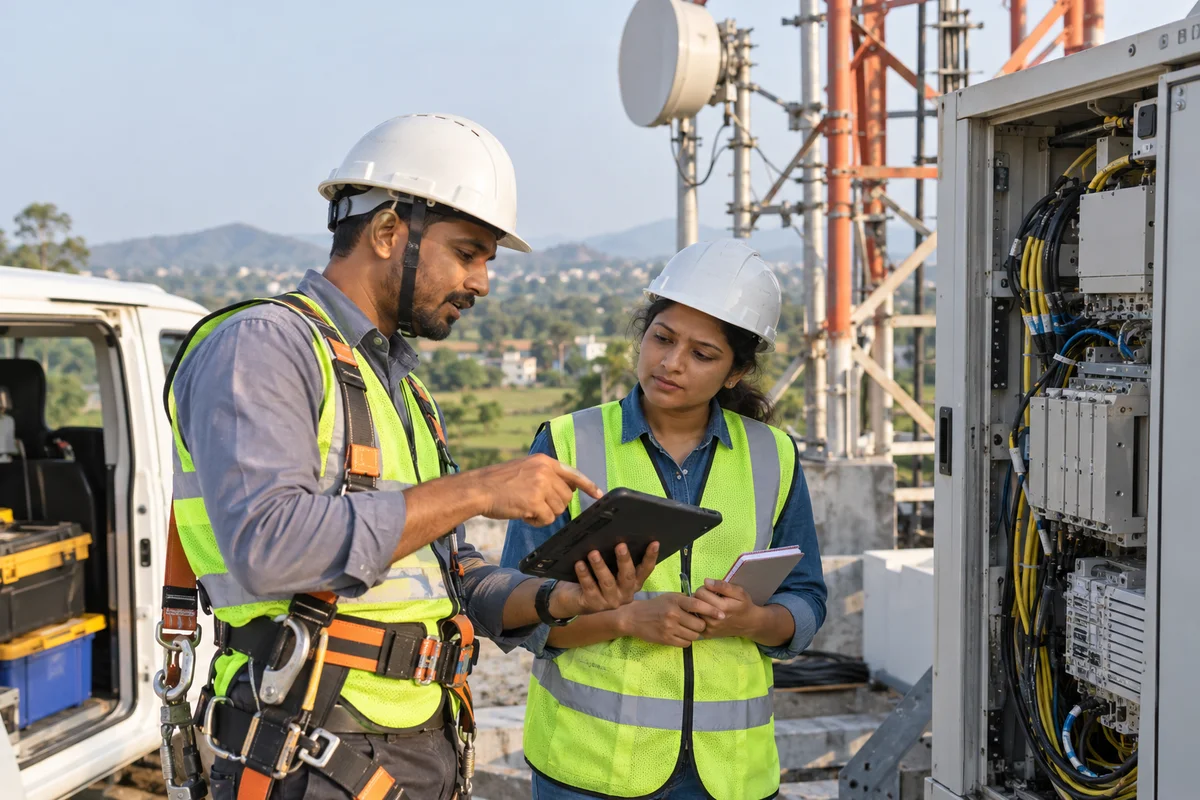
The one engineer who understands the old microwave link is on leave when it starts dropping. The team finds a notebook photograph, tries a restart and then rings the person on holiday, who talks them through it from a bus.
How do you stop one engineer or splicer being the only person who knows?
Map each critical task against every person who could do it, rate them by what they have been seen to do, and find rows with one capable name or none. Pair that person with a learner on real work, write down the steps, and test the learner alone before counting the gap as closed.
Choose skills that map to failure
Begin with what stops service, stops installations or puts someone in danger. Keep each skill narrow enough to observe. Networking is too broad to rate, while restoring a failed aggregation switch from a saved configuration is something you can watch. A starting set across a mixed operator could include these.
- Outside plant: fusion splicing, reflectometer testing and trace reading, closure repair, cable blowing, pole and duct work.
- Passive and active access: splitter planning, optical terminal provisioning, wireless link alignment, set-top box and customer device faults.
- Network operations: alarm triage, router and switch changes with rollback, power and battery backup checks, vendor fault escalation.
- Site work: climbing, rescue, rigging, earthing, generator and rectifier maintenance.
- Customer and coordination: outage communication, enterprise customer escalation, permit applications, landlord and site-owner access.
Add the local knowledge that no course teaches: where old routes actually run, which cabinet floods, who holds the key to a rooftop and which enterprise link has an undocumented workaround.
Four levels are enough
- Level one: has seen it and can assist safely.
- Level two: performs it with a competent person checking.
- Level three: performs it alone to standard, including records.
- Level four: handles unusual cases and can teach and assess it.
Rate from evidence: observed jobs, test readings, closed tickets and a supervisor's sign-off. Self-ratings are a useful conversation starter and a poor record. Keep authorisations in a separate column with expiry dates, because a level four climber with a lapsed certificate cannot be dispatched to climb.
Levels 1 to 4, blank = none
X = certificate expired
Team / territory:
Skill          | A | B | C | D |
Fusion splice  |   |   |   |   |
Trace reading  |   |   |   |   |
OLT provision  |   |   |   |   |
Router change  |   |   |   |   |
Power backup   |   |   |   |   |
Climb, rescue  |   |   |   |   |
Outage comms   |   |   |   |   |
Count of 3 or 4 on each row:
Rows with one or none:
Learner, teacher, test date:
Matrix owner:
Spot the hidden dependence
A matrix filled from memory flatters the business. Check it against behaviour. Sort recent tickets by fault type and see who closed them. Ask the monitoring desk whom they ring when the runbook fails. Look for passwords, configuration backups or route drawings that live on one laptop or phone. Note which person's leave gets quietly refused or interrupted. Ask what could not be done if one named colleague were unreachable for a fortnight.
Then rank the gaps by consequence and likelihood in plain terms. A task that affects an enterprise customer or a whole distribution area, held by one person who is also on call, comes before a rare task with a vendor support contract behind it.
Move knowledge from one head to several
- 1
Pick a few gaps
Choose the riskiest rows and one learner for each. A long training calendar covering every cell will collapse in the first outage-heavy month.
- 2
Protect teaching time
Schedule paired jobs and reduce the expert's ticket load to match. Agree with them what recognition teaching earns, so sharing does not feel like giving away job security.
- 3
Capture while doing
The learner writes the steps, photographs and warnings during the job. The expert corrects the draft. Store it where the night shift can open it.
- 4
Reverse the roles
On the next job the learner leads and explains choices, while the expert intervenes only for safety or service risk.
- 5
Test alone and rotate
A signer confirms level three after an unaided job. Then roster the learner to do that task regularly, or the skill will fade.
Who teaches whom
Splicers teach technicians the tray work and trace reading. L2 engineers teach monitoring engineers a few safe, runbook-based fixes, which also gives the junior a reason to stay. Field technicians show call-centre agents what a good fault description contains. Vendors can train on their equipment, but ask that attendees demonstrate the task to colleagues within weeks. Contractor experts are part of the picture: if only a contractor can restore a route, record that as a dependence and agree handover documentation.
Reduce dependence without waiting for training
Some protection is available this week. Back up device configurations centrally and have someone else restore one in a lab. Photograph and label cabinets, splice trays and power connections. Move vendor support accounts and site access contacts to shared company records with controlled access. Write a one-page first response for each critical failure: how to recognise it, what is safe to try, what must not be touched and whom to call.
Then run a short drill. Choose a task on the matrix, tell the expert to stay silent and ask the backup to work through the written steps on spare equipment. Gaps appear quickly: a missing password, a drawing that no longer matches the street, a spare nobody can find. Fix the document and book the next practice.
When a key person resigns, begin handover that day. Put the learner on their remaining jobs, record the tasks only they perform and agree what contact, if any, happens after they leave.
Keep it alive
Update the matrix when someone joins, leaves, passes a test or receives new equipment. Retire skills for decommissioned technology and add them for new rollout before the first live fault. Show each person their own row and the next level, with a date to discuss it. Do not publish rankings or use blank cells as punishment, or ratings will inflate.
Where to go next
Fill in one team's matrix and circle the rows with a single name. Our learning and development process work turns those gaps into a training routine, and the telecom industry page places it among other people risks. If you want support building it, tell us your requirements.