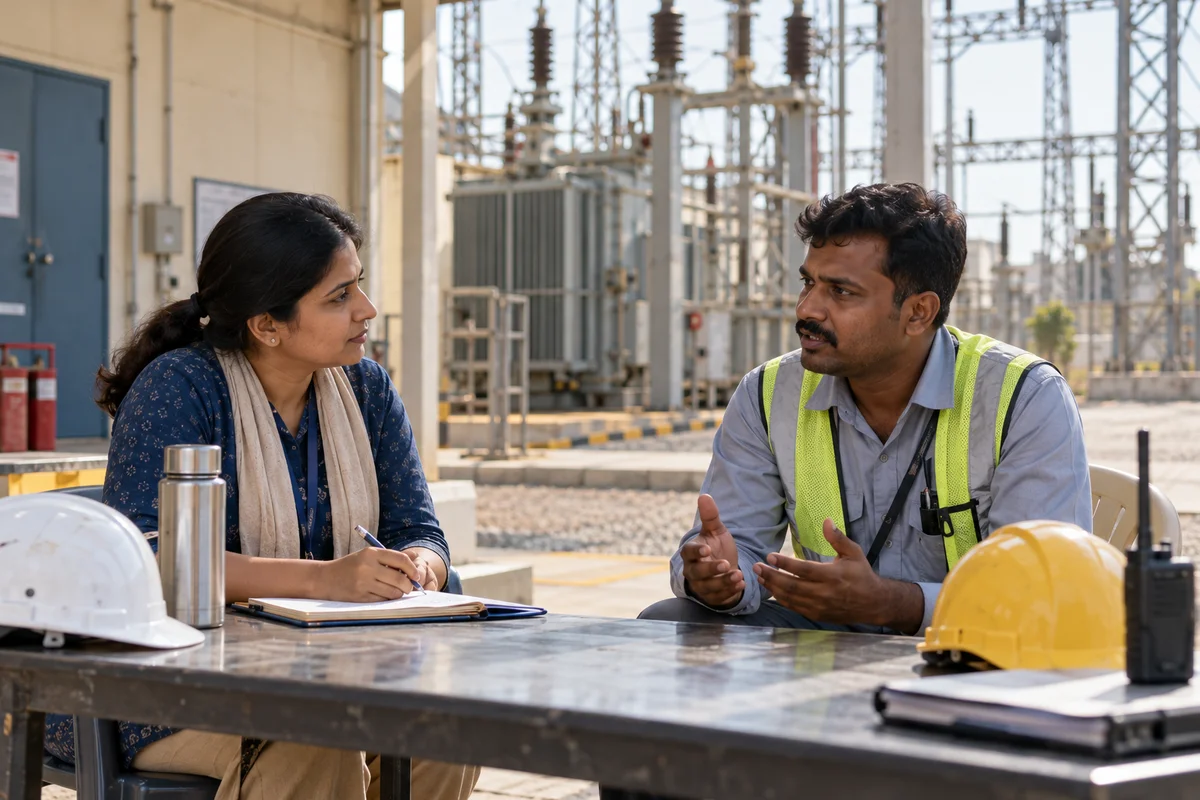
Picture a battery energy storage site where one senior technician understands the protection settings and the alarm history. That technician is on a flight when a fault trips the system, and the rest of the crew stand beside it, phoning.
How do you build skills and stop depending on a few people?
List the critical tasks for each site, rate every person against them on a simple four-level scale, and find tasks with fewer than two people able to work alone. Assign a teacher, a learner and protected shift time to each gap, then confirm progress by watching the work.
Choose skills by what stops the work
Skip generic course titles. Ask supervisors what has waited for a particular person during the last few months, and what could not safely proceed on nights. Write each answer as a task. Examples across this sector:
- Isolate, lock out and prove dead on a defined class of equipment
- Issue and close permits for height, hot work or confined space
- Diagnose inverter, charger or motor control faults
- Respond to control room alarms and carry out the agreed shutdown
- Adjust dosing and clean membranes on a treatment or reverse osmosis unit
- Run commissioning tests and complete the as-built record
- Inspect and operate a particular loader, crane or drill rig
- Prepare samples, keep custody records and challenge an odd result
Four levels, defined in plain words
- Level one, helps: knows the hazards and assists while someone else does the task
- Level two, supervised: performs the task while a competent person watches
- Level three, alone: completes it correctly without watching, including records and escalation, and holds any permission required
- Level four, teaches: handles unusual cases, coaches others and is accepted by you as an assessor
A level is not the same as legal authority. Someone may be skilled yet waiting for a licence renewal or client approval. Mark that with a flag beside the level, and treat the flagged person as unavailable for that task when rostering.
Site:            Date:
Levels: 1 help 2 watched
        3 alone 4 teach
* = permit missing or expired

Task        | A | B | C | D
Isolation   |   |   |   |
Permit issue|   |   |   |
Fault find  |   |   |   |
Alarm action|   |   |   |
Commission  |   |   |   |
Records     |   |   |   |

Names: A=    B=
       C=    D=
Tasks with under two at 3+:
Next learner and teacher:
Build it in one working session per site
- 1
Draft the task list
Supervisor and an experienced technician or operator name the critical tasks. Keep it short enough to read on one page.
- 2
Rate with evidence
The person rates themselves, the supervisor rates separately, and differences are settled by observing the task. Doubtful ratings go to the lower level.
- 3
Mark the weak spots
Highlight tasks with nobody or a single person at level three or above, then rank them by consequence and how soon cover will be needed.
- 4
Pair teacher and learner
Name both, the task, the planned shifts and what the learner must demonstrate. Put the sessions on the roster.
- 5
Sign off and refresh
A competent assessor observes, records the result and updates the matrix and permissions register. Recheck rarely used skills at set intervals.
Who teaches whom
Good experts are not automatically good teachers. Give them a short outline: show the whole task, explain the hazard at each hold point, let the learner talk it through, then let the learner do it. Planned maintenance, commissioning and scheduled shutdowns are natural teaching windows; an urgent breakdown is not, although it makes a useful discussion afterwards. Manufacturers' training covers a product well, but someone on site still has to connect it to your drawings, spares and procedures.
Experts sometimes guard knowledge because it feels like security. Say openly that teaching is part of the senior role, give credit for each person signed off, and show the expert what improves for them, such as fewer night calls and leave that stays uninterrupted.
A sample learning plan
Take inverter fault diagnosis with a single capable technician. The learner first studies the manual, the single line diagram and past fault records. Next they attend call-outs and write up what the expert checked and why. Then they lead the diagnosis on planned or simulated faults while the expert watches, and finally handle a defined range alone with phone backup. Each stage ends with something observable. Faults outside that range stay with the expert until the next round, and the roster shows this plainly.
Use the matrix to make decisions
Look at the sheet before approving leave, bidding for a new site or accepting a shorter programme. Empty columns tell you where recruitment is needed because nobody can teach. Single entries tell you where training should start. A new technology on the horizon, such as a different charger or storage system, belongs on the list before the contract begins, with a named person to learn it from the maker. Review the sheet on a regular date and after any resignation, transfer or incident.
Signs of dependence the matrix will miss
- One phone number rings whenever something unusual happens
- Settings, passwords for equipment or wiring changes live in a personal notebook or device
- A client asks for a named individual and accepts no substitute
- Leave requests from one person are repeatedly moved
- Handover notes say to wait for a colleague
For each sign, capture the knowledge in a controlled site document or system, review access properly and have the learner use the note on a real job. A document nobody has tried is a draft.
What not to bother with
Do not score attitude, teamwork and technical tasks on the same grid, because the numbers stop meaning anything a roster can use. Do not average a crew into one rating, which hides the single point of failure you are looking for. Avoid colour schemes nobody can read on a printed copy in a site cabin. If the sheet takes longer to update than the next roster takes to build, cut tasks until supervisors keep it current without being chased.
Where to go next
Fill in the matrix for your most exposed site and choose one gap to close. Our pages on HR for energy and utilities, the learning and development process and founder dependency and succession go further. To design this with support, tell us your requirements.