
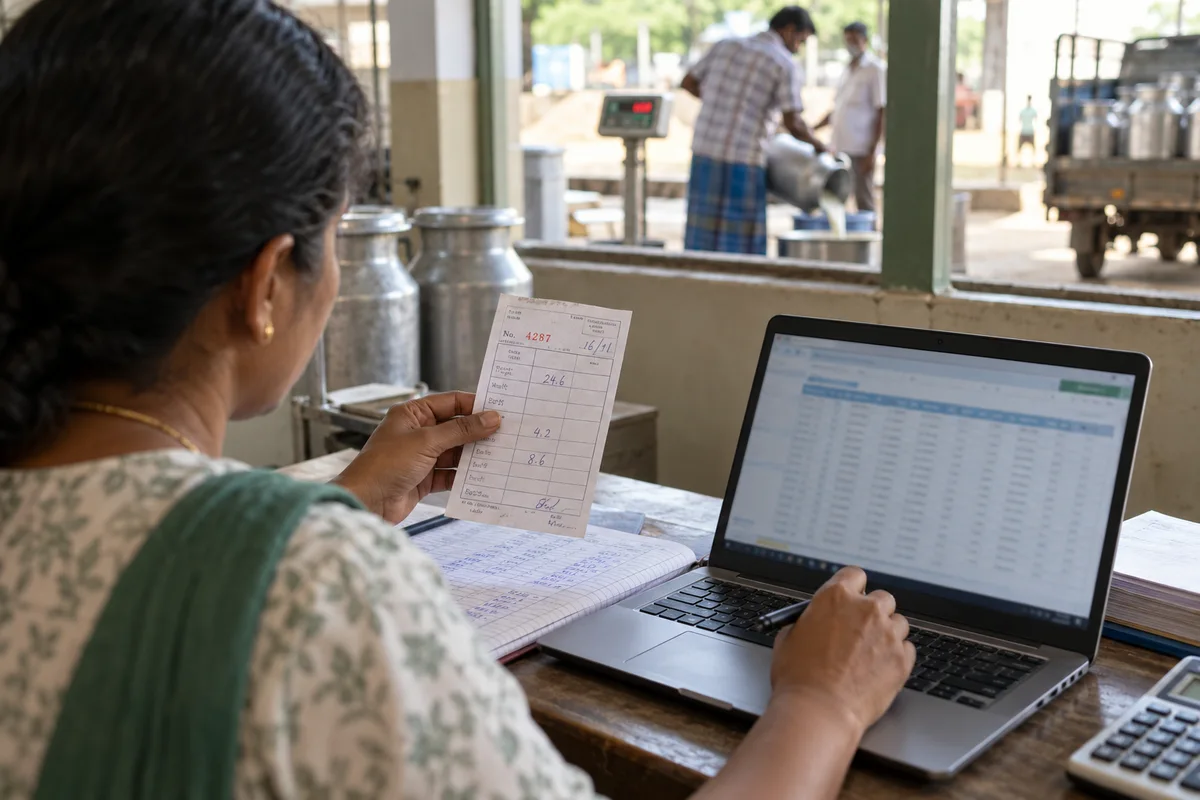
The only person who understands the compressor alarm has gone to a family function two districts away. The centre secretary stands beside a bulk cooler that is warming, holding a phone that rings without answer.
How can a dairy stop depending on a few people?
Draw a matrix of posts and people, mark who can do each task alone, and find the rows held by one name. Train a second person on those rows first, using real equipment and written checks. Confirm the skill by observation, then let the backup run the post regularly so the ability stays fresh.
Ask which absence would hurt tomorrow
Start with risk, not a wish list. For each post ask what happens in the first hour if the named person does not arrive. Milk left unchilled, animals unmilked, a pasteuriser nobody may start, a route nobody knows and a member payment run nobody can prepare are different harms. Rank them by how fast the damage comes and whether anyone nearby can step in.
What belongs on the matrix
- Animal side: milking by hand or machine, udder checks, withholding treated animals' milk, calf feeding, ration mixing.
- Collection: sampling, fat and solids testing, adulteration screening, weighing, analyser cleaning and calibration checks, member record entry.
- Cooling and plant: bulk cooler operation, alarm response, cleaning in place, pasteuriser control and logs, packing machine changeover and seal checks.
- Utilities: boiler, refrigeration and electrical maintenance, kept distinct where authorisation is needed.
- Dispatch and road: crate counts, cold chain care, vehicle checks, route sequence, doorstep exceptions and cash handover.
- Office: farmer or member payments, complaint handling and reorder of consumables.
Site:          Month:
Key: L learning, C with checks,
     A alone, T can teach
Task          | P1 | P2 | P3 |
Milking       |    |    |    |
Sample + test |    |    |    |
Records       |    |    |    |
Cooler alarm  |    |    |    |
Line cleaning |    |    |    |
Pasteuriser   |    |    |    |
Packing seals |    |    |    |
Route A       |    |    |    |
Vehicle check |    |    |    |
Payment run   |    |    |    |
Rows with one A or T:
Next backup and trainer:
Check date:
P1 to P3 stand for people; add a column for each worker. A row counts as covered only when the second person at A or T can actually be present for that shift. Two capable workers who share a motorcycle, a household or the same weekly rest day are one point of failure.
Teaching on a working dairy
Dawn is the worst time for a first lesson and the only time that shows the true job. Split the learning. Explain and practise cleaning order, readings and records during a calmer period, then have the learner perform them during live work with the trainer beside them.
- 1
Write the one-page method
Ask the expert to talk through the task while someone notes the sequence, limits, warning signs and who to call. Add photographs of switches, valves and the correct clean surface.
- 2
Show and explain
The trainer performs the task and says why each check matters, such as why a shortened rinse can leave residue or a skipped sample can spoil a whole tank.
- 3
Practise safely
Use sample milk, water runs or a stopped line where possible. Introduce a doubtful reading or a missing crate and ask what the learner does.
- 4
Perform with checks
The learner takes the post while the trainer watches and signs. Correct one or two points at a time.
- 5
Run it alone
Schedule the backup on the post with the expert off duty. Review the logs the same day and update the grid.
Rotation without confusion
Rotate on a planned pattern, such as a set weekday, and not at random. Tell farmers and route customers when a different person will attend, and give that person the notes they need. Rotation also reveals habits that never reached paper: the sample container kept in a particular place, the customer who pays on alternate days, the pump that needs priming.
Rotating collection staff has a second value, because another pair of eyes on weights and readings discourages quiet errors. Introduce it as normal practice for everyone, so that no operator feels accused.
Keeping experts willing
A veteran may fear that sharing knowledge makes replacement easy. Recognise teaching in the grade, give credit when a learner passes, and use the freed time for rest the expert has been unable to take. Never schedule training as an unpaid extension after a night of work. If an expert's method conflicts with the equipment instructions, settle it with the supplier or a qualified person before it is taught.
Check that cover is real
Each month pick one row and ask the backup to run it with little warning to the rest of the team, while keeping safety support close. If the work stalls because of a password, key or unknown contact, fix access as well as skill. Reassess anyone who has not performed a task recently, especially after new equipment arrives or the method changes.
Plan around milk volume and leave
Schedule teaching for leaner weeks, when an extra pair of hands can be spared and a rejected practice run does not delay a full tanker. Before the flush period, confirm that each critical row has an available backup and that their last practice is recent. Check the leave calendar against the grid: approving two capable testers for the same festival week removes cover that the sheet appears to show.
When someone resigns, read their column first. List each row that falls to a single name, agree handover sessions during the notice period and decide whether to promote, recruit or hire an authorised service provider for specialist maintenance. Collect keys, passwords, farmer contacts and supplier numbers while the person is there to explain them.
Start small this week
Choose one site and one morning. Write the posts down the side, the people across the top and mark only what you have personally seen or what a supervisor can show from records. Circle the single-name rows, ask each of those experts which colleague learns carefully, and agree the first teaching session. Share the grid with the team and invite corrections, because workers know who really steps in when a machine stops or a route changes.
Where to go next
Find related guidance for dairy and milk businesses. A learning and development process can organise methods, trainers and sign-off, while workforce planning shows how much cover each shift needs. To talk through your own risk rows, send your requirements.