
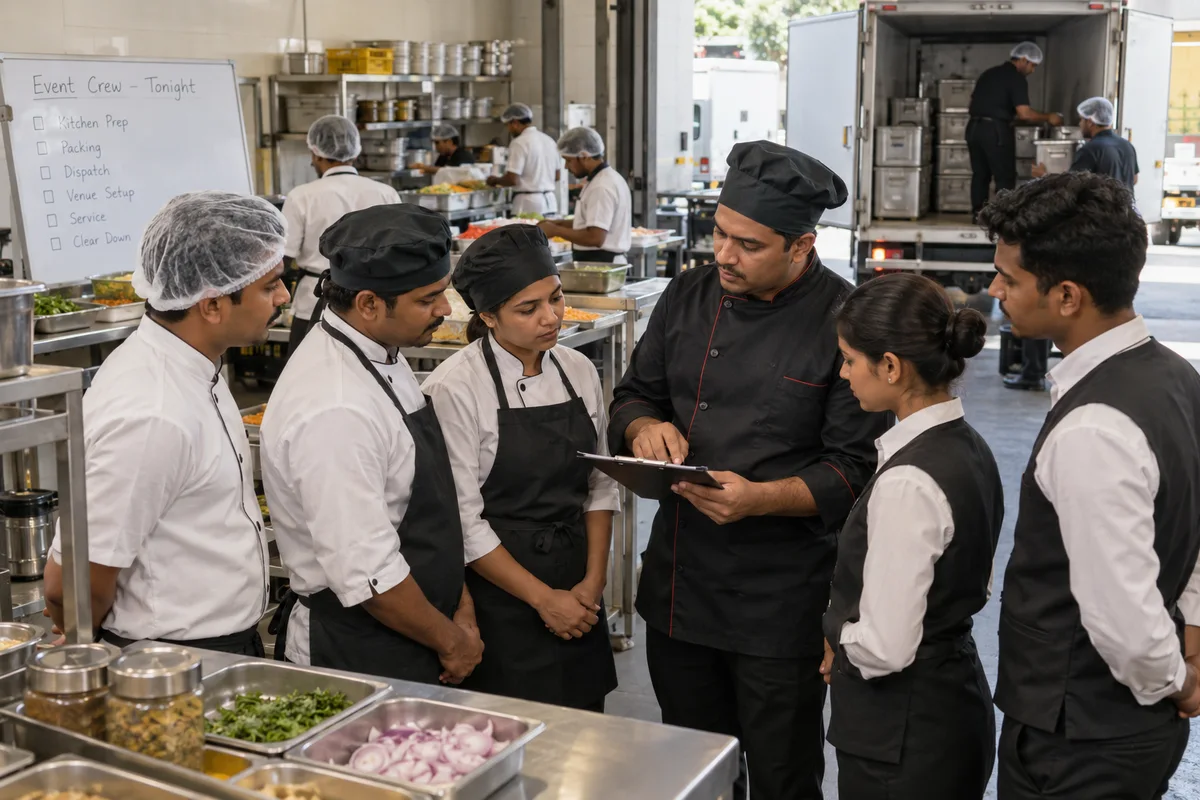
Imagine your head cook rings in with fever on the morning of a large lunch. The assistants can cut, grind and fry, but nobody else knows how much of the spice base goes into a vessel that size, or when to take the rice off.
How do you stop the kitchen depending on a few people?
List the tasks that decide each meal, rate every core worker on each task using four observable levels, and circle any task with only one confident person. Then have that person teach a named second cook on real services, record quantities and timings, and let the learner lead before a peak date forces it.
Start with tasks, not job titles
A title such as cook or helper hides what a person can really do. Break the work into tasks small enough to watch. Walk through one wedding function and one canteen day from store issue to final washing, and write down each point where a mistake would spoil food, delay service or upset the client.
- Cooking: rice in bulk, gravies and base masalas or sauces, breads, fried items, sweets, live counters.
- Scale and planning: converting a guest count into raw material, issuing stores, adjusting when numbers change.
- Special meals: therapeutic diets, allergen-separated food, children's portions.
- Safety: cooling, reheating, holding temperature, tasting method, labelling and discarding.
- Despatch and service: packing, loading, counter set-up, replenishing, token or coupon counting.
- Equipment: steam vessels, burners, grinders, hot cases and dish washing machines.
Four levels a head cook can judge
Avoid scores out of ten, which mean different things to different supervisors. Use levels described by behaviour. Level one has watched and can assist. Level two does the task with someone checking. Level three does it alone at the usual guest count and corrects problems. Level four does it at the largest count you take and can teach it. A level is earned when someone has seen it, on a date, with a name beside it.
Levels: 1 assists  2 checked
        3 alone    4 teaches

Task        | A | B | C | D
Bulk rice   |   |   |   |
Gravy base  |   |   |   |
Breads      |   |   |   |
Sweets      |   |   |   |
Quantities  |   |   |   |
Diet meals  |   |   |   |
Cool/reheat |   |   |   |
Packing     |   |   |   |

Cover rule: two people at 3 or 4
Seen by: ______  Date: ______
Find the single points of failure
Read the grid across each row. A row with no one at three or above is a task you are borrowing from outside, possibly from a freelance master cook who also works for others. A row with one person is a risk with a name on it. Then ask the harder question for each: on which services in the coming months is that person's absence unaffordable?
Look beyond the stove. The coordinator who alone remembers a client's preferences, the driver who alone knows the venue entry, and the store keeper who alone knows which supplier delivers at dawn belong on the list as well. So does the dietitian whose handwritten changes only one clerk can read.
Get the recipe out of one head
- 1
Choose the dishes
Begin with signature items and anything cooked in large vessels. A handful is enough for the first round.
- 2
Record while cooking
A second person weighs and notes each addition, the vessel used, the flame stage and the time. Asking the cook to write it from memory gives you a home recipe.
- 3
Capture the judgement
Note what the cook looks, smells and listens for, and how to rescue a thin gravy or undercooked rice. Short phone videos work, if the cook agrees.
- 4
Let the learner lead
On a smaller service the second cook runs the dish with the card, while the lead watches and stays quiet unless safety or the meal is at risk.
- 5
Repeat at a bigger count
Quantities do not scale in a straight line. Correct the card after each larger batch, then update the matrix.
Make teaching worth the teacher's while
A senior cook may fear that sharing the method lowers their value. Say plainly that teaching is part of the top level, and attach recognition to it: a teaching addition, the lead title, first choice of off days after the season. Credit the cook by name on the recipe card. Never use the cards as a quiet way to replace the person who wrote them; the rest of the kitchen will remember.
Pair people by language and shift as well as skill. A night kitchen cook can learn little from someone who leaves at dusk. Pick the pair, the dish and the service, and write it on the roster so the lesson survives a busy morning.
Where the called crew fits
You cannot train every casual helper deeply, and you do not need to. Mark three things on your crew list: stations they have handled, whether they have had the hygiene briefing, and whether a captain would call them again. Give regular helpers a chance at skilled stations on lighter days. Some will become your next section leads.
Plan lessons around the service calendar
Training that depends on a free day will not happen. Put it into services that already run. A weekday canteen lunch with a stable menu is a good place to learn bulk rice. A small family function suits a first attempt at leading sweets. A pre-event preparation evening is the time to practise converting a guest count into a store issue list, with the head cook checking before anything leaves the store.
Keep each lesson to one skill and one learner. Before it, say what good looks like: texture, taste, readiness time, vessel left clean, holding temperature checked. After it, the teacher marks what the learner did alone and what needed a hand. That short note is your evidence for the next level, and it stops ratings drifting towards whoever is liked best.
Plan for spoilage honestly. A learner will sometimes get a batch wrong, so start where a correction is possible and a standby dish or cook is close. Never test a new second cook on therapeutic or allergen-separated meals without qualified supervision, however steady they are with ordinary dishes.
Keep the matrix alive
Pin it in the office, not on a wall where ratings embarrass people. Update it after a lesson, an exit or a new contract. Before accepting a large or unusual booking, check the rows it will lean on. A new hospital contract, for instance, raises the diet and allergen rows from useful to essential.
A learning and development process turns these pairings into a planned routine, and founder dependency and succession planning helps when the single point of failure is you. Related people topics are gathered under catering and institutional food services.
Where to go next
Draw the grid for your core kitchen this week and pick the one row that worries you. If you want help building levels, recipe capture and training pairs, send us your requirements.