
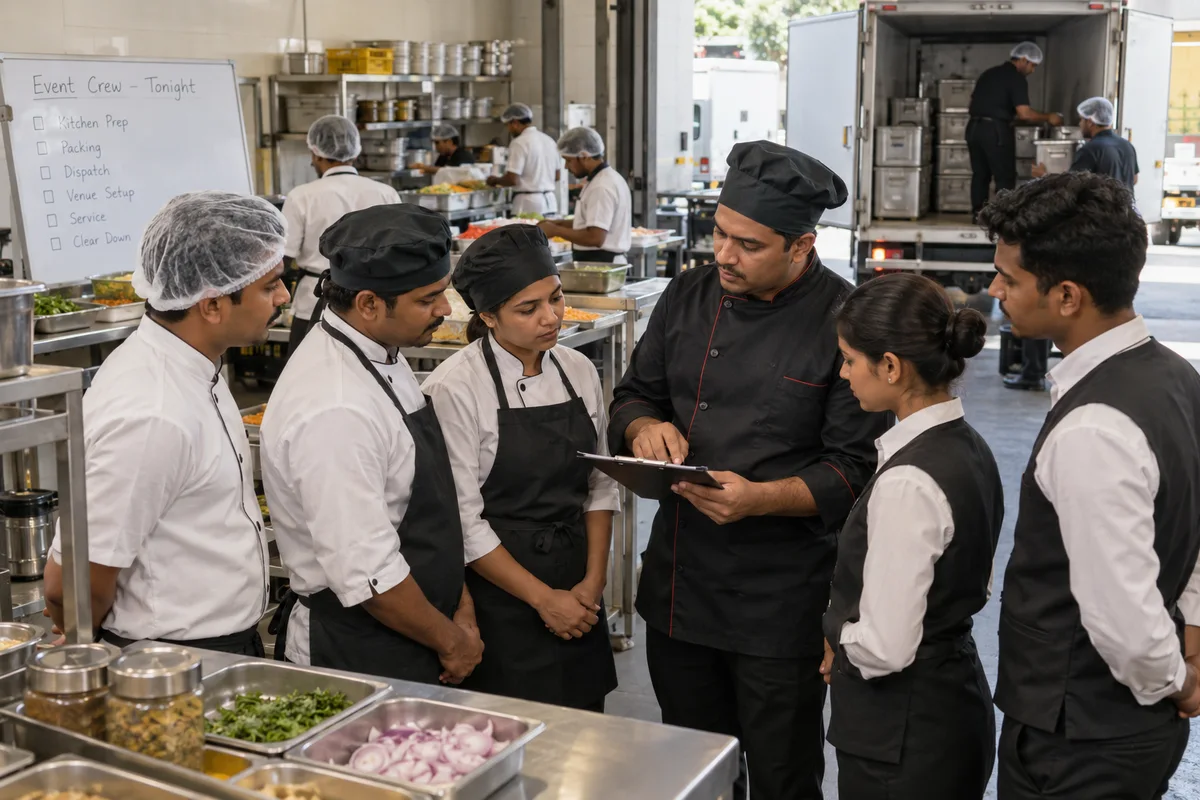
Picture a caterer with a wedding dinner on Saturday and a factory canteen to run the same morning. The head cook's phone holds the helpers' numbers, the rates live in the owner's memory, and two servers say they were promised more than last time. Nothing has gone wrong with the food yet.
Which HR basics should come first?
Set up the things that decide whether a meal goes out on time and whether people are paid as agreed: a crew list, written role rates, an attendance tally, named backups for key cooks, and a short food-handling routine with a person who signs it off. Policies, appraisals and software come after those five work.
Why order matters when meal times cannot move
An office can finish a report tomorrow. A school kitchen cannot serve lunch tomorrow, and a reception dinner has one chance. So judge every HR task by one test: if it is missing on a busy day, does service fail or does money get disputed? Anything that passes that test goes to the front of the queue.
Your business also has two kinds of worker at once. The permanent core of head cook, assistants, store keeper and drivers needs clear terms, leave and a reason to stay. The called crew of helpers, servers and dishwashers needs to be reachable, briefed and paid correctly. Set up both, but do not force one rulebook on them.
The order of work
- 1
Build one crew list
Move names out of personal phones. For each person record role, areas they can travel to, events worked, who vouched for them, and any hygiene briefing they have attended. Mark who can lead a section. Keep it where the booking coordinator and canteen manager can both see it.
- 2
Write the rates down
List what you pay for each role and for each unit you use, whether event, day, shift or plate. State what happens when an event runs late, when someone travels out of town, and when a booking is cancelled. Share the figure before the person agrees to come.
- 3
Tally attendance on site
Give one captain a sheet for each event and one supervisor a register for each canteen shift. Record arrival, departure, role actually worked and any advance paid. Settle from that sheet and from nothing else.
- 4
Name backup cooks
For rice, gravies, breads, sweets, diet meals and any signature dish, write the lead cook and a second person. Where the second column is blank, you have found your first training task.
- 5
Fix the food-handling routine
Choose a short list of checks covering hand washing, clean aprons, hair covering, illness reporting, holding of cooked food and vessel cleaning. One named person per shift or event signs it.
- 6
Give the core team written terms
Put role, pay, working pattern, weekly off, leave and notice in a letter or sheet each permanent person can keep. Include who they report to on event days, when the usual chain breaks.
Who does what on an event day
Paper only works when each line has an owner. Agree these hand-overs before the next function and say them aloud at the crew briefing.
- Booking coordinator: confirms each name the day before, sends report time and rate, and fills gaps from the standby list.
- Head cook: states the sections needed for the menu and guest count, and flags any dish with no backup.
- Captain: marks arrival, checks aprons and hair covering, assigns stations and records extra hours as they are agreed.
- Driver: confirms vessel and food counts at loading and again at return.
- Owner or accounts person: pays from the signed sheet and answers any query on it within a stated time.
Add one rule for the gap everybody dreads, the helper who does not arrive. Say who is told, by what time, and who may approve a replacement at a higher rate. Without that rule, the captain either runs short or promises money the business never agreed to.
What a good event crew sheet looks like
The sheet below is the hinge between booking, kitchen and settlement. The coordinator fills the top before the event, the captain fills the middle at the venue, and whoever pays closes it. Keep one per function, even for small ones, so the habit is there when wedding season arrives.
Event and date: ______
Venue: ______  Guests: ______
Captain: ______
Lead cook: ______
Report time: ______
Cooked food ready by: ______

Name | Role | In | Out
______ | ______ | __ | __
______ | ______ | __ | __

Agreed rate shared before: Y / N
Hygiene briefing done: Y / N
Advance paid: ______
Extra hours agreed by: ______
Settled on: ______ by: ______
Canteen contracts need one thing more
A standing canteen at a factory, school or hospital runs on routine, so its weak point is the quiet gap: a cook on leave, a counter attendant who moves to a rival contractor, a night shift with one person who knows the diet orders. Write a weekly roster, show who relieves whom, and keep a short site sheet with gate procedures, client contacts, menu cycle and special diets. A relief worker should be able to read it and start.
Check what each client contract asks of your people, such as health checks, identity passes, uniforms or training records. Hold those records by site, with a date for renewal, so a client visit does not turn into a search through bags and drawers. An HR audit is one way to find which records and routines are missing before a client or inspector points them out.
What can wait
- A long handbook. Begin with one page each on attendance, pay settlement, conduct at client sites and food safety.
- Formal yearly appraisals. A short talk with each core team member after the peak season teaches you more at first.
- Attendance software. Move to it once the paper tally is filled reliably, because a tool will not fix a captain who forgets.
- Grades and titles for casual helpers. A skill mark on the crew list is enough to begin with.
- Engagement events. Meals, rest places, transport home after late functions and paying on the promised day count for far more.
How to tell it is working
Ask three things at the end of a busy week. Could the coordinator confirm a full crew without ringing the head cook? Did every settlement match its sheet? When one cook was away, did the named backup run the section? A no points straight to the step that needs another pass. For the wider picture of how this sector's people problems fit together, see catering and institutional food services.
Where to go next
Take the next confirmed booking and run it with the crew sheet, then fix whatever the captain could not fill in. If you would like an outside view on what to put in place and in what order, you can tell us your requirements.