
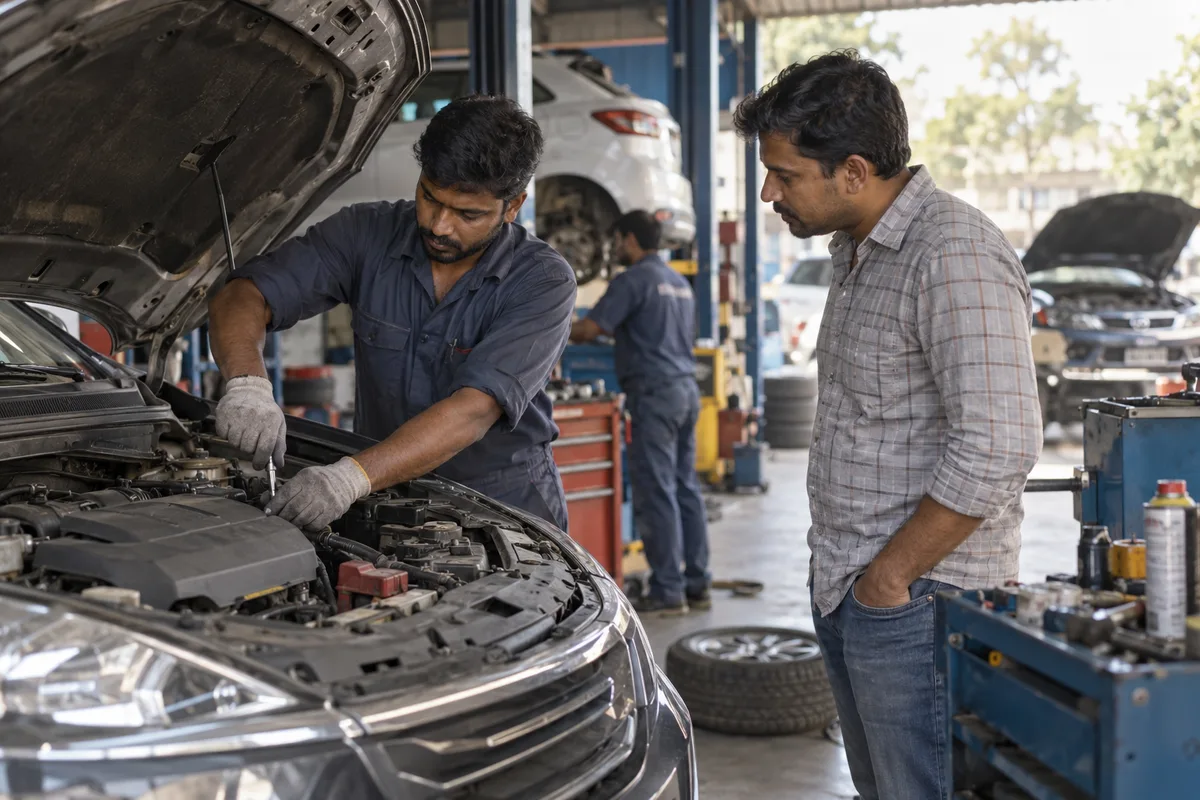
An intermittent warning light, a car that will not start when warm and an air conditioning fault arrive before nine. All three job cards drift to the same two benches. A junior mechanic changes oil beside them, within earshot, learning nothing, while a customer rings to ask why nobody has looked yet.
How can a garage get more technicians able to solve difficult faults?
Treat diagnosis as a taught task. Name the faults only seniors handle, choose the ones that arrive again and again, have the senior explain their testing order on real cars, then let a learner lead under watch. Record what each person may do alone, and book the teaching time like paid work.
A senior's skill looks like instinct. Much of it is a sequence: listen to the customer, reproduce the fault, check the cheap and likely causes, read the data, test before replacing. Learners who only hand over spanners see the part that was changed and miss every decision that led to it.
Make a short skill record
Skip the list of every task in a workshop manual. Use the jobs that fill your bays and the ones that jam them: periodic service, brakes, suspension, clutch, electrical fault finding, scan tool reading, air conditioning, engine drivability. For each person, mark one of four levels: watches, does with help, does alone and has work checked, does alone and can teach. The floor supervisor marks it with the technician present and cites a recent car. Self-ratings and years of service are not evidence.
Learner:        Teacher:
Job card number:
Customer complaint:
Learner's first two checks:
Teacher's changes and why:
Readings taken:
Likely cause named by learner:
Proof before replacing part:
Road test or recheck result:
Learner may now:
  watch / assist / lead / solo
Next job to practise:
Date:
Run one pairing at a time
- 1
Choose the bottleneck job
Count job cards that waited for a senior over recent weeks. Pick a fault type that waited again and again and is safe and regular enough to teach.
- 2
Pick a willing learner
Choose someone who finishes basic work cleanly and records findings. Tell the others how they can be next.
- 3
Have the learner speak first
Before touching the car, the learner says what they think and which test they would run. The senior corrects the order and explains the reason.
- 4
Let the learner do the work
The senior watches at the stages where error is costly or dangerous and keeps their hands off otherwise.
- 5
Close with the card
A few minutes after the job, fill in what was learnt and what the learner may now do. Change the skill record only after several sound jobs of that type.
Book it honestly. A taught job takes longer. Mark one or two bay slots a day as teaching slots on quieter days, and have advisers avoid tight promise times on them. If the garage never has a quiet day, begin with the explanation alone: the learner joins the senior for the first checks, then returns to their own bay.
Why would a senior technician agree to teach?
Under pay linked to jobs closed, every minute spent explaining costs them money. Credit teaching time at an agreed rate, or pay a stated teaching amount when the learner passes a check on that job. Give the senior a visible standing as lead technician or trainer, and relief from some routine work. Say openly that the aim is to let them take leave without their phone ringing. Ask which learner they want and what tools or reference material they lack.
Juniors have a concern too: that learning means more responsibility at the same pay. Show what each level opens, in duties and in pay, and apply it evenly. Allocation matters as much. If the supervisor's favourites get the diagnostic cars, the skill record becomes a ranking of who was liked.
Use comebacks as lessons
This is the next thing to install. When a car returns with the same complaint, link the new job card to the old one. Ask what was heard, tested and replaced, and what proof was recorded. Review it with the first technician present, as a case, without docking pay on the spot. Causes split into diagnosis, workmanship, parts, incomplete customer description and pressure to release early. Only some are training matters, and the card shows which.
Third, give advisers a promise-time routine: check with the supervisor which skill the job needs and whether that person is present, quote a time for diagnosis separately from repair, and call the customer when findings change. Attendance recorded at the bay makes this possible.
Keep what the seniors explain
Each taught job produces something worth keeping. File the cards by vehicle system and symptom in a shared folder or a ring binder at the diagnostic bench, with photographs of connectors, readings from a sound car and the trap that wasted time. Ask the learner to write the note and the senior to correct it, since writing it tests whether the logic was understood. Before the next similar car, whoever takes it reads the note first. Once a fortnight, spend a few minutes at the start of a quiet day on one note, led by the learner, so that other technicians and the service adviser hear how the fault was proved and why it took the time it did.
Signs it is working, and signs it is not
- Good: more job types have a second name at the solo level, and seniors take leave without cars waiting for them.
- Good: learners write fuller findings and ask for a check before ordering parts.
- Warning: cards are filled in at month end from memory.
- Warning: teaching slots are the first thing cancelled each busy morning.
- Warning: one learner receives every opportunity while others stop asking.
What can wait
A classroom syllabus, online course subscriptions, printed grade certificates and a complex points scheme can wait. External courses help when they answer a named gap and the technician practises on your cars soon afterwards. Hiring another senior may still be right, but check that the new arrival will be expected to teach, or you will simply have three benches where cars queue.
Where to go next
Our HR for car garages page also covers attendance, incentives and comebacks. The learning and development process page shows how to plan, record and review training. When you want a second view on your skill gaps, describe your garage and needs.