GullyHR

Workplace training · Hostels

Interpersonal Skills for Hostels

Interpersonal skills are the behaviours people use to work with each other: opening a usable working relationship, cooperating across teams, earning trust, giving and taking feedback, and disagreeing without damage. GullyHR runs interpersonal skills training as a customised workshop programme for employees, team leaders and managers whose work depends on other people's cooperation, and can also run it as a track inside the communication skills programme.

A small diverse group of colleagues practising introductions and attentive conversation in a workshop.

The operating context

Build cooperation across a working relationship

A hostel rents beds in shared dormitories to backpackers, students and young workers. A small team keeps rooms clean, the desk open all night and the common area calm, with volunteers, helpers and managers living in the building.

Hostel managers and ownersFront desk and reception staffHousekeepers and bed attendantsNight desk and security staffCafe, kitchen and common-area helpersVolunteers working for a bed
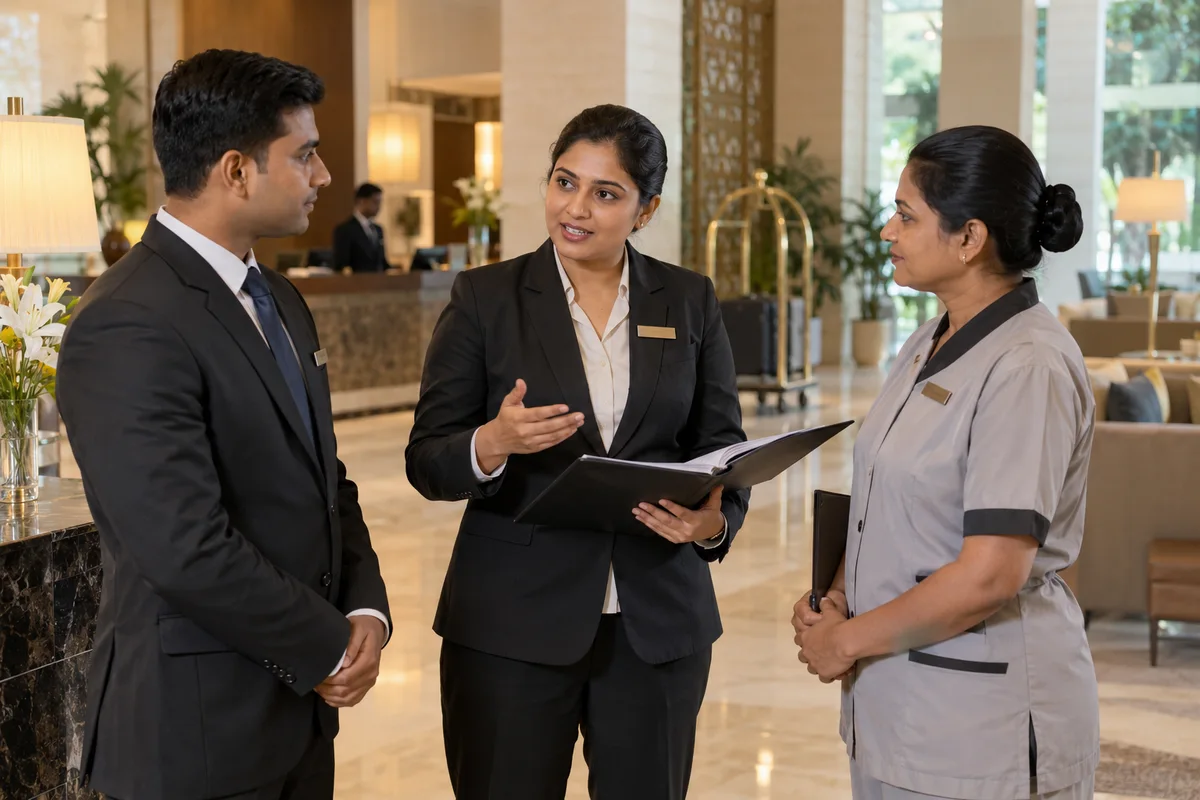
Hotel colleagues from HR, reception and housekeeping discussing the next shift

Workplace practice

Use a shared task to practise asking for help, setting expectations and checking understanding across the roles below. Workforce to consider: Hostel managers and owners, Front desk and reception staff, Housekeepers and bed attendants.

Records to prepare

Paired exercise, peer feedback and follow-through task. A workforce issue to consider: Young team members leave to travel on, and each departure takes tips, local knowledge and routines with it.

A situation to practise

Test a colleague's different communication style without assuming that silence means agreement.

Which parts of your business should the scope cover?

The right workforce and approval structure depends on the operations you run. Confirm which of these apply, and whether they share one HR process.

  • Boys' and girls' hostels near engineering and medical colleges
  • Hostels near coaching centres for competitive exams
  • Working men's and working women's hostels near IT parks
  • Hostels for nursing, paramedical and hotel management students
  • Hostels attached to schools and educational trusts
  • Hostels for trainees and apprentices near industrial areas

When this programme can help

  • Two departments have stopped talking, and every request between them now lands on your desk to be passed along.
  • A technically strong employee is quietly worked around by the rest of the team, and nobody has ever told them why.
  • The first time an employee hears that colleagues find them hard to work with is in the appraisal, nine months after it started.
  • An argument about who owned a task becomes a forty-message WhatsApp trail and reaches you as a complaint weeks later.

Businesses this service is designed for

  • Businesses past the stage where everyone sits in one room, where work now moves between departments, shifts or locations and cooperation has to happen without the founder standing in the middle.
  • Teams assembled fast during a growth phase, where most people were hired within months of each other and no shared way of working has settled yet.
  • Employees promoted for technical strength who now depend on colleagues they cannot instruct, project leads, quality heads, senior engineers.
  • Cross-functional and client-facing work where one team's output is another team's input: sales and delivery, production and quality, accounts and operations.

Skills and workplace practice

GullyHR runs the programme; your workplace supplies the material it works on. We hold a needs discussion with you and the managers concerned, gather real situations from your teams, write the role plays around them, facilitate the sessions and report back on what we saw in the room. You nominate the cohort, release people for the whole session rather than the first half of it, allow candid input while situations are being collected, and ask about the action plans afterwards. It runs as a training programme against an outline you approve before delivery, for a single cohort or across several.

Working relationships get built on purpose instead of left to chemistry.

How to open a working relationship with a colleague you did not choose, what to invest early, how to keep it usable when you need each other twice a quarter, and how to restart one that went cold after a bad handover.

Asking another department for something becomes a skill, not a favour.

Framing a request the other team can act on, agreeing what finished looks like and by when, keeping them posted while the work runs, and handling the honest moment when your priority is nowhere near theirs.

Every team member knows what the team actually needs from them.

Contributing in a meeting without taking it over, raising a concern to the team rather than around it, covering for a colleague without keeping score, and owning a shared miss instead of locating the person to blame for it.

Trust becomes something people build, not something they hope for.

Doing what you said by when you said. Saying early when you cannot. Keeping what was told to you in confidence, and being straight about your own mistakes. Participants also work on what rebuilding takes once trust has gone.

Feedback is offered as an observation, not a verdict.

Describing behaviour and its effect instead of labelling the person, picking the moment and the setting, and asking colleagues for feedback on your own work. Receiving is practised as hard as giving, hearing something uncomfortable without defending or going silent.

Differences get worked through while they are still small.

Naming a difference plainly, separating what someone wants from why they want it, staying on the issue as the temperature rises, and knowing when a matter genuinely belongs with a manager. Covers differences of working style, seniority, language and age inside one team.

People start responding to the concern, not only to the words.

Listening for what a colleague or a customer is actually asking for, checking your reading of it out loud instead of assuming, and holding a boundary while still being decent about it.

Contacts inside and outside the company are kept warm deliberately.

Introducing yourself and your work so people remember it, staying in touch with useful contacts beyond your own team, asking a contact for help without awkwardness, and representing the company at a client meeting or an industry event.


Prepare, practise and apply

Agree the participants, the workplace behaviours to practise and the situations managers want to improve. Use relevant work examples and confirm how learning will be observed after the programme.

  1. 01

    Needs discussion

    A conversation with you and the managers concerned about which relationships are failing and where, between two departments, inside one team, or with customers. This decides what the programme works on and, just as usefully, what it leaves out.

  2. 02

    Situation gathering

    Short conversations with a few managers and prospective participants to collect real situations: the request that never gets answered, the handover that gets argued about every month. These are de-identified and become the exercise material.

  3. 03

    Behaviour self-check

    Participants complete a short interpersonal behaviour self-assessment before the programme. Where you want it, the reporting manager rates the same behaviours, and the gap between the two views is used to weight the modules.

  4. 04

    Design and sign-off

    Modules are chosen and sequenced, cohort size and mix are fixed, and the role plays are written against your situations. You approve the outline before anything is delivered.

  5. 05

    Facilitated session

    Each module opens with a short input and moves quickly into discussion and structured practice in pairs and small groups, on situations from your own workplace rather than a textbook case about a fictional company.

  6. 06

    Observed practice

    Participants rehearse the hard ones, giving difficult feedback, raising a disagreement with a senior colleague, take feedback from the facilitator and their peers, and then run the same conversation again.

  7. 07

    Individual action plan

    Each participant writes down two or three named relationships or recurring situations they will handle differently, what they will do and by when. The plan leaves the room with them.

  8. 08

    Manager briefing

    Reporting managers get a short brief on what the cohort practised and what to look for at work, so the new behaviour is noticed and asked about rather than quietly dropped in the first fortnight.

  9. 09

    Reinforcement clinic

    After an interval you agree, participants come back with what happened when they tried it, what worked, where they reverted, and practise the situations that are still hard.

  10. 10

    Review with management

    A written summary for you: participation, movement on the self-assessment, participant feedback and the situations that kept recurring across the cohort, with a recommendation on what to do next.

Review practice and participant feedback, agree manager follow-through and check application at work. Attendance alone is not evidence of changed behaviour.

Programme materials and follow-through

  • A programme outline for your sign-off, listing the modules, their sequence, the cohort composition and the workplace situations each exercise is built on.
  • A participant workbook covering relationships, cross-team requests, teamwork, trust, feedback, differences, empathy and networking, with the frameworks used in the room.
  • Role play and case material written from your own workplace situations and de-identified before use.
  • An interpersonal behaviour self-assessment, issued before the programme and again after it, with an optional manager view of the same behaviours.
  • A one-page feedback format participants can keep at their desk: the observation, its effect, the request.
  • A written individual action plan for each participant, with a copy for the reporting manager where you want that.
  • A manager brief describing what the cohort practised and what to reinforce in the weeks that follow.
  • A programme report for management covering attendance, participant feedback, self-assessment movement and the recurring situations we observed, with a recommendation.

What your team provides

  • The cohort, nominated in advance and released for the whole session rather than part of it.
  • Candid input while situations are being gathered, with agreement on what may be used in the room.
  • Your approval of the programme outline before any delivery begins, with changes made where needed.
  • A reporting manager for each participant who will ask about the action plans afterwards.

Share personal records only after the scope, access and handling arrangements are agreed.

Responsibilities and approvals

The client owns employee records and approves policies, spending and employment decisions. GullyHR's assigned responsibilities are documented in the engagement.

Deciding what the programme should fix

GullyHR
Runs the needs discussion with you and the managers concerned, and proposes which modules to include and how deeply to work each one.
Your team
Says plainly where cooperation is failing today, which teams are affected and what has already been tried.

Collecting workplace situations for the exercises

GullyHR
Holds short conversations with a few managers and participants, and rewrites what is said into de-identified role plays and cases.
Your team
Makes those people available and allows candid input, on the understanding that nothing said is reported back as a complaint.

Running the session

GullyHR
Facilitates the programme, sets up and observes the practice, and gives each participant feedback in the room.
Your team
Nominates the cohort, releases participants for the whole session and provides the room or the online arrangement.

Making the behaviour hold afterwards

GullyHR
Briefs the reporting managers, runs the reinforcement clinic and reports on what changed and what did not.
Your team
Asks about the action plans in normal one-to-ones and tells us what is actually being seen at work.

How we agree that the work is complete

Review these outputs with your process owner and agree the evidence required for sign-off.

  • The programme outline, with modules, sequence, cohort composition and the situations behind each exercise, was signed off by you before delivery.
  • The role plays use situations from your own teams, de-identified, and a manager has confirmed they are recognisable.
  • The behaviour self-assessment was issued before and after, and the comparison is in the programme report.
  • Each participant holds a written action plan, with a copy for the reporting manager where you asked for one.
  • Management holds the programme report covering attendance, feedback, self-assessment movement and recurring situations, with a recommendation.

Tools and implementation dependencies

Where you use the GullyHR platform, the administrative side of the programme sits in the learning and development module: nominations and cohorts, attendance against each employee record, the self-assessment issued and collected as a form, participant feedback in one place, and the completed programme on the employee's learning history so it is visible at appraisal time. The facilitation itself is done by a person, in a room or on a call, no system teaches someone how to raise a disagreement with a senior colleague. If you run a different HR system, the same records are handed over in a format you can import.

Read the full interpersonal skills service guide →

Agree the engagement before work starts.

Interpersonal skills workshop

One customised workshop for a single cohort, built on situations gathered from your workplace, with the self-assessment, the individual action plans and a manager brief.

Multi-cohort programme

The same programme run for several cohorts across departments, shifts or locations, so colleagues who have to work together are working from one shared standard rather than from different rooms.

Learning journey with reinforcement

The workshop followed by practice clinics at intervals you set, manager check-ins between them, and a closing review with management on what changed at work.

Intact team intervention

The programme run for one team that already has to work together, with the reporting manager in the room and the team's own live situations as the material, rather than a mixed nomination list.

Scope and exclusions

  • The agreed programme defines participants, sessions, practice and follow-through. Technical qualifications, clinical training and continuing coaching are separate unless expressly included.
  • There is a live dispute between two named people that needs a formal process, not a skills session.
  • You want a verdict on who is at fault in a relationship breakdown; we facilitate learning and do not investigate.
  • Candid input will not be allowed while situations are collected, so the practice would not reflect your workplace.
  • The main issue is unclear spoken instruction rather than how teams relate to one another.
Confidentiality, specialist review and accountability

Limit access to the records needed for the agreed work. Confirm authorised users, secure sharing, retention and return or deletion arrangements before exchanging personal information.

Applicability depends on locations, workforce arrangements and the issue under review. Confirm applicable requirements with your qualified adviser before adopting policies or employment actions; this service is not a legal certification.

Employment-law opinions, statutory filings, professional or clinical standards and safety-critical technical decisions require the appropriate qualified professional; include those dependencies in the scope.

Questions before you decide

For hostels, identify who owns these records: paired exercise, peer feedback and follow-through task. Start with an anonymised example and the decision you need to make; agree the sample and access before sharing personal data.

Discuss a training programme

Tell us the teams and locations involved, what is happening today and what you want this work to resolve.

Start with your business need

What does your HR team need to solve?

Tell us your industry, team size and the issue you want to address. Bring one example of where work gets delayed or ownership is unclear, and the deadline or decision you are working towards.

  • A free first conversation with an HR practitioner
  • A clear scope and fee before any paid work
  • A practical next step for your business

Let’s start with your business

Share your contact details and the HR challenge on your mind. We’ll help you find the right starting point.

Include your country code, for example +44 or +1. Indian numbers can be 10 digits.

Your details stay private. Privacy policy